
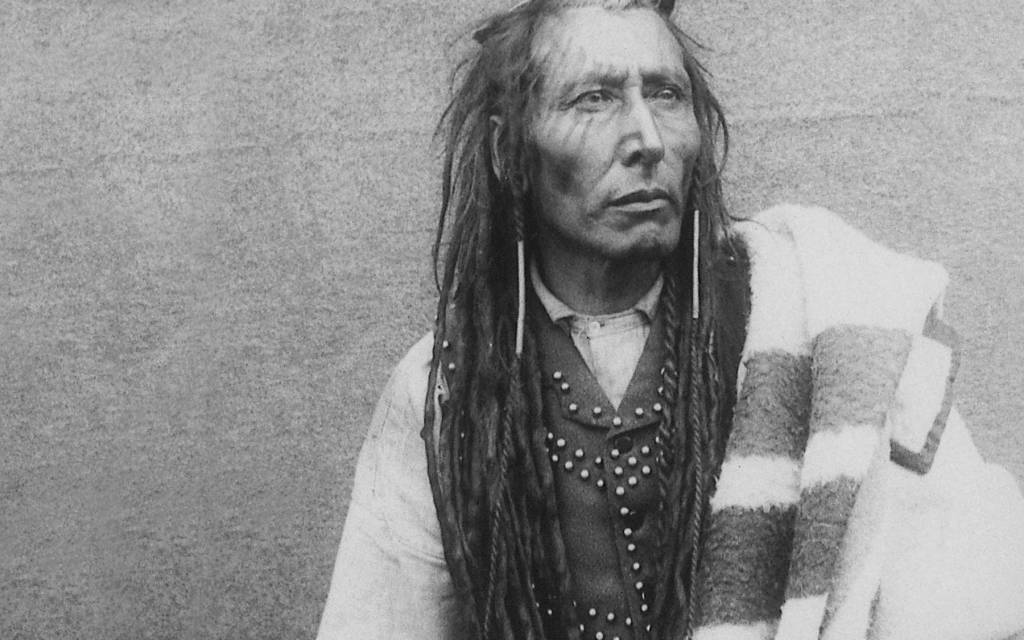
Pîhtokahanapiwiyin, a Plains Cree chief known as a peacemaker, will be reunited with two of his most cherished possessions after 138 years. The Royal Ontario Museum has announced that it will return a saddle bag and ceremonial pipe to his ancestors. The museum had been sold the pieces in 1924 and 1936 respectively.
Also known by the name of Poundmaker, this leader of the Plains Cree died at Blackfoot Crossing, North-West Territories, in July of 1886. Prior to his death, he had spent seven months of a three-year sentence at Stony Mountain Penitentiary for treason.
His role in the Riel Uprising, or North-West Rebellion, was often portrayed inaccurately by Canadian historians in the period and in the years following the rebellion. It may well be that Canada sent an innocent man to prison.
His crime? Being an Indian.
I choose that word not to be insensitive. Instead, using the vernacular of the times, I just wanted to point out that this guy was as guilty as sin in the eyes of the white jury that rendered verdicts during the trials held in Regina. Evidence had very little, if anything, to do with it.
Ironically, It was Poundmaker who stood against some of the war chiefs who wanted to rise up against the Canadian authorities for a myriad of reasons, many of them retrospectively legitimate to any fair-minded individual. He was lumped in with other aboriginal chiefs Starblanket, Wandering Spirit and Big Bear who played more militant roles within the resistance to the government.
Poundmaker’s crime was to lead his desperate people to Battleford, Saskatchewan to speak to the Indian Agent about the precarious situation his people found themselves in due to the declining Buffalo herds and the broken treaty promises of the Canadian government. The white settlers of that town, awash in rumours swirling around the Rebel Rebellion, took the approach of the Cree as a threatening gesture, and, fearing massacre, fled to the RCMP outpost at Fort Battleford for protection. After a couple of days of nobody willing to come out and talk to him, Poundmaker turned his people around to head home. Sometime in the two days in which Battleford stood deserted, looting of the community took place, the blame for which was placed squarely on the shoulders of the Cree. To a degree, that may well have been the case given the desperate straits Poundmaker’s band found themselves in, but there is anecdotal evidence that some whites took advantage of the situation to help themselves to some of their neighbours’ belongings.
Poundmaker led his people to an encampment called Cut Knife Hill, where he was attacked by Canadian militia under Lt. Col. William Otter. The attack was unsuccessful and Otter’s men bid a hasty retreat. Poundmaker’s Cree were more than willing to give chase to the withdrawing Canadians but were held back by Poundmaker. He could have inflicted sizeable casualties upon the Canadian force, but instead disengaged.
After the Battle of Batoche led to the defeat of Riel’s Metis, Poundmaker made his way to the authorities at Battleford to make peace with Maj. Gen. Middleton. He was, instead, arrested for treason.
“Everything that is bad has been laid against me this summer, there is nothing of it true. Had I wanted war, I would not be here now. I should be on the prairie. You did not catch me. I gave myself up. You have got me because I wanted justice.”
Despite serving seven months of a three year sentence, the experience ruined Poundmaker’s health. Several months after his release, Poundmaker died at the age of 44.
Now, after 138 years, he’ll be re-united with his saddle bag and his pipe, one a prized personal possession, and the other a sacred personal possession.
 NEWSMAGRENFREW