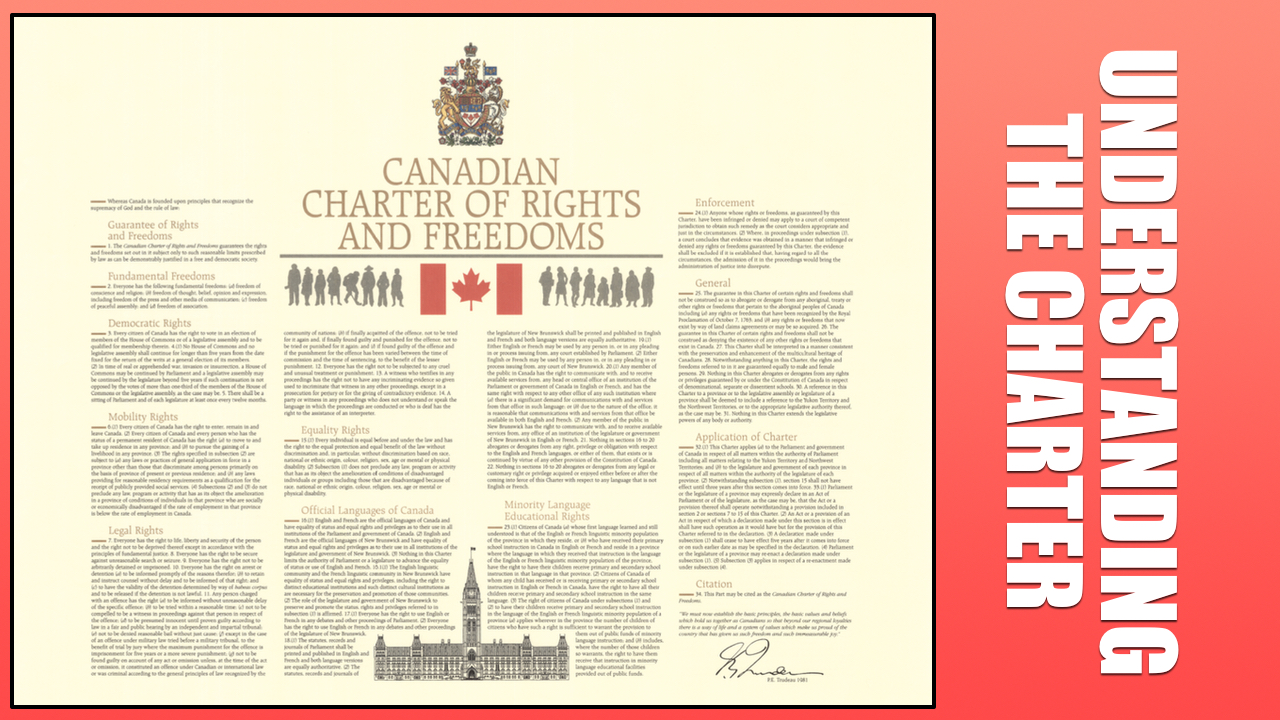
In thirty-four sections, the Canadian Charter of Rights and Freedoms lists and describes the rights and freedoms that are held to be inviolate in our Canadian democracy. Of these sections, the most important is right at the beginning, Section 1, also known as the Reasonable Limits Clause. It states as follows:
“The Canadian Charter of Rights and Freedoms guarantees the rights and freedoms set out in it subject only to such reasonable limits prescribed by law as can be demonstrably justified in a free and democratic society.”
What this means is that every right, and every freedom, is potentially subject to some form of limitation so long as that limitation is deemed to be “reasonable” by the Supreme Court of Canada if and when a law infringing upon that right is challenged in court.
So what does that mean, then? A right is a right, isn’t it? And aren’t rights supposed to be absolute? The answer to these question are yes to the first, and no, not necessarily to the second. So how would the Supreme Court arrive at a decision that allows a law that limits in any way a right or freedom?
The court uses a process called the Oakes Test, derived from the landmark case of R. V. Oakes, the details of which I won’t get into. But that case established a legal precedent in Canadian legal jurisprudence. It brought about the procedural checklist that must be satisfied in order to allow a piece of legislation to impinge upon any right or freedom. That checklist takes the form of several requirements that must be answered in the affirmative for the law to be able to stand the scrutiny of the court and be allowed to continue. The steps of the Oakes Test are as follows:
Step 1: The government passing the law must be intra vires, or within its proper jurisdictional power to pass the law in the first place.
Step 2: The government that is trespassing upon a Charter right must explain clearly the objective of the legislation. That objective must be pressing and substantial. Meaning important and urgent.
Step 3: The government must demonstrate that the legislation or policy in question be rationally connected to the pressing and substantial objective listed in Step 1. If the purpose of the law isn’t logically connected, then it will fail the test and be struck down.
Step 4: The government must demonstrate that the law in question minimally impairs the Charter right, in other words impairing the right to the minimal degree possible or necessary.
Step 5: The government must demonstrate that the law in question has beneficial effects that outweigh any negative effects on the Charter right being impinged. This is called the proportionality requirement.
If the legislation or policy fails to satisfy any of these five steps, the law will be struck down by the court. The government will then have the opportunity to re-work or re-word the law in such a way that it becomes compliant with this test. Alternatively, the government can throw up its hands and just walk away from the legislation. Or, as a last and rare resort, the government may invoke the notwithstanding clause that would allow the legislation to remain so long as the legislature comes back every five years to re-invoke the clause.
Rights and freedoms are not absolute nor have they ever been. It’s just not possible. One person exercising their rights in one area may interfere with the rights of others in another area, which if left to itself would result in anarchy.
Also, a great historical bargain exists between citizens and their government. Citizens are willing to allow rights and freedoms to be limited somewhat in exchange for the state providing protection, rules, order, and safety. It was like that with kings and their subjects and it’s like that in democracy with citizens and their government.
Speeding laws are a pretty basic example of this. People are reasonably willing to be limited in how fast they drive if that’s something that promotes road safety and helps minimize road deaths and serious accidents causing injury.
Look at police spot checks or RIDE programs. At face value it’s an illegal stop without any reasonable or probable cause for doing so. But in the eyes of the court, such arbitrary stops are permissible because they address a pressing and substantial problem, that being the number of deaths and injuries, measured in thousands, as a result of impaired driving. The policy has a clear objective in attempting to stop or minimize impaired driving and all the carnage that goes along with it. It’s rationally connected to the objective as the stops are carried out to ascertain the sobriety of drivers. The impact is minimal, unless of course you’re impaired, since the stop is usually measured in a few seconds and doesn’t impede the motorist egregiously. Police are not allowed to use the stop as a means of conducting a search or some other investigative follow-up unless there is evidence of impropriety in clear view of the officer while making the stop. And the inconvenience of being stopped is outweighed by the need to get impaired drivers off the road. So, in short, the RIDE Program would pass the Oakes Test and be allowed to stand.
So let’s take a look at a once-in-a-century pandemic that killed millions world-wide and tens of thousands here in Canada in a little more than a year. Over 56,000 Canadians died of COVID 19 in that time span. As it was happening, governments invoked mask and vaccine mandates as an attempt to bring the scourge under control and to relieve the once-in-a-lifetime pressure being faced by overrun hospitals and their staffs. As a result, there were howls of protest by a certain element of the population who felt their rights were being infringed upon. And I’ll bet not a single one of them knows one thing about Section 1 of the Charter. They just chant FREEDOM over and over again, as if it’s some universal and absolute right to not have to wear a mask or get vaccinated in the face of legitimate medical and scientific knowledge.
I can’t fault them as much as they should be faulted because, let’s face it, they just don’t know any better, and many of them don’t want to know any better. They think what they think and, ironically, often invoke the Charter in their arguments without having the slightest idea of what’s in there or how it all works. Plus, the education system has done a terrible job on this point, with teachers not even aware of the importance of Section 1, focussing instead on the rights themselves as if they exist in some vacuum.
Hell, I’ve even seen people driving around with the Canadian Bill of Rights in their back windshield, as if that mattered to anything. Passed in 1963, the Bill of Rights established rights that were to be respected in areas of federal jurisdiction only, and not to the broader population. It was a simple bill that could be voted out of existence by any government wishing to do so. The Charter, on the other hand, is entrenched in the Canadian constitution and cannot be changed unless a vigorous constitutional process is followed that makes it very difficult, almost impossible, to do. Big difference.
When you get your “facts” from American television personalities who don’t know what the hell they’re taking about, or from disruptive right-wing Canadian media who either don’t know or don’t care, then I can see how the Charter and how it operates would remain a mystery to a person. Hell, I’ve even heard Canadians say that the mandates violate their second amendment rights, which is unfortunate, because that’s an American thing, not a Canadian thing. It also applies to guns.
Somewhere out there, there’s a village missing its idiot.
 NEWSMAGRENFREW