PART 1: BUDGET VERSUS ACTUAL
Budgets are part and parcel of an effort, by individuals and organized groups, to map out in advance a plan for their money. Having one, or conversely not having one, can be the difference between getting ahead, getting by, or falling behind.
So they’re important.
But a budget is only as good as the follow-up examination and evaluation that comes from comparing your stated budget with the actual movement of money in and out for the same period of time defined in the document.
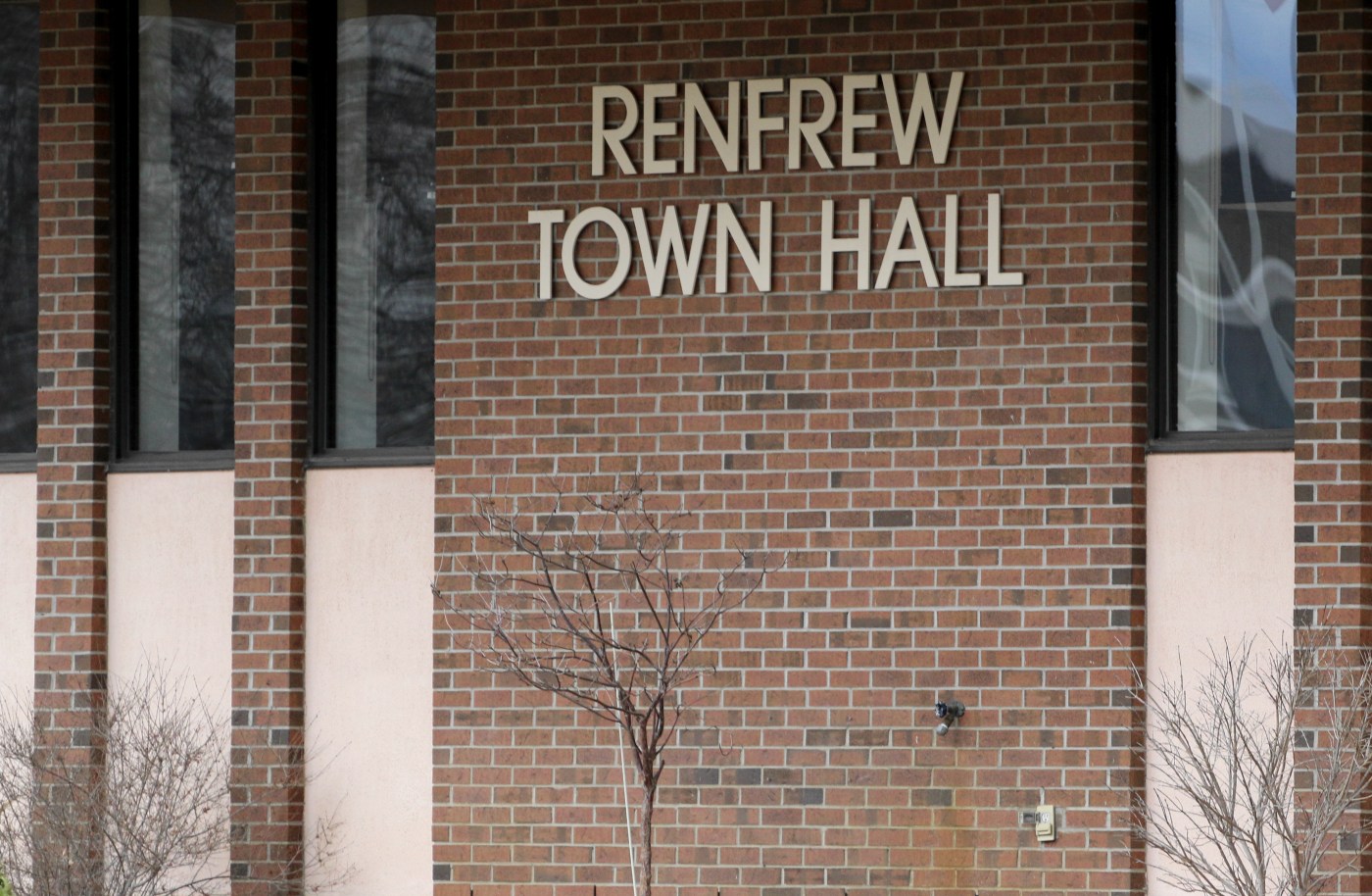
So it is for the folks who toil as part of Renfrew’s Town Council, whether they be elected officials or members of the administrative staff. Budgets in the municipal sense are set out for six-month periods, and are assessed immediately following the conclusion of those six-months.
Hence the term BUDGET VERSUS ACTUAL. It simply means that the comparison described above is taking place in an open Committee of the Whole.
A committee of the whole is a meeting using procedural rules based upon Robert’s Rules, the bible for procedure in a democratic legislative or deliberative assembly. Unlike a single committee, governed by those same rules, a committee of the whole is an open gathering that includes all members of that particular assembly, in this case, Town Council. It is, simply put, the business of all the committees that are currently in existence and in operation. An imperfect definition, but there it is.

SEGMENT 1
In this Committee of the Whole, town councillors will put questions to the Town Treasurer after the treasurer delivers her report to open the session. Questions are usually those of clarification or requests for additional information. All questions are posed ‘through” the mayor, who serves as the chair and arbiter of procedure and decorum, as assisted by the Town Clerk. It’s why you’ll hear everyone direct their commentary or questions through the mayor, as in “through you, Your Worship, to the treasurer,” although the title mayor can be used in place of Your Worship. This applies to any open, official communication between participants, all of which go through the mayor. Sort of like the Speaker in the House of Commons.
In this first segment, Renfrew Treasurer Charlene Jackson delivers a report covering a fairly robust number of things, things that have been discussed in specific committees perhaps, but that are now part of the official record. It goes by pretty quick, so don’t be thinking you have time to deke out for a coffee. The subject matter is important, and has a price tag attached to it, one articulated in the original budget, the other the actual dollar amount directed toward the endeavour under discussion.
Budget versus actual.
Listen carefully to this segment. It goes by pretty quickly and contains a lot of stuff that one would need to have prior knowledge to understand. All formal participants would have access to this material from their time spent in the course of their duties, attendance at committees, and at full council meetings in the past. But you can still make out some of the detail and the overall gist of things. Some of that prior background knowledge may become available in the appendices to follow the treasurer’s report.
As part of her report, Treasurer Jackson refers council to a number of appendices, or appendixes, that provide deeper, more fulsome information pertaining to the topic, the initiative, the contract, or the job. Many of her items will involve capital projects, projects that will either build new facilities or extensively renovate existing ones. Those identified appendices will be delivered by Acting Director of Development, Environment & Infrastructure, Andrea Bishop. That report will be featured in a subsequent posting as part of this series. I can only hope that I got Ms. Bishop’s title right.
SEGMENT 2
Treasurer Jackson is posed questions by the councillors present.
1). Councillor Dick: Wanted to know why labour costs were included in one project’s report, but in no others. The project in question involves the construction of a gravel parking lot on Opeongo Road that services the south-eastern approaches to Ma-Te-Way, right by where the trails begin if approaching from that direction. The parking lot was budgeted at $10,000 but subsequently ballooned to just over $32,000 by the time it was completed.
The treasurer responded by saying that any project involving the direct labour of town employees, parks and recreation employees, etc would be included in the cost of the project. This parking lot included such labour by town employees, ostensibly hauling gravel to the parking lot as it was constructed. There was no indication as to why no contractors would be involved in something like this, and what advantage there might have been in having civic employees doing the work. The treasurer pointed out that the total cost of the project, labour included, would be an approximation of the amount that would have been paid for an outside contractor to complete the same project. The labour cost of $26,000 represented the lion’s share of the budget overage for the project. It’s possible the reason for those labour costs being what they are is contained in one of the appendices to follow.
2). Councillor Cybulski: Wanted to know if Council can show the parking lot as a completed municipal asset valued at $32,000 rather than an over-budget line item on a balance sheet. In other words, Councillor Cybulski suggests it be shown as a municipal asset of $32,000 rather than one of $10,000 as per the budget forecast.
Treasurer Jackson indicated that yes, the completed project is or will be listed as a municipal asset at a value point of $32,000.
COMMENTARY SEGMENT 2
Labour costs, whether on budget or over budget, make up part of the value of the finished product, whether that’s a home, a car, or a parking lot. And so listing the parking lot as an asset worth $32,000 in the Asset Management Plan is entirely appropriate. After all, there can be no parking lot without the labour, therefore no asset without the labour. But as a budget versus actual discussion, it will show as a $26,000 deficit specific to that project.
SEGMENT 3
In this segment, Councillor Dick asks the treasurer to provide some guidance as to what accountability exists for cases where the initial project budgets get blown out of the water by extreme cost overruns.
1). Councillor Dick: There is an evident history of municipal projects going over budget, some by a little, many by a lot. Some that come to the attention of council, and some that don’t. The councillor is looking for an explanation as to why this happens — the differences in reporting — and why nobody seems to be in a position to take responsibility or accountability for this. He likens the situation to his own businesses, where he says that any employee causing budget overruns like this would be held accountable and that there would be consequences applied.
Treasurer Jackson responded by saying that change orders, or amendments to a work contract, do exist but that they’re classified according to the dollar amount they represent. And so, for a change of contract that comes in at under $50,000, the department head and treasurer would sign-off on that. For changes between $50,000 and $100,000, the signature of the treasurer and the Chief Administrative Officer (CAO) is needed. Change amounts greater than $100,000 would require council approval.
The treasurer went on to say that, at some points, change orders existed, but then were taken out of project reports for an unidentifiable reason. This has led to some of the inconsistencies brought up in Councillor Dick’s question. She also alluded to the fact that, in the past, there were instances where council approved a change order, but then the project cost ballooned beyond the scope of the order, leading to anything reflecting that unapproved cost being taken out of the project report. The treasurer indicated that previous staff would have better answers for why this was done, but left a very strong impression that doing so was, at best, inappropriate. Her word was detrimental. She used the example of a storm sewer needing replacement being buried under different work, perhaps road construction, where the work above was done, but then the storm sewer breaks, causing a need to dig the whole thing up again in a couple of years, replace the sewer, then repave the surface above, all at an extraordinary cost to the local taxpayer. I’m not entirely sure I represented that comparison accurately, but I hink i do get the point that, if you’re going to go in with the engineering to dig, resurface or pave, it’d probably be a good idea to find out if the related infrastructure, in this case the storm sewer, was in the kind of condition where one could safely assume it might last longer than a couple of years. I have a feeling that this kind of “not knowing what ought to have been known” has happened more than we might care to think.
2). Mayor Sidney: The mayor indicated his confidence in staff moving forward. As new staff begin handling projects from beginning to end, rather than inheriting the situations left by previous staff, the town will see an overall improvement in the efficiency, accountability, and professionalism of this very important sector of local government.
ANALYSIS / COMMENTARY
I completely understand the frustration articulated by Councillor Dick, a frustration he doesn’t share in isolation. I further appreciate the difficulty in explaining this, as the treasurer did as diplomatically as one could hope for.
I don’t know the scope of the councillor’s business holdings. A quick Google search revealed a couple of rental properties here in Renfrew, a pop-up firecracker stand, and a licensed hair salon where I hope the alcohol is intended for the clients and not the stylists. So I don’t know how many employees he has, but the song remains the same: If one of his employees were to run-up budgets like we’e seen with municipal projects, the employee in question would be sitting in the corner, red-faced and knuckles rapped. Perhaps even out the door. Which is entirely a valid point.
The treasurer’s report is disturbing, so I appreciate her diplomacy and careful choice of wording while navigating Councillor Dick’s question. Much of what she shared carried with it the strong odour of possible malfeasance, not on her part, but perhaps on the part of others who came before. Or incompetence. And neither is a good look. We’re all aware of an active criminal investigation underway regarding the Ma-Te-Way expansion, so perhaps I’ll follow the treasurer’s lead and diplomatically leave that right there. As well, it’s beyond my scope in doing what I’m doing here. I truly wish the best for all souls involved.
I applaud the mayor for taking the opportunity to pump the tires of the new staff, many of them serving as acting department heads or acting executive administrators. These people have huge tasks in front of them, among them the need to face council and attempt to report on the actions or inactions of others. It will be a difficult ride for them, but I have no reason to doubt the mayor’s confidence in them.
On the whole, an important question from Councillor Dick.
SEGMENT 4
Councillor Legris asks the treasure about money saved in some of the municipal rmaster plans that reflect on-going projects.
1). Councillor Legris: Wanted to know why there appeared to be money left over — imagine that! — in several master plans governing four on-going projects. In other words, these projects appear to be coming in under budget. He wondered whether that was an indicator of some work intended for the project not being completed as yet, and therefore not being reflected accurately in the master plan. The councillor pointed out that some $40,000 had been saved, budget to actual, over the course of these four master plans. The scope of the plans had not changed, so why the surplus?
Treasurer Jackson responded that a project may be considered to be 100% completed, but the final billing for the project may not have been received. In other words, the work is done, but perhaps there are bills still outstanding related to that completed work. And so a project is only truly 100% completed after all bills related to it have been received and paid. So hold on to your hat, those master plans could still go into deficit once those final bills come knocking. And then again, they may not, and maybe this is some good new for a change.
Also, the treasurer pointed out that if a project is being funded by the town’s reserves, only the actual amount paid comes out of those reserves, and not the budgeted amount. So if a project was budgeted for $40,000, but came in at $32,000 once all the dust had settled, then only $32,000 will be taken out of reserves.
NEXT UP: THE APPENDICES
 NEWSMAGRENFREW