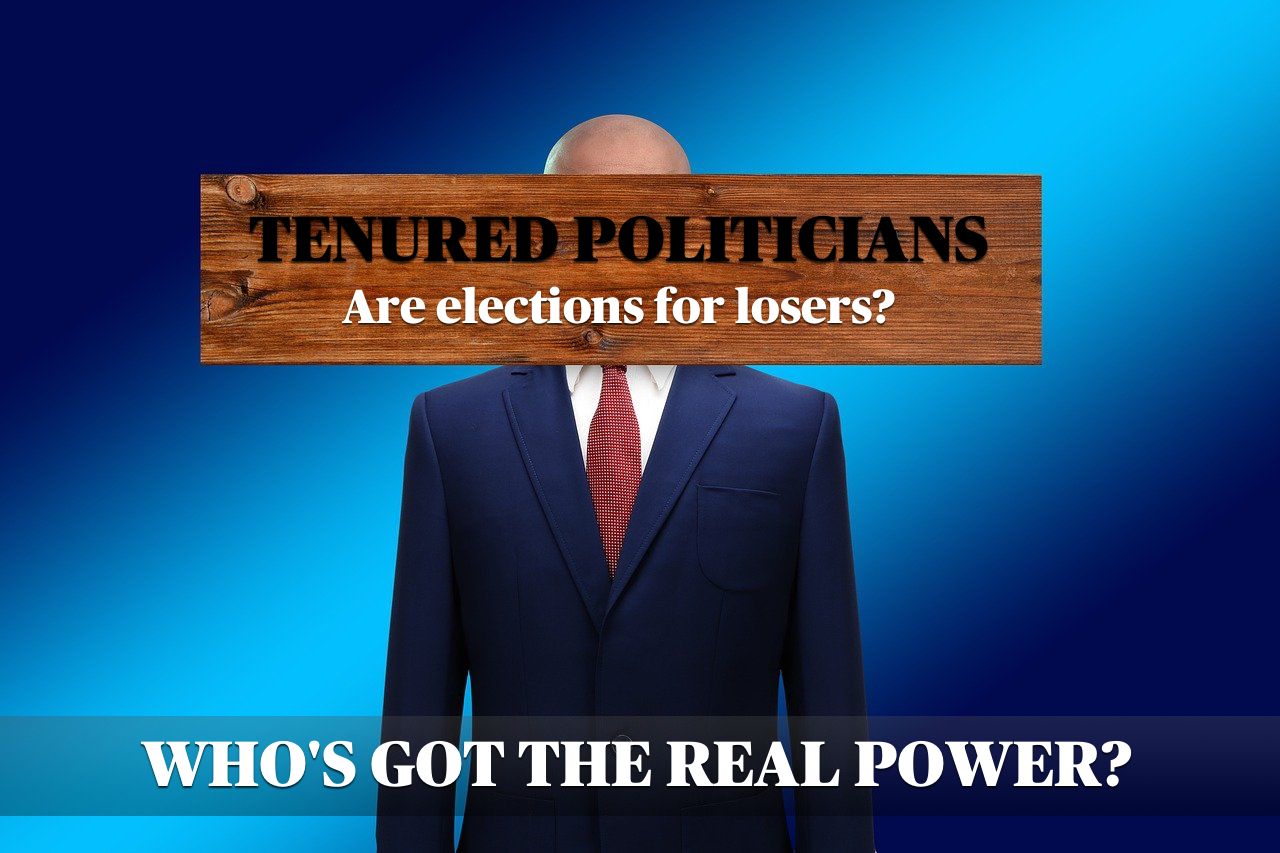
There are two types of politicians that walk the floors of town halls, city halls, legislative halls, or agency halls. A third type frequents the boards constituted by the first two, giving us a full compliment of three very different forms of political figures.
The first, and most obvious, are the elected politicians, the ones who got to where they are the old-fashioned way, by doing all the grunt work, working the phones, knocking on doors, hammering in lawn signs, kissing hands and shaking babies. The ones who are up front-and-centre when the public gets its dander up and is looking for answers to difficult questions. The people who have all sorts of things thrown at them, whether it be criticism, profanity, rotten tomatoes, any of it or all of it. These are the people elected by the other people, the public, and are the forward-facing tier of democracy. They have something called legitimacy.
And then there are the tenured politicians.
They’re the ones who got hired by the first group, probably with educational credentials out the ears, plucked out of nowhere to be given the task of steerage, of keeping the ship both afloat and headed on the desired course as directed by the captain and other ship’s officers. They are the ones with their hands on the wheel.
Perhaps the best way for me to make my point is to use Granny, the most wonderful woman in the world, as an example. Always a warm and encouraging smile, thoughtful to a fault, spoils the grandkids shamelessly to their delight, a member of her church and volunteer for numerous church and civic causes. She is the apple in the apple pie.
But put her behind the wheel of a car.
This beatific human being becomes something completely different while she navigates the Costco parking lot.
So it can often be with tenured politicians. They start as one thing, but inexorably make their way up the ladder, in competition with others, but with no need for term limits and things like elections to get in the way. They become entrenched.
They aren’t part of the system. They become the system.
That said, If you thought politics was confined to the election trail or the council chambers, then it would likely shock you to know that unelected people endure a political dance of their own as they go through their careers as stated public servants, perhaps morphing into the. masters along the way.
It’s been like this all through history. There’s always been the throne, and then there’s always been the power behind the throne. Who is greater?
King Louis XIII or Cardinal Richelieu? Who does history remember more easily? I knew Richelieu off-hand, I’m a history guy, but had to look up which Louis. So there’s my point.
This, I suppose, is completely unavoidable, so long as humans are in charge of organizing and running other humans. People are essentially people, for good and bad, and it was like that 500 years ago as much as it’s like that today.
I have absolutely no axe to grind with anyone currently serving in the Ivory Tower that is Town Hall. I don’t know a thing about them, one way or another. I can talk to people here and there, up and down the main drag, in the coffee shops, in the meat department of my local grocer, none of it for attribution. You get stories there, but you get stories that are all hearsay, and most of it is about former staffers anyways. Once upon a time, not long ago, reality television might have had a field day with Renfrew Admin if as much as 30% of what I’ve heard is true. It would also help explain some of the messes we get into.
You’d be surprised how a little place like Renfrew can take on the appearance of an afternoon soap opera. Then again, maybe you wouldn’t, what with people being people..
Gloria Raybone is the new Chief Administrative Officer for the Town of Renfrew. I feel somewhat conflicted with that. Do I send flowers of congratulations or flowers of condolence? Or both?
Gloria hails from Tweed, a municipality most of us know from our road travels to Toronto. It’s slightly smaller than Renfrew, but there are people who live there too, and some of them are elected politicians while others are tenured politicians. Gloria appears to have been around long enough to be able to appreciate how it all works, so it’ll be good to have that experience at the head table here in Renfrew. I was tempted to reach out to her to maybe do a piece on her arrival, and maybe get a sense of her before they fit her with the mandatory cone of silence.
Outside of the Reeve, Peter Emon, I’d have to say this cone of silence is absolute, or pretty close to absolute.
Finally, there’s a third layer of politicians in all of this, as in all communities, large or small.
The elites.
They bring an even more ominous level of political reality to everything they’re involved with. For many of them, the sun shines for them, and for them only, and it’s not unusual for these types to throw their weight around, mostly because of the money they have or the money they represent. The smell of that cash draws others to their orbit, gives them a sense of power, and for many, it’s something they love the feel of.
There are these types of political players here in town. They have names, but not many of them, in fact the great majority of them, will ever have their names appear on an electoral ballot. That’s because they don’t have to. They have more sway on things, more influence on things, by being on the outside of the legitimacy curve, but impacting dramatically everything inside of it.
Many say democracy is messy. It is, especially when the only properly and democratically elected people in all of this mix seem to shrink in comparative influence to the other two, non-elected groups.
Because this sort of thing happens everywhere, does it follow that it must also happen here? Is that just the way it has to be? Or can it be a question of degree?
We’re never going to be able to expect that people will stop being people, but is our only option to shrug our shoulders and resign ourselves to the fact that this is just the way things are?
In truth, I’m not very good at that.
This is a people problem. People created it. So people can fix it.
It starts and continues with strong leadership, elected leadership. It starts with a mayor, a reeve, and councillors willing to lay down strong claims as to who it is that’s in charge.
They lead the agenda, they drive it, not simply rubber-stamp the agenda of unelected others. Those others need to understand that they’re subservient politically to the elected people.
Because out of all three of these political types, only one of them has a vote.
Nobody chose town staff to be in charge. Nobody chose a radio station or a cabinet maker or a construction firm or any other business and their principals. Nobody chose any of those folks who sit on boards who have members appointed. Boards where they pretend to be listened to, when it’s the bureaucrats that are really in charge of everything. Boards that seemingly provide democratic legitimacy to mandarin decision-making. Only because a councillor or two happens to be on the board as democratic window-dressing.
I’m not here this morning to overly criticize any of the current elected politicians. In fact, I’ve actually seen a couple of them deflected and dissuaded as they seek out information from a reluctant town staff. In fairness, I’ve also seen a council unanimously stop a rubber-stamping of a tech contract as recommended by that same staff, one that had a budget ask tens of thousands of dollars more than the existing contract. Sure, maybe it was a sound recommendation, but council has every right to review it. Every right and every expectation to do so.
But then, in closed session, they went ahead and approved it despite some serious questions of legitimacy. What happened between open and closed sessions on this issue is the crux of the thing. Whatever happened behind those closed doors may well be precisely the biggest existential threat to openness and transparency in local government.
What changed? What was the compelling argument to continue with the contract award? Who made that compelling argument? What factors made the argument compelling? And why was this something the rest of us couldn’t see? Couldn’t know about?
If there’s anyone out there who can explain this, the coffee’s on me.
This council must absolutely assert itself. That assertion must extend beyond the efforts of two, possibly three members. If you’re to have any value beyond just taking up a perfectly good chair, you have to take stands that may be unpopular with some who may be entrenched. Just try to remember who you work for, who put you there, and who pays the bills.
You’re either there to serve us or serve something else.
Fight back.
Against the staffers wherever and whenever necessary, and the elites, also when necessary. They are your jurisdictional inferiors. You are not a prop that exists to legitimize all their decisions. Rather, they are there to execute and implement your decisions.
You make policy, not them.
Delegitimize the elites. They’re not the big deal they think they are, and only become so when they sense a vacuum of leadership. So occupy the space you’re entitled to, and crowd them out.
You were elected. We chose you. Not staff employees. Not elites.
You.
 NEWSMAGRENFREW