I don’t know what it is about that radar of mine, but I have to say it’s been a mostly reliable asset of my twenty-some years of being an adult.
I noticed the most recent meeting agenda had a delegation scheduled for a Mr. Ian McFarlane, and surmised it had something to do with that IT contract that has bounced around back and forth, in and out, to and fro, and open and closed for the past month.
It turned out that’s exactly what the delegation was about.
According to Mr. McFarlane, there were a number of irregularities with respect to the awarding of that contract, irregularities that may have led to a different result had they not been present.
Go figure.
I don’t have the numbers in front of me, but the contract was awarded to a company named OnServe and was in the area of $80,000, which represented an increase of almost $60,000 over the current fees associated with Renfrew’s municipal IT operations. I believe I heard Mr. McFarlane mention that his bid came in at somewhere in the area of $35,000. I’d have to go back and view the youTube livestream to get that number down perfectly, but I feel confident enough to put it in the mid-thirties.
Mr. McFarlane seemed to be of the opinion that his proposal may not have been read in the first place, which is a pretty strong assertion given the dollar value of his bid. He also maintained that the company that successfully won the contract doesn’t even do much of the work stipulated by the RFP — request for proposal — including the important point of not having a practice where company representatives spend any time at the client location to serve and service.
Perhaps the most weighty assertion, though, was his suspicion — or perhaps it was fact — that the company, OnServe, had actually consulted with the town to craft the RFP in the first place, or if that’s not the case, to do an assessment of what the town needed in the way of information technology. If that were to be the case, then OnServe would have had what may have amounted to privileged information regarding the town’s current IT situation, involving systems and equipment, that might give it an advantage if it were allowed to compete for the contract.
But that’s the thing.
If true, then why would OnServe be allowed to bid for a contract when they may have had information that the other bidders weren’t in possession of? I believe Mr. McFarlane said that he asked for this information, but was refused by town staff. And what more could I possibly say about that?

He also called into question the scoring matrix used to evaluate proposals. He claims he received impossibly low scores in areas of obvious and unassailable strength, something he says other local bidders, like Valley Bytes, also experienced. Comparatively, other bidders, including one from the Toronto area, scored higher in categories that had localized features built into them.
I didn’t have the hard copy handout that councillors had available to them, but my understanding is that McFarlane’s company, TeneTech, may have finished last, dead last, out of eight total applicants. Yet he apparently spent somewhere in the area of 12-15 years working for, or with, the Town of Renfrew on IT-related services in the past. Yet he scored low on categories involving experience with municipalities and local experience.
To him, the whole thing didn’t appear to be adding up.
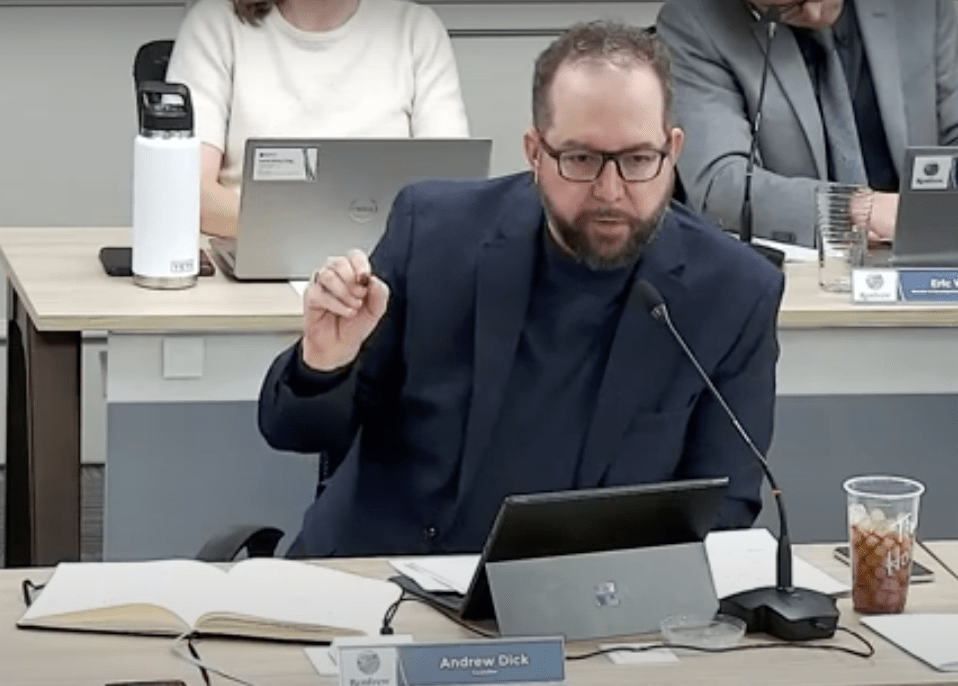
Council had only a couple of questions, which I found a little odd, and the questions had more to do with terminology than anything else. But then Councillor Andrew Dick took on the role of accomplished trial attorney and posed a series of questions that signalled that there was going to be more to this issue coming down the road.
The questions pertained to OnServe being involved with an assessment of the town’s IT needs prior to the issue of the RFP. He also wanted to know more about a document that McFarlane said was denied to all the other bidders, a document that supposedly contained all of the town’s specifics with respect to IT, like server age and other related privileged data.
Councillor Dick wanted to know who it was that denied that document request.
Mr. McFarlane said that questions were submitted to a RFP portal online. Some questions were answered, but the ones involving the document weren’t. He said that this was the same for all of the other bidders not named OnServe.
Councillor Dick’s final question had to do with on-site requirements articulated in the RFP. He asked if an on-site component and requirement was part of the RFP. And further, did the successful company have an on-site presence built into its bid?
McFarlane answered yes, and then no to those two questions in that order.
At the end of the meeting, Councillor Dick presented a motion suspending any further action on the award of the IT contract until things could be examined more closely. As this topic was already a closed-door item recently, one would have to assume that these things weren’t evident, known about, or brought up at the time, which raises a certain number of questions about the thoroughness or completeness of the person(s) tasked with bringing this before Council in the first place.
This is all sort of refreshing because, for a change, this issue doesn’t involve a sole-source contract, or one awarded to a sitting member of Council. No, in this case, there’s a legitimate RFP in play, but now there’s questions surrounding its integrity.
I try my very best to be as positive as possible, I really do. But story after story has me absolutely befuddled as to what I’m hearing and witnessing.
This, unfortunately, seems to be another one of those.
 NEWSMAGRENFREW