
It was back in October 2024 when Councillor Andrew Dick announced at Council that the ballparks at Ma-Te-Way were going to be lit in the summer of 2025 and “It doesn’t matter what it costs.”
It’s February 2025 and baseball season is just a little over three months away, so we seem to be approaching a time of critical decision-making when it comes to this issue.
There is one thing that’s generally regarded as being certain and where agreement is unanimous. The lights at Ma-Te-Way are a mess, and that mess is going to require some cash to fix. And if the fix is to include the Dog Park and a parking lot, then the cash required will be more than to just light the three fields.
Councillor Dick is a ballplayer, so he’s close to the issue. That’s not a problem in any way, as these ballparks are pretty heavily-used, and they do bring money into the community in terms of user fees and peripheral spending from ball teams on game day or on tournament weekends. So, while calling the ball fields economic engines might be a stretch to a degree, any time a ball team comes to town or stays in town, that peripheral spending does have an impact on restaurants, convenience stores, motels, pizza shops, and yes, beer and liquor stores, although that last area can now be folded into grocery and corner stores as well.
The situation regarding lighting at Ma-Te-Way involves not a crumbling infrastructure, but rather a crumbled infrastructure. In other words, the best-before date was, to put it bluntly, a long time ago, and perhaps mitigated by decisions that could have been made by past councils, but that’s a moot point in that they weren’t made, and so here we are, in the dark.
In late 2024, Council approved an exploratory investigation of infrastructure needs by engineering consultants Jp2g and to report their findings back to Council. This work was done and completed with recommendations for future action. In addition to a recommended option, Jp2g also provided two other options for Council to consider, both with different price tags and timelines.
In essence, there are three fields under discussion here, Seeley, Rusheleau, and Tye, all of which host ball games past dusk when lights would be needed. A failure to light these fields impacts the scheduling of the many users who utilize these facilities, as well as having a negative impact on user fees. So it’s a big deal.
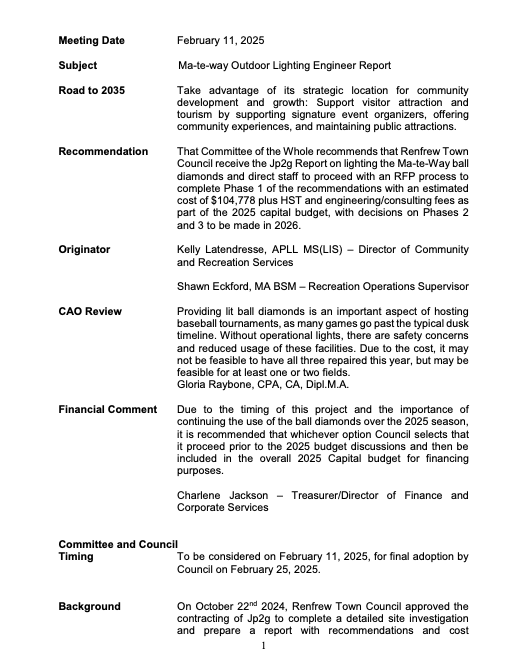
The options, as you may well imagine, include fixing one, two, or all three fields and have the costs charged to the 2025 municipal budget, or delayed until the 2026 budget. If you were thinking that Renfrew was a little short of money in recent times, then you’d be more than correct. The 2025 budget is likely to be an unpopular one among town ratepayers because of increases already built-in as a result of Ma-Te-Way being incredibly over-budget, not to mention budget overages for the Town Hall renovation and the various road-construction projects where the horse got away from the rider.
So the decision to be made will be a difficult one, because money’s short and it will be shorter still in 2026, and nobody can really say what financial disaster lurks out there that hasn’t made itself obvious yet.
Jp2g has recommended what they refer to as Option 1, which involves getting one field, that being Tye Field, up and running and leaving the other two for 2026. This is also known as NADO — Not Andrew Dick Option — who has said on record that, although money’s tight, there’s enough of it around that can be squeezed out of the system and thrown towards keeping local ballplayers happily scrambling about in the infield dirt as daylight fades and the darkness falls. This option, or Phase 1, carries a price tag of $104,778 plus HST.

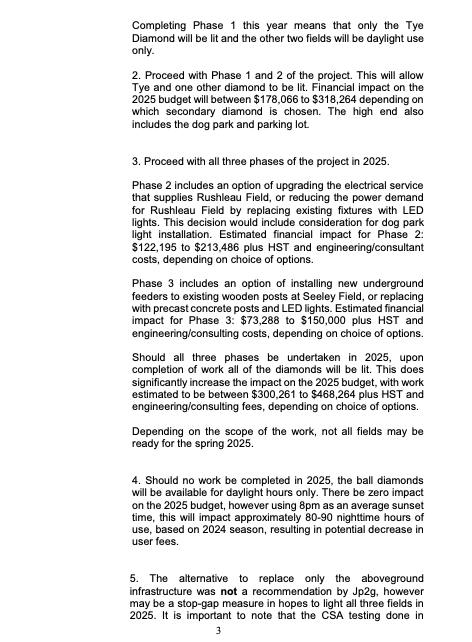
Option 2 involves Phases 1 and 2, which is getting Tye and one other field in action, with a price tag of between $178,066 and $318,264, depending on which other diamond is chosen and whether or not the Dog Park and a parking lot will be included. Both of these items would go to the 2025 budget.
Option 3 is the GFBO — Going For Broke Option — where all three fields get the treatment, at a cost of between $300,261 and $468,264, all of which would be absorbed by the 2025 budget, a dart to the heart of a community attempting to be as fiscally responsible as can possibly be managed while at the same time keeping a community of 8500 people running.
Another option was identified, but it’s the least appealing one, even though it costs nothing right now, but will eventually have to pay the piper at some point. That option involves the WAPO — Wing and Prayer Option — where we go full steam ahead and hope the wires work, whether they be underground or atop polls. This option actually represents recent Renfrew policy with respect to lighting ballfields, the idea being that if you undertake the ostrich head-in-sand approach, you just might be able to slide through a whole season without having to do anything and without having to pay for anything. The flip side of this option is that an already deteriorated wiring infrastructure may experience catastrophic failure, and that’s a tough result when it’s the bottom of the seventh, two runners aboard in a one run game, and the lights go out, in more ways than one.
It’s a tough choice, and there’s no correct one that stands head and shoulders over the others. One thing that does suggest itself is the idea that it’s probably not a good fiscal idea to slide your problems forward to the 2026 budget, as there’s absolutely no way of knowing what that creature will look like, but with an almost certainty that it won’t look any better than the 2025 budget. In fact, it may well be worse.
As well, it’s tough to have facilities that are in prime condition and then not be able to use them. Yes, Ma-Te-Way cost a lot more than it should have, so did the Town Hall, so did those roads. But can you really have ball fields in the dark? To some it may sound like a reasonable compromise, but we need to face the fact that not all baseball-related activity happens on a Saturday in daylight hours. Ball fields in all communities rely of lights, and those fields are almost never empty.
To me, Option 1 is the careful option. But it’s also the option that may lock in a less than ideal situation, one where a 2026 budget is even less able to absorb costs associated with field lighting. That’s a situation where Tye Field can be opened in 2025, but then budget considerations in 2026 might make funding the fixes at the other two fields seem impossible, or improbable. And that would represent an unintended de facto compromise that nobody wants, that is to have only one field in operation after the sun goes down.
To me, if this is an important municipal priority, then the bullet must be chomped-on in fiscal 2025, when people are expecting a hurt anyway, yet they’re not done blaming it on Ma-Te-Way. The money spent, while painful, should put to rest this issue well into the foreseeable future, possibly measured in decades.

Think of that municipal debenture as a sort of consolidation loan. If we’re going to be on the hook for tens of millions of dollars anyways, a less then half-million hit, while substantial, will get swallowed up nicely over a thirty year period. Well, not nicely exactly, but you know what I mean.
And so, Councillor Dick, there may well be lights at the end of the proverbial tunnel after all.
 NEWSMAGRENFREW