
It’s times like these where we, as Canadians, usually rise to our challenges. Sorry, where we always rise to the challenge in front of us.
We were there at Queenston, at Chateuguay, at Ypres and Vimy. We more than showed up for Italy and Normandy, and even Dieppe speaks to our courage in the face of overwhelming odds against, some of those odds courtesy of our friends, the British. We fought and won the Battle of the Atlantic.
Were among the most-feared and most respected in Afghanistan, and lost over 150 good people in that demonstration of resolve.
We fought the Americans twice, in the Revolution and War of !812 and turned them back both times. We fought the Kaiser’s army in World War 1 and earned the reputation as “shock troops” by the Germans who were always carefully aware of where the Canadians were along the front line. We fought the best the Nazi’s had at Juno, up through Normandy and into the Low Countries, and liberated Holland before joining the Allied thrust across northern Germany. And we chased the Taliban off of every battlefield in which they faced us.
So, in short, we’re more than up for the most recent challenge, economic war against the United States.
This is the time for a truly great people with a truly great vision, to come out of all of this a stronger and more economically independent nation than we were before.
This is a time when we truly get to work on investing in ourselves, our nation, and our very own people.
One area that’s come to mind is in the area of housing, or more accurately, in the availability of affordable housing, or even more accurately, in the non-availability of affordable housing. It’s a time to build, then build again, then build even more. Take a national crisis, other than tariff warfare, and turn it into a national strategy for recovery. It’ll be a little slice of Canada’s version of FDR’s New Deal during the Great Depression, where Franklin Roosevelt spent America’s way out of an economic depression, although World War 2 probably was the ultimate catalyst.
We can do something similar. Bigger, capital infrastructure projects that keep workers working, businesses afloat and thriving, and leaving a footprint for the benefit of all Canadians moving forward. We may have had a housing crisis going into all of this, but smart thinking will ensure we don’t have one when we come out of it.
There’s another thing we can do that we’ve done really well in the past, and that’s buy government bonds.
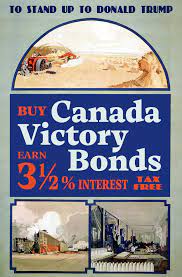
Canadians of both world wars would remember the institution of Victory Bonds, where Canadians could invest in their own government as that government went about the business of fighting a war. These were the pre-cursor of Canada Savings Bonds, which were a popular saving instrument for millions of Canadians until just very recently.
Perhaps it’s the time and opportunity to bring such bond programs back, under whatever name, so that Canadians can invest their money safely in a government effort to fight this war, yet build for the future at the same time.
To be sure, neither Victory Bonds or Canada Savings Bonds were the sexiest way to invest your money, since the stock market can make you more, and faster. But the stock market can also lose you more, and faster, as well. With government bonds, you won’t get fabulously rich, but you won’t get fabulously poor either.
They’re just slow and steady, like a train or a ship at sea that never stops moving, day or night, slowly and surely getting you to where you need to go. It may not be flying at 500 mikes an hour, but it’s more of a chugging along, adding up, slow and steady, and always getting there in the end.
My mother lived through the Depression and served during World War 2. She raised a family after the war, and while we weren’t exactly moneybags as a family-unit, we did okay. But all through that time, whenever she could, she’d invest in Canada Savings Bonds, always making somewhere in the area of a 5% return, and the bonds carried compound interest. Her strategy was probably the best one, buy them and then forget about them.
When she passed in 2003, we were shocked to discover that she had amassed $450,000 worth of Canada Savings Bonds. Slow and steady, always working in the background, not needing any great financial acumen, not requiring any white-knuckle and bulging eyeball episodes caused by dramatic market fluctuations, like we’re experiencing right now.
Slow, steady, and inexorable.


And liquid, as in you could cash them any time without penalty, a feature you don’t get with other saving instruments, like RRSPs.
We intelligently pumped dollars into the economy during the last episode in 2008 when the Americans let us, themselves, and everyone else down through their economic and financial recklessness. Interestingly, our current prime minister, Mark Carney, was instrumental in that policy. He would be instrumental in this one as well.
I used to buy bonds as well, as per my mother’s advice, and did so until they were discontinued. They were easy to buy, as in automatically deducted rom my paycheque, and I never had to think about them until I was forced to stop by the fact that they were not offered anymore.
Seems to me to be a perfect opportunity for Canada to bring back a good idea.
 NEWSMAGRENFREW