I’m back for another ride on the acountability/transparency train, not because I like the view or because I’m a train guy, but more because I feel as if I lost my wallet on a previous trip and have hopes that it might turn up.
Fat chance.
Today, I’m going to rant a little bit about agendas, as in meeting agendas, as in the ones that are released out of the Clerk’s office a few days before any general council meeting that’s open to the public.
Agendas are important, not because they’re road maps for discussion, but also because it gives the boys and girls at home and on our ships at sea an opportunity to get some idea as to what the topics for that meeting are to be. It does double-duty as an informative and handy reference for anyone attending a meeting in person or viewing the process via the YouTube Livestream service offered by the town.
We all know, or ought to know, that accountability of public officials, whether elected or staff, is something more than merely the mouthing of words. Words are cool and everything, but for accountability to have any meaning, those words have to be consistent with deeds, with real and appreciable evidence that efforts are made, and things done, to ensure that those words and deeds match up.
As it goes for accountability, so too does it go for transparency.
We can say transparency is a matter of critical importance to us, but then go about our business in such a way as to render our lofty ideals as being practically useless. No good idea is a good idea unless it’s backed-up and followed-through by good action to implement the good idea. Anything short of this is lip-service, window-dressing, chimera, fool’s gold.
Take your pick, they’re all bad.
Simply broadcasting your meetings live doesn’t spell the end of the accountability/transparency goal, although it is a legitimate service provision, at least for the handful of people who take advantage of it. And I suppose for the people who wish to peruse council affairs from afar and after-the-fact. But as a stand-alone, the livestream is not the ultimate and comprehensive fix. It’s a part of the fix, albeit important.
Having an integrity commissioner sounds good and looks good on paper, and there are some among us who would point at this as a sound measure of accountability and transparency. It is, or I should say it would be, if it were more than a paper tiger, and a wet paper tiger at that.
First, the law firm that provides this service bids for the right to provide this service, in competition with other law firms. My point is that they’re chosen from a number of competitors to take on that role, which means that Council selects the very people people who will be in a position of ethical oversight over their actions as a group and as individuals.
Meaning the defendants appointed the judge.
This is such a comprehensive and patent conflict of interest that it literally blows me away how such an inconsistency can be allowed to continue and flourish. I don’t care if the province turns a blind eye to it, or that other municipalities do the same thing. When it comes down to brass tacks, a conflict is a conflict, and smoothing it over with the “industry standard” argument is just a pathetically weak attempt to justify something beyond justification.
Then there’s the situation when the integrity commissioner files and presents a report in response to a complaint.
I’ve witnessed integrity commissioner Tony Fleming make two reports to Council, and both times the report, both written and verbal, was thorough, cohesive, and obviously a good return for the money spent. In the first case, Council just ignored his recommendation, just flat-out ignored it. In the second case, the report was tendered, and then to all intents and purposes, universally ignored, almost as if a complaint of any sort wasn’t made, even though I’m pretty sure that complaint came from within council itself. There’s no way of knowing who filed the complaint, because we seem to live in a time where people can say whatever the hell they want, accuse anyone of anything, then hide behind the whole “confidentiality” thing. That’s how HR — Human Resources — operates as a means to saving their own backsides when things go south, which they often do when HR gets involved in anything more involved than sharpening a pencil.
Tony Fleming, by all indicators, is a man of integrity. He is treated by this Council as anything but. Tony does his job, whereas Council does not. Whereas taff does not. They just collectively nod their heads, and if the conversation gets awkward in any way, they suddenly find items of critical importance on their laptop screens so they have a place to go with their eyes.
All this serves as an introduction to my criticism of the meeting agenda.

I appreciate, of course, the fact that it’s released publicly in advance of the meeting, I truly do. It has provided me with a valuable informational support in an area — municipal government — that seems to flummox me, despite my very best and earnest attempts to understand that very same thing. I wonder sometimes, is it the same everywhere else? Part of me hopes that is so that I don’t have to consider that I live in, or very close to, a dysfunctional town. And then the other part of me hopes it’s not the same elsewhere, in that such a thing would provide hope that we, too, could bask in the sunshine of good government and good government administration.
Someday. Maybe.
The agendas are a lot of work, I assume, for whoever it is who puts them together. But unfortunately, or maybe fortunately for the curator, the agendas appear to be easier recently to create and push out.
That’s because they are more or less a carbon copy of the last meeting’s agenda, a carryover of things discussed and not discussed, addressed and not addressed. The most recent agenda, in all fairness, was none of this, and appears to be in synch with the video, although I’m just 52 minutes in, but so far so good. I’ve not yet read anything that I feel I may have read before, perhaps several times.
Overall though, the blame for any inconsistency lies entirely with the administrative staff.
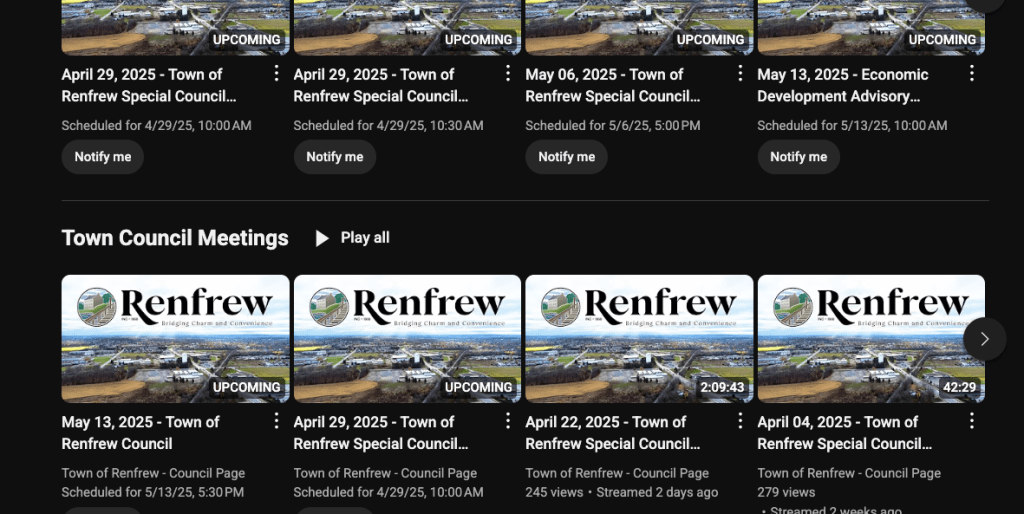
Ideally, you should be able to cross-reference the meeting video (or what you’re seeing if you attend in person) with the agenda, able to move back and forth between appendices, the agenda itself, and the video.
Sometimes, the agenda is no match for the meeting, meaning it doesn’t necessarily correspond to the meeting it purports to cover. It could very well be chock-full of everything that was on the previous week’s meeting agenda, and as is often the case, becomes simply a regurgitation of that material, document for document, appendix for appendix, a piece of administrative redundancy that makes me want to shake my head. How this whole business can’t be properly and efficiently organized by a group of people who went to school to learn how to organize, process, and deliver is beyond me, but here we are. it’s not my job to teach administrators how to administrate, but in all honesty, the whole wagon-load of them could probably stand to attend a workshop on this.
My best availability is Friday, for the record. And with the way they throw their money around, I really can’t wait.
Before heading for the exit, I have to make another comment about the circular, in-house explanations staff give councillors that is often full of administrative lingo that I guess they feel everyone ought to understand. I suppose if we hung out with other municipal types all day, and pushed administrative paperwork around our desk all day, it could be assumed that we’d be able to understand what in blazes they might be talking about. It makes me wonder, do these people speak like this when they go home?
A failure to respond to this also has negative implications for openness, accountability, and transparency.
On the video, I witnessed an exchange lasting almost ten minutes where councillors asked questions of staff and staff simply could not answer them, with the treasurer delivering her standard “I’m working on the budget” when tasked with responding to a question involving her jurisdiction. Which, I guess, is her public way of chastising a “wayward” councillor for having the unmitigated gall to ask her a money-related question. I wonder what she’d say if it was a closed meeting?
Budget time is the World Series for all treasurers in all organizations. Did she not know that before signing any lucrative deals she may have to become treasurer in the first place?
Perhaps one of the most meaningful outlays of money moving forward would be for Council to contract out for the provision of interpretation services, similar to what you’d see in the House of Commons. That way, when staff speak, councillors can simply put on their headsets or ear-plugs and receive a translation that would improve their ability to separate the wheat from the chaff, to borrow a biblical metaphor.
In most jurisdictions in Canada, such translation involves transitioning between English and French. In Renfrew, the translation would be from English to English, but perhaps with an additional need to translate apparent prevarication into something resembling English.
Agendas, integrity commissioners, admin-speak. Three things, or issues, that have the appearance of serving to detract, and often distract, the accountability process. All three are communication processes. All three are suspect when applied poorly.
All three of these things could use a re-working. I don’t know what, or who, we have on hand who might be up to the task, or of fixing this, since they’d likely disagree there’s a problem in the first place. But that’s a very human thing, isn’t it?
Recognizing a problem exists when it’s you that’s the problem.
 NEWSMAGRENFREW