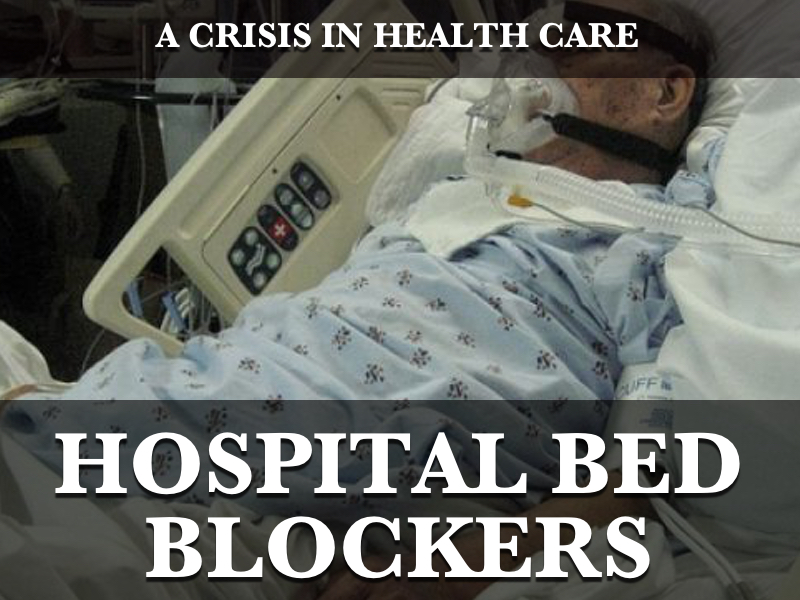
By now, pretty-much every one of us has some understanding of the acute shortages that plague our health care system. Doctors, nurses, and medical technicians make the news on a semi-regular basis, so much so that the general public kind of tunes out on the issue, unless they happen to be someone who is either in hospital, awaiting a hospital stay or surgery, or have a loved one in that situation. But the rest of us, somewhat unfortunately, have no idea, or if we do, it gets kicked back into the back seat of our brain.
What I haven’t mentioned is the acute shortage of beds in hospitals. While doctors, nurses, and technicians are absolutely essential, hospitals are usually measured in the currency of beds, as in how many they have. And then after that, how many they have open. Which is generally not many.
In hospital medicine, while not an official philosophy or anything, it’s generally accepted that the rule of thumb is “get them in, get them fixed, then get them out.” What you don’t want if you can avoid it is the prospect of a long-term stay, which removes a bed from the equation. And given the number of people awaiting a hospital bed, it’s a rather crucial workflow concept.
But now there’s a new term making the rounds, not even a small pun intended. That term is a bed-blocker, which refers to a person who has been in a hospital bed for a lengthy stay. Such people are often elderly, perhaps homeless, are in a sensitive and often critical status, and maybe don’t have the financial resources to get themselves into long-term care in a private institution of some sort.
It’s a sad situation, as in sad, not just unfortunate. These people take up beds, and occupy them for long periods of time, and perhaps with no realistic prospect of getting out. They will often linger in hospital until they pass on, hooked up to ventilators or intubated to keep them breathing, and to other apparatus to essentially keep them alive long enough to die.
And we as yet don’t have an answer for this.
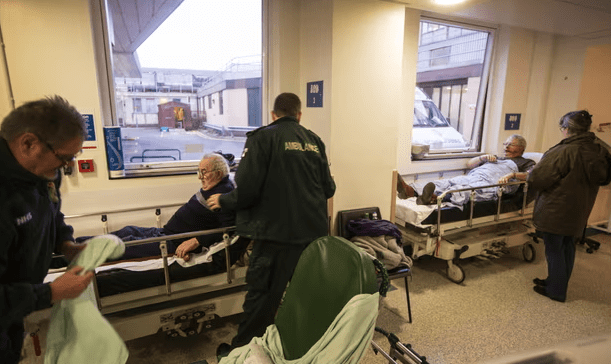
Ontario premier Doug Ford, though, is getting impatient, in that he wants to get these so-called bed-blockers out of the hospital. It’s the where-to part that’s the challenge.
You can’t simply transfer them to a long-care facility, because they’re tight for beds as well. Plus, such facilities, even though some are referred too as nursing homes, don’t have the same level of capability and expertise that a hospital does. And the fact is that many of these patients are intensive-care types, who require a degree of specialized training. We’re not talking bed pans and pillow-fluffing here, we’re talking about patients who are likely to still be in critical care.
So where do we put them?
Hospitals are more of a, to repeat, “get ‘em in, fix em’, and get ‘em out,” which sounds a lot like the grill over at your local McDonalds, although hospitals don’t have drive-thru windows yet. What hospitals were never intended to be were end-of-life facilities. The mantra was never “get ‘em in, hook ‘em up, then watch ‘em die,” which comes across as a little insensitive, but it accurately makes the point. The ideal result of a hospital stay is a discharge from that hospital, more or less fixed-up, and hopefully a return home. But this is a problem when these people are too ill, have no real home, and have no family to speak of.
As with everything else, it all comes down to money. We either build more hospitals or additions on to current ones, and create more beds, or we build more nursing homes with more beds, but also with staff that has the higher level of training necessary to deal with all types of patients, or clients, including these ones.
If there’s a more innovative way to deal with this situation that doesn’t involve money, I’m all ears. It’s bad enough that we shuttered psychiatric hospitals and threw all those people onto the streets to fend for themselves and draw the ire of everyone else inconvenienced by the presence of homeless people and their encampments. Are we now considering doing the same for patients in long-term critical care?
As if.
I agree with Premier Ford that something should be done, that some other form of care has to be identified for these people and then made viable. But shifting them over to private or private/public long-term care homes isn’t the way to go about it, at least not the way those places are currently constituted and operated. Also, a good chunk of these people couldn’t pay their way for such a placement anyways, which means that taxpayer money is a given, as nothing’s going to happen without it.

I’m aware that people don’t like paying taxes, have been for awhile. I’m also keenly aware of the fact that if all goes well, people get old. And a lot of people who squawk about taxes may well find themselves in this very situation, where I bet they’ll have no problem with the taxpayer paying the freight. It’s only rich people, the loudest and most consistent of tax-squawkers, who will have the ability to pay their way into one of these types of homes. There’s no middle-class anymore, so those folks, if they were still around, might be lucky enough to be taken care of through pensions other than government pensions.
All in all, it’s those people from a lower socio-economic status that tend to clog up hospitals, since many have no access to a general practitioner (doctor) as their initial source of primary care for themselves or their families. These are the folks who jam up hospital emergency departments. They are likely to be the prime candidates for being bed-blockers later in life.
In short, they are simply people who, for whatever reason, can’t pay on their own for their senior care should they lose their ability to make their own decisions. The health care they receive now is solely dependent upon the Canadian universal health care system, with OHIP — Ontario Health Insurance Plan — being their only way of accessing affordable health care.
So Doug, I’m right behind you, in that I too want to relieve the pressure on hospitals. I too wish to find another place, a responsibly thought-out and funded place, for these so-called bed-blockers. But our main difference is in the fact that I want to have a plan in place before I willy-nilly start cutting cords and hoses and machines and then follow that up by “dumping” these unfortunate souls into another system that’s overcrowded and overworked.
I feel if we were Finland or Sweden we’d be further ahead in meeting this crisis and exploring ideas and policies to solve it. But because we tend to think more like our American neighbours, despite our health care system, we sometimes find ourselves with American-type problems. And when it comes to health care, the Americans have a ton of problems as they simply can’t get their heads around the idea that we’re all in this together, rather than the core American belief of every man for himself. Girls too.
They should have that on their money.
 NEWSMAGRENFREW