Every Canadian voter is familiar with the electoral system called “First Past the Post.”
They know it because they know how it works or they know it because they can see the results of it. Both of those positions may likely involve maintaining that practice, since it happens to be all Canadians have ever known. And they’d rather keep the familiarity of a failed system than attempt to do anything about it through change or modification.
First-past-the-post refers to the idea that, in an election, the person getting the most votes wins. Pretty straight-forward, easy to understand, something accepted for as long as Adam and that freaking snake in the garden.
But it’s problematic for a significant number of reasons. The first is that, in a crowded field of candidates, the sharing of votes among those many candidates will likely result in a winner who receives like 17% of the vote, because all the other candidates split the remaining votes among themselves, and 17% was enough to get the person receiving that 17% the win, because all the other candidates got less than that. So a person is elected despite the fact that 83% of the eligible voters didn’t vote for them. So there’s that.
First-past-the-post makes it possible that your vote never counts, or never matters, particularly when you live in a riding where one party has a stranglehold. Take good old Algonquin-Renfrew-Pembroke, where it doesn’t matter how you vote, the Conservative is going to win no matter what. So if you support another party, well then too bad, move somewhere else if you want something different.
On a larger scale, it’s like Alberta voting for nothing but Conservatives, yet the federal government goes Liberal. But it used to be worse. Voters in Alberta and British Columbia would often in the past see the CBC or CTV announce a majority government of some party before they even got in the car to go vote. It can make you feel like your vote doesn’t matter, and by extension, you don’t matter. Anger is a natural consequence of all this.
On a national level, FPP — First Past The Post — can result in majority governments with the winning party only getting 39% or so, which means that 61% of the population didn’t want that party to govern. In fact, you can actually lose the popular vote — the entirety of votes received across the country — and still form a majority government, which is definitely something counter-intuitive.
And back in Alberta, they’re starting to talk about separation, and FPP is one of the reasons for that, although Albertans would probably vote to keep the very system that holds their aspirations back because they’re conservative, and therefore more likely to be traditionalists. “This is the way we’ve always done it” kind of thing.
And it works that way across Canada, where the results don’t correspond with the votes, but we stick with it because, well, we don’t know. We’d rather do it this way than start using some woke, radical-left voting ideas that everyone knows a thinly-disguised attempt by the socialist hordes and Antifa to make communists out of all of us, the sneaky bastards.
And yes, that level of ignorance and abject stupidity exists.
So what do we do about this, ignoring for the moment the radical-right assholes who want to bulldoze everything down because somebody hurt their feelings or they feel left out because the world jetted past them when they weren’t paying attention? Which is pretty much their own problem but they blame the rest of us, their mirrors of personal accountability not working or never existing in the fist place. See angry men behind this last comment, particularly young angry men, who would be okay with burning everything down just to satisfy their “rage against the machine.” But then having absolutely no idea what to do with the resultant ashes. Cutting off noses to spite faces.
Back to voting.
There are two other reasonable alternatives, each with their merits and each with their faults, because system-perfection isn’t anything that’s ever going to happen in the human condition.
The most well-known of the alternatives are ranked ballots and proportional representation, with a throw-in hybrid called mixed member proportional representation. If you’re keeping score at home, those would be RB, PR, and MMP.
The easiest of all of these to explain is the first, ranked ballots.
When you go into the voting booth with your ballot, you don’t mark an X beside the candidate of your choice, you mark a 1, as in the number one. You then put a 2 beside what would be your second choice, and a 3 beside your third choice, and so on.
When the ballots are counted, somebody’s going to finish last, and they’re removed from the race. The votes are then counted again, but the removed candidate’s supporters are re-assigned in that the number 2 choices on those ballots would be added to all the number ones of the candidates still in the race. And then somebody else finishes last and they’re knocked off the ballot, but with all their voters’ ballots being scrutinized to determine their second choices. And so on until one candidate finally emerges with 50% + 1 of the total vote, or a majority. That person becomes the elected representative.
So even if you voted for the person finishing last, your vote is still alive in the subsequent counting, because of the rankings you made. So as far as having your vote truly count, this is kind of a legitimate step in the right direction. Canada’s political parties use this system to select their leaders, so why couldn’t it be applied in general elections?
If there are flaws, then there are flaws, but at least it gives all voters some say in the selection of their Member of Parliament.
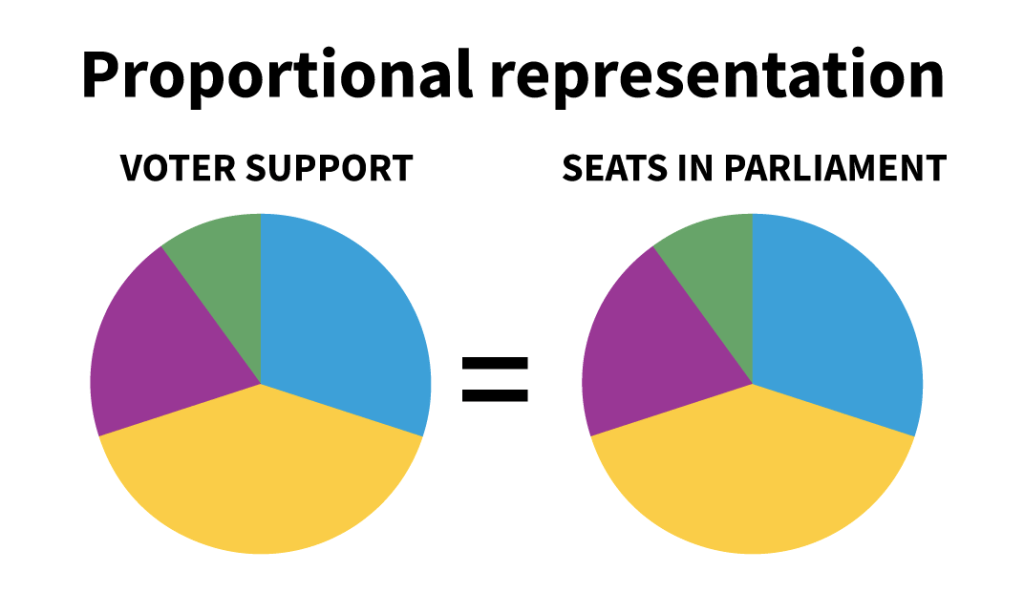
Proportional Representation is a different beast altogether, and one based upon percentages. The key thing behind it is that if a certain party gets 42% of the popular vote, they should get exactly 42% of the seats in the House of Commons. So, in a very real sense, your vote does count, and it does so each and every time.
How it goes about this is another thing altogether, and I could focus on just this one system and punch out 4000 words no problem, but that’s not my mandate here. Nor is advocating for this system or any other.
In many cases of its application, you vote for the party and the results of that voting is cross-referenced against a list of candidates provided by each political party. It’s from this candidate list that seats are awarded. If the Conservatives were to get 40% of the vote, then they should get 40% of the seats, or 135 seats. And the Conservatives themselves will select which candidates on their roster of candidates would fill those 135 seats. Same for the Liberals and all the others. Voting percentages in the popular vote are transferred into equivalent seat percentages in Parliament.
Mixed-Member Proportional has elements of all other previously mentioned systems.
You vote locally for a local candidate, regardless of party. But you also vote again for party preference. This gives you the opportunity to vote both for the local person or candidate, and again for the party. This way you can vote for a local individual, based upon your local considerations and priorities, but can also throw your support to a party, even a different party than the local candidate, if you think that party best represents your interests or political viewpoint on a national scale
The main problem with this is that it requires more seats in the House of Commons. That’s because every successful local candidate would get a seat in Parliament, but then a whole whack of other seats need to be available to accommodate the party-preference voting. And it’s those extra seats that would be filled by people taken from the candidate lists put forward by each party.
In short, you get your geographic representation, but you also get a party-preference representation added to it.
In all honesty, all of these systems have flaws, and potential political instability ranks towards the top of these. Proportional representation, for example, can lead to the Italianization or Balkanization of our political process, where no party can seemingly garner enough support to govern without being threatened by overthrow, which is a pretty unstable way to go about the business of government. It can make “coalitions” necessary, which I guess isn’t a totally bad thing, but still, all coalitions will last as long as they’re useful for the political parties involved in them.
And no slight to Italians or people in the Balkans intended.
We know that FPP is not the panacea it might have been intended to be. We have regions that feel left out and become embittered. We have regions of greater population density that tend to dominate the national political scene. And we have these seemingly never-ending discussions about national unity which are, at best, unhelpful.
So we need to do better. We’re always charged with attempting to do better, right? The world changes, even right here inside our own borders. Life never stands still, and what might have worked several decades ago may no longer fit the needs of the present. So any evolution of our voting system to match the needs of the times seems to me to be a responsible and mature effort to make. A responsibility to make.
We know there are other forms of “government” in the world. Ours, no matter how messy, is the preferred one.
As Winston Churchill once remarked, “Democracy is the worst form of government, except for all the others.”
He was absolutely correct.
 NEWSMAGRENFREW