
Corporate expense accounts have been around for as long as corporations have been around, so it’s no big surprise that top executives at Renfrew Victoria Hospital — RVH — had expense accounts. And as far as corporate accounts go, there’s always been the requirement that receipts be gathered and tendered to back up any expense claims. It’s simply just a part of good corporate governance.
Often, senior officers in a corporation or other high-level institutions need to get out of their offices and connect with other people in the interests of, and often at the behest of, the corporation that they represent. There’s absolutely nothing unusual about that practice, and you can’t expect people to pay out-of-pocket for expenses incurred in representing the corporation. But again, just keep those receipts.
Because corporate credit cards and the honour system are a really poor match.

According to the report authored by supervisor Altaf Stationwala, the person sent by the Ministry of Health to “take over” RVH in light of alleged irregularities, senior RVH executives, identified only as former CEO’s, had racked up many hundreds of thousands of dollars in credit card costs while only offering receipts that represented approximately 9% of those charges. And when I say hundreds of thousands, it’s important to point out that the tab was over a million, a very powerful word. Of course, a million is ten hundred thousands, and the expenses under discussion here numbered more than ten. Much more than ten.
What about the idea of a senior RVH executive receiving a $1 million interest-free personal loan from RH, or Renfrew Health, the arms-length extension of RVH that exists so deeply in the shadows that most of us have no idea who was even part of that group? Except we know that the hospital CEO sat at the head of that Renfrew Health table. So, essentially, we have a CEO, pardon me, a former CEO, approving a million dollar personal loan for themselves. One that, if my reading of the document is accurate and correct, was never paid back fully, which was okay because the RVHB — Renfrew Victoria Hospital Board — agreed in advance to “cover” any shortcoming in the payment of that loan. An amount of $95,744 was written off by the hospital board as a result. Further, that same CEO was given an additional $100,000 as a means of what is called “CEO retention,” meaning we’re gonna give you a hundred grand if you decide to stay with us for awhile longer.

That same un-named former CEO (and there are only so many of them, in fact only two) was allegedly double-dipping on pension compensation as well, having access to the traditional Hospital of Ontario Pension Plan — HOOPP — but also accessing funds from a SERP — Supplementary Employee Retirement Pension — a redundancy that amounted to that CEO receiving an undisclosed amount upon retirement in addition to the HOOPP coverage. The sum from the SERP is undisclosed — what a surprise — but what records exist show contributions being made to this SERP over a 25-year period that amounted to a sum of $1,254,625.
If we’re talking a CEO that was in place for 30 years or so, that can only be one person. It may well be that the CEO replacing that person followed along in the very same footprints, perhaps assuming that this was simply the way things have always been done, which is a very amateurish and convenient way to look at it.
From the look of it, and according to Stationwala’s report, that former CEO — the long-serving one — allegedly snagged an estimated $1.6 million in remuneration in addition to their regular salary as CEO, an interest-free personal loan of $1 million, and another $1.3 million in SERP benefits. But the former CEO wasn’t alone.
It appears other RVH executives were also lining up at the trough, receiving additional compensation from RH on top of their RVH salaries. It seems that over an eleven-year period, certain RVH executives were helping themselves to over $3 million in additional compensation, ostensibly for duties they were already being paid for as part of their regular RVH salaries.

And no auditor said peep about any of this. But as the report states, RVH had been using the same auditor for 35 years, which is nowhere near a responsible corporate practice. The auditor in question, like the former CEOs, was not named. But also like the former CEO, easily figured out in such a small town.
Given that RVH and and St. Francis Memorial Hospital — SFMH — in Barry’s Bay were administered jointly with RVH by the same CEO, executive perks specific to SFMH were also on the table to be tapped into, resulting in a duplication of benefits, including two separate car allowances. Yes those cars were gassed-up as needed, but they were also washed and detailed regularly, all of this charged to the hospital, yet no questions were asked. It seems that reporting processes were either ignored, shoved aside, or incredibly weak in composition. So apparently, nobody at RVH knew about anything connected to SFMH. Financial disclosure appears to have been far from the order of the day.
I could go on and on, so rather than re-invent the wheel here, I’m attaching the report as a document at the end of the article. So if you’re detail-driven, everything you might need to know is located there, unless you happen to be looking for any names attached to any of this alleged wrong-doing. But it’s a small town, and those names won’t be difficult.
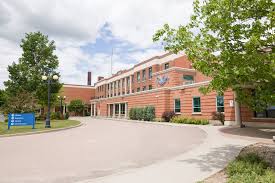
Nowhere in the report was there any mention of a hospital diverting funds to an arms-length entity so as not to show an operating surplus that would have been clawed back by the province if it was properly disclosed. Seems to me that this would have been a big part of the report, so not seeing it raises some questions as well. Was this not the case? Did RVH show surpluses on their books to the Ministry of Health? And if money was diverted, why was it not instead put towards areas of need at the hospital, like security in the emergency room, or reducing wait times for patient CT scans? Why, instead, was that money directed to what appears to be enhanced executive compensation?
In addition to the report’s disinclination to name names, it also doesn’t give up the identities of anyone serving on the Renfrew Health Board, other than to say that they were former RVH executives. This is probably a mitigation move to prevent lawsuits from people launching offensive actions in the name of defence. But it’s unfair to the people currently serving on the RVHB, the same people who were there at the time of these alleged improprieties. Because those people are still in place, they can be discovered on the RVH website, whereas the former CEOs and RH members have been scrubbed clean.
Stationwala takes great pains to point out that nobody currently serving in an executive role at RVH had anything to do with the allegations in this report. He also goes to great lengths to defend the members of the RVHB who were serving at the time of these alleged transgressions. Being interviewed as part of his investigation, board members (directors) expressed shock at what had been unearthed, were dismayed to learn of it, and some even offered to resign, but Stationwala felt that wasn’t necessary. So the upshot of that is that we have a new executive team running the show at RVH, yet we still have the same Board of Directors.
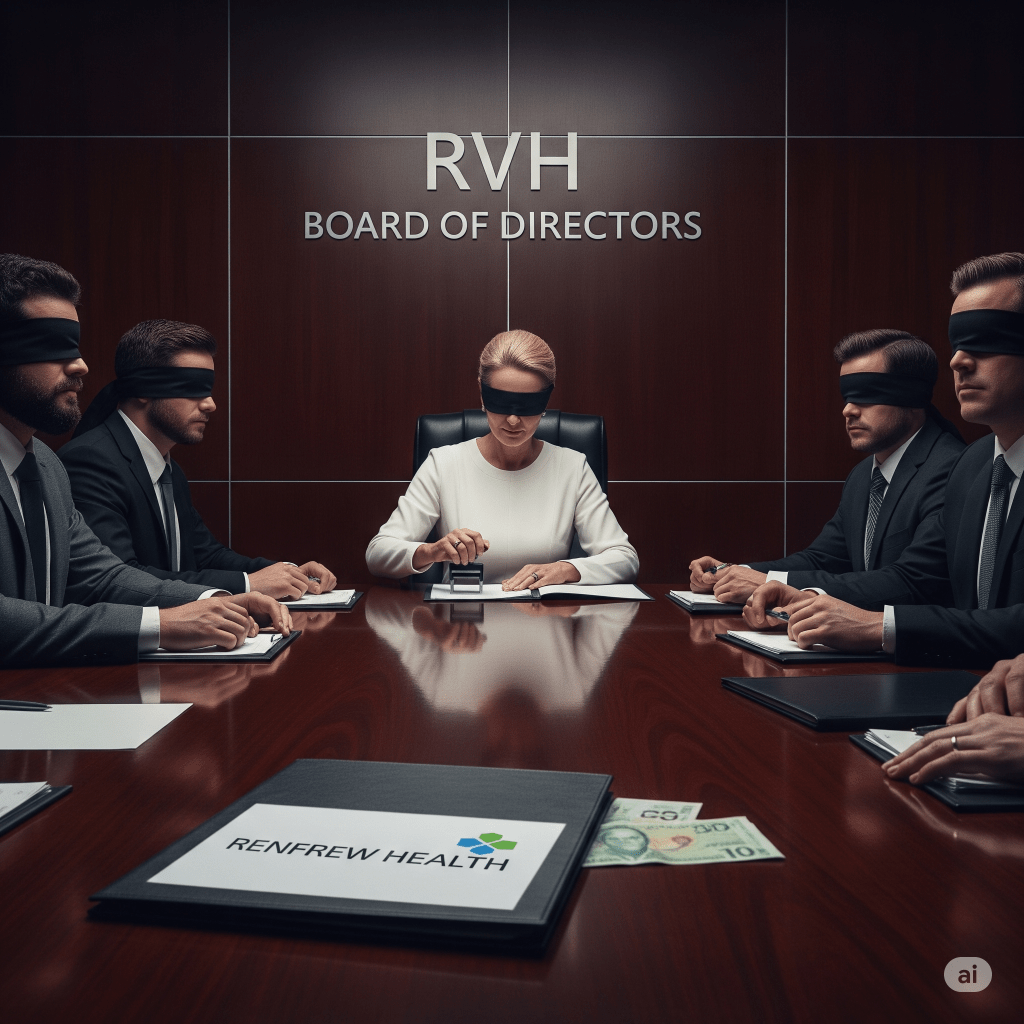
That RVHB had a duty, a fiduciary duty, to provide oversight and accountability, something they failed to provide, and significantly so. Shock and dismay are one thing, but not acceptable on their own. That board has a major responsibility, and yet somehow all of this stuff got by them. It doesn’t matter if you miss the ball because of being tricked, or through negligence, or inattentiveness, or wilful blindness, or just something as innocent as naivety. None of that matters. What matters is that this was going on, it was going on for years, and it was going on during your watch. As such, those resignations should have been accepted.
In fact, they should have been requested.
I’m not here to suggest that a scorched-earth policy is the correct one. But some remedies are simple ones, and just as the former executives have been replaced with newer ones, so too should the Board responsible for that time frame be replaced by a new one, if for no other reason than to remove all doubt, make a clean break with the past, and to move forward with an absolute and unassailable clean slate.

With Ma-Te-Way, it’s the local taxpayer who will be taking the hit. With the RVH thing, it’ll be provincial taxpayers who were abused. But in Renfrew, the local taxpayer and the provincial taxpayer are the same person.
And my goodness are they ever desperate for responsible and sound representation on their councils and boards. All that’s been missing is news of some impropriety on the part of a school board, or a police board, or a hydro board. I’m certainly not suggesting that any such impropriety exists, but sometimes it’s the same people, professional board-sitters, who manage to infiltrate a number of these entities, and that’s not cool, nor is it healthy.
Another version of my so-called small-town elites and the harm they potentially represent to any community, inadvertently or not.
 NEWSMAGRENFREW