
Are there attendance requirements for members of municipally-mandated committees?
I understand that people are busy, and I further understand that there ought to be some degree of flexibility when it comes to balancing a person’s personal and occupational life with the requirements of being involved in a committee.
That said, what’s the point of a committee, made up of a number of “civilians,” when half the civilians aren’t present at the meeting?
The last Economic Development Advisory Committee was held a week ago, and had it not been for the presence of town staff and a pair of councillors, the room would have been essentially empty, with only three non-council and non-staff members present. It may be enough for a quorum, but it’s not enough to satisfy the requirements of a mature and responsible advisory committee. And by the way, a quorum is a minimum requirement, and doesn’t in any way convey a sense of responsible government. It simply sets a minimum standard, but is in no way to be confused with effectiveness of purpose. We’re better when we have the whole team on the bench, and weaker when we don’t.
So yes, if the people who are supposed to show up don’t make it, then we have a hollowed-out husk of an advisory committee. And I’m sure they were all legitimately busy, but my point is that it really doesn’t matter.
It’s the Economic Development Advisory Committee, not the Be There When It Suits Me Committee.
Newly installed CAO — Chief Administrative Officer — Gloria Raybone was there, and she was true to her personal script, taking the time to educate everyone in the room of the responsibilities of the committee and its members, almost as if this was the very first time hearing it. Which puts the missing members members at a disadvantage, I suppose, missing out on this critical review lesson and therefore having to navigate their committee responsibilities without the benefit of Raybone’s wisdom. In other words, not everyone on that committee has the full and entire breadth of understanding of their responsibilities. I suppose it will be left up to the missing members to go back over the YouTube capture of the meeting to get fully up to speed on Ms. Raybone’s guidance from above.
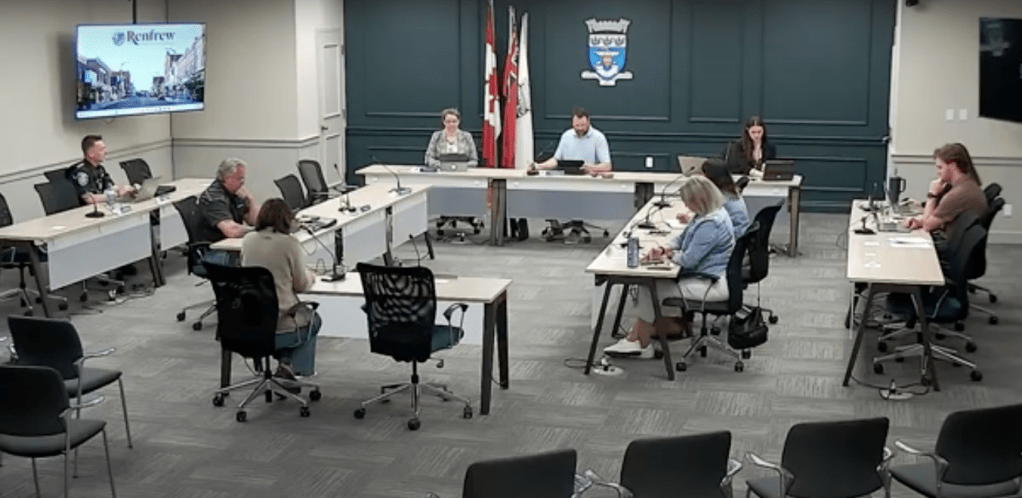
Director Clerk Errett wasn’t there, a deputy clerk standing in for her. Maybe Clerk Errett isn’t a regular at these meetings anyway, but I find that surprising given the fact that she’s the glue that keeps the whole place together and prevents it from flying off into the universe. But now that Ms. Raybone is in town, her guidance will keep the locomotive on the tracks I’m sure.
How does one qualify to be a member of this committee? Or any committee? What does one need to do, or be, in order to be considered in the first place?
Do you need to be a business person? If so, is it because business people, by default, feel that they’re better-suited to grapple with the concepts inherent in economic development?
Do you have to be a member of Renfrew’s small-town elite, the folks who golf together, play bridge together, cottage together, and run the town together?
How are the members arrived at? Are they approached, and if so, by whom? Do they apply, and if so, who makes the decision around membership?
No matter, when several members of a committee miss a meeting, then the committee is lessened and reduced in effectiveness. And it doesn’t matter the reasons for the absences.
This is by no means unique to the EDAC. Committee meetings, board meetings, council meetings, are all subject to the vagaries of attendance. So much so that it almost appears as if empty spots at the table are the norm. Not the new normal, but an extension of a time-honoured and finally-honed existing normal.
So if we have a committee of six members, and two don’t show up, that’s fully 33% of your combat power that’s gone missing. To ensure that we have six seats occupied, do we then raise the membership to ten so as to better our chances of yielding six? And what about the lost input of the missing members? Were they not appointed because they possessed that savvy combination of acumen, experience, and sage wisdom? Yet we’re willing to proceed without those contributions? And if that’s the case, and it is, are we not saying by our actions that those contributions don’t matter? Because if that’s the case, then we’re effectively saying that none of the members, and/or their contributions, are needed to carry on. If we can move forward without these people, we can move forward without any people, which would probably be the default perspective of administrative staff who would know longer have to operate with the inconvenience of pesky civilians underfoot. That is, assuming that the civilians are of the pesky sort.
I took note that one of the absences was a fellow who more than successfully negotiated what a lot of people think is a one-sided deal for his radio station at the expense of the town and its ratepayers. In short, he actively hammered out a deal that many feel went against the best interests of the town, yet here he is “advising” that very same town on economic development matters. Is this is a full-blown conflict, a soft-boiled conflict, or just another manifestation of “the way things are done?”

I don’t have attendance figures for this committee, or any other, but if a body is to be taken seriously and considers itself to be part of a mature organization, then attendance on the part of its members is important. And further, if attendance becomes an issue for a committee member, it may well be appropriate for some form of consequence to be levied, most likely an invitation to no longer be part of the committee.
Being a part of a municipality’s business and direction-setting isn’t a hobby, nor is it an excuse to sit in Council Chambers and swivel around in the cool chairs and hear yourself speak into a microphone. Maybe do your preening in a mirror, preferably in private.
Does CAO Raybone have anything to say about committee attendance? Was there any kind of policy in place when she toiled for the GTA, aka the Greater Tweed Area?
Are there any spots in the “official” local tapestry where the “old boy and girls” network, and membership therein, is the deciding factor as to how much influence a person is allowed to exert?
In short, it’s disappointing and frustrating watching these things happen. It’s like watching a bunch of kids play grown-up, only to have them — the kids — getting it into their head that what they’re playing at is the real deal, and that they are too.
If the Town of Renfrew wants to be taken seriously, they should perhaps look into the idea that they should conduct themselves seriously, and maybe not pander to the whims of folks who revel in their own personal sense of indispensability.
And in order to be to be serious, you need to be present.
 NEWSMAGRENFREW