
He was at the very top, a boy, maybe six, perhaps seven years old. His mom, or the person responsible for his safety, was at the bottom, looking up. He seemed unsure of himself.
The boy was at the very top of a play structure, a modern one, by all appearances state of the art. His hesitancy involved coming down a ladder-type feature, with rungs, where a climber could move down or up, depending on which way a child might want to go.
Sometimes the climb up is easier than the climb down because, well, you start low and work yourself high. And you’re not necessarily realizing fully how far up off the ground you might be climbing, what with your eyes being directed upwards, towards the top. But when you’re at the top looking down, you become more fully aware of the drop, and of the reality of elevation, and the further reality of gravity, and what it might do to you if you make some sort of mis-step on the way down, or even before you begin the journey down.
It’s a play structure, though, for heaven’s sake, and so safety was obviously top-of-mind for the people who designed it and manufactured it, not to mention the people who researched it and procured it, in this case on the part of the municipality. And so, as a play structure in a public park, one swarming with kids at times, the assumption is that there is no danger here.
I would estimate the platform upon which the boy was standing to be anywhere from twelve to fifteen feet off the ground. In fairness, the ladder was designed so as to allow a child to descend through the interior of the ladder, meaning that the ladder was enclosed to a degree, as in the child could reach out in any direction to secure a hand-hold or footing, making it what I suppose some would feel to be “fail-safe.” As well, a child also has the option of climbing up or climbing down the ladder on the exterior portion, a more traditional type of climbing experience.
The boy had taken an easier, more subtle way to the platform, up there with his friend of about the same age. Which is to say that the elevated platform was roomy enough for perhaps a half-dozen children, not because of design necessarily, but having more to do with the nature of children, who will crowd a space with very little thought in the heat of the action. The platform also serves as a entry spot for a couple of slides that run from the platform down to the bed at the bottom of the structure, a bed made of a combination of mulch and sand so as to soften any potential slips or falls, as well as being a softer landing spot for those coming off their slide runs.

The boy was neither on or off the ladder, but rather both. His feet were on the top rung, while he held a railing for balance and support. The rung that his foot was on, and indeed all the rungs of the apparatus, were a very narrow metal, so standing on one of gave absolutely no balance or purchase without the simultaneous hand rails also being used.
He wanted to go down the ladder but he was afraid, because he was up and looking down, and maybe fifteen feet isn’t much of a fall, unless you ask the fellow who just fell fifteen feet. And having a mother at the bottom, supervising the whole thing, doesn’t change the laws of physics should the kid panic or have the kind of misadventure that may lead to a fall. Standing at the bottom looking up may be a form of supervision, but when you’re falling from that height, it really doesn’t matter if you were supervised on the way down or when you reached the bottom of your fall. A broken leg doesn’t hurt any less if the breaking of it was done in a “supervised” environment.
As to the mom that was standing at the bottom and looking up? At least she wasn’t thirty yards away on her phone sitting on a picnic table. That other mom probably thought she was doing a boffo job at supervision as well. Which reinforces the fact that supervision doesn’t mean you’re simply present, it means that you’re actively present and engaged, with a large topping of common sense to make it all far more safe than otherwise. Talking on a phone at a distance is essentially the same as not being there at all. Might as well have a smoke while you’re at it.
Falling hazards are just one of many that await children on the playground structures that we see in our public spaces every day. Yet we continue to make use of them, more often than not supervised, but although supervised, not infused with common sense. Because I don’t care who you are, if you’ve put yourself in a position where there’s an elevation difference of fifteen feet between where you’re standing and the child you’re there to protect, you’ve placed yourself in a relatively risky position.
Thousands of times, every single day, play structures are utilized by children without any serious mishaps. Which is absolutely fabulous, unless you’re the one with the broken limb, broken nose, or concussion. You don’t care much for statistical safety when you’re the outlier, as in the one in a thousand, one in a hundred, or even one in a dozen who manages to get hurt on one of these things.
I understand that to be viable, play structures have to be durable, since they receive an awful lot of attention form hundreds of kids over their lifetimes, and need to be able to stand up to all the challenges that weather and the environment can throw at them. To accomplish this durability, these things need to be made out of sturdy materials that aren’t going to break, or snap, or otherwise fail. What was once wood has now transitioned to metals and hard plastics, materials equally as hard as a wood surface, but less likely to be a threat for slivers or other wood-specific inconveniences. But these materials are also susceptible to overheating in the hot summer sun, and so children, and their responsible adults, need to be acutely aware of the potential for burns on these surfaces, particularly on any slide features. Plus, these materials are every bit as hard as wood.

The joints and fasteners are worthy of suspicion. Not on the town play structure at Ma-Te-Way, because upon inspection, all joints, connectors, and fasteners were of the sturdier type and were obviously well-inspected and maintained. But that’s not to be assumed with every play structure, with the biggest culprits being “S” hooks that have either degraded, have come apart, or have experienced enough wear and tear that they’ve created gaps that could compromise the structural integrity of the apparatus, most often on swing sets.
There is no area where adults park their understanding of physics more completely than in the area of bounce structures, or “bouncy castles.” Take this enclosed area, with an uneven floor, and inflate it with air so as to make that floor, or that surface, bouncy. Put eight kids in there, jumping up and down to their heart’s content. Maybe some five year olds, perhaps some seven year olds, maybe a four year old. Hell, while we’re at it, maybe toss in a ten year old, or maybe even a twelve year old. Different kids, of different ages, sizes, shapes, personality and aggressiveness, all jumping up and down in that same, inflatable, closed space.

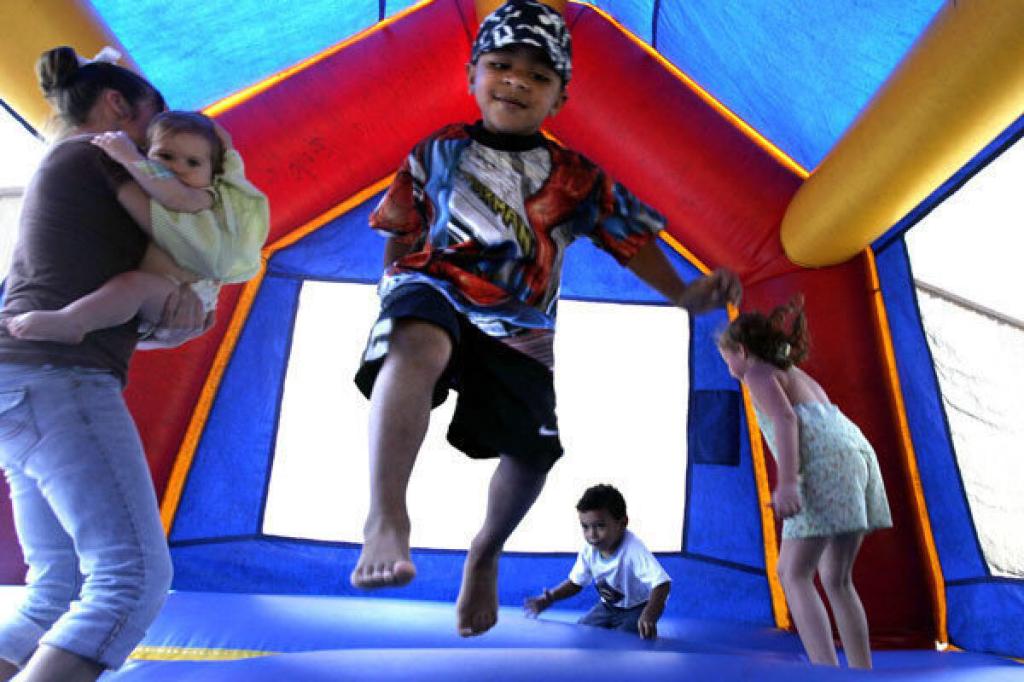
Bodies in motion. Bodies with all kinds of hard points, like skulls, elbows, teeth, shoulders, knees, all of that flying through the air, up and down, as randomly as the kids are different. Some bounce cautiously, others more recklessly. Some bounce simply up and down along the same vertical plane, while others land on the floor at an angle, thereby launching themselves through the air at an angle. And once in the air, they’re beyond the control of anyone or anything until they come back down to the floor of the equipment, or until something else stops them, like another child, perhaps also airborne at the time of impact. And so you have mid-air collisions, resulting in cuts, contusions, broken noses, and concussions.
Head injuries just waiting to happen. And you can supervise it all you want, but what control do you have when you’re not in there yourself, when you’re sitting in a lawn chair watching, thinking you’re supervising, when all you’re really doing is supervising the timeline until one of those kids gets hurt. But it’s all good, because you know your school wouldn’t have one of these things at its Fun Fair if it were dangerous. So you put your child’s safety in the hands of the person who ordered the bouncy castle in the first place, maybe even the school principal. A person who, just like you, parked their common sense at the door and just made the assumption that everything’s safe because they wouldn’t be allowed to rent it out of it wasn’t. The kind of assumption that comes close to negligence in my book. The kind of assumption that can lead to the serious injury of a child.
We can have kids play slow pitch, and require a hitter to wear a batting helmet to protect against a ball coming at them at a snail’s pace. Yet we contrast this over-the-top safety with our absolute refusal to see the dangers inherent in playground equipment, and especially bouncy playground equipment.
Speaking of slow pitch and the batting helmets, we also take dedicated girls’ teams, and boys’ teams, and fold them into mixed teams for the sake of convenience. So now you have a mixture of girls and boys, of different sizes and strengths, with different experience levels, all out there at the same time.
And that ball, the one that travels so slowly to the batter? That same ball will come off a bat like a rocket, and whoever came up with the word “soft” to describe that ball never had one of them smack them in the face after coming off the bat of a stronger, experienced hitter. So if little Suzy, a real gamer if there ever was one, yet hopelessly inexperienced, happens to be playing third base, she may have to eat one for the sake of adult convenience, or teacher convenience, or worse, stupidity.
Some teacher/coaches understand that Suzy should not be playing the hot corner over at third, not because it’s dangerous, but because her inexperience means that she’s going to be a weak spot in the infield. Hell, she probably doesn’t have anywhere near the arm necessary to even make the throw to first. Maybe the team’s from a small school, and everyone made the team, so Suzy makes the roster, despite not having the skills or experience required for the sport. So, in a moment of brilliance, the coach decides to hide Suzy in right field, the field that statistically gets the least amount of action, since most hitters are right-hand hitters who usually pull the ball to the left side of the diamond. So put her out in right where she can’t hurt the team too much. That is until some batter launches a fly ball to right field, and of course, Suzy’s out there without a clue. So the brilliance of the plan falls apart with this fly ball, which smacks her right in the face, bashing her glasses into her face, cutting her, and requiring a trip to the hospital. Oh, and the batter comes around to score, as do all baserunners, so in retrospect, it wasn’t a great baseball decision after all, either defensively or with any degree of safety in mind.
I’ve played and coached baseball my entire life, and all of what I just described I’ve seen. And yes, I’ve taken kids to the hospital, three times in fact, all as a result of a bunch of adults who thought it was a good idea to have mixed-slow pitch teams at the intermediate level, instead of gender-dedicated ones. In all three cases, an inexperienced girl was injured when struck by a ball coming off the bat of an experienced male player.
The problem with adults and common sense stems from the fact that they’re adults, which often means they’re the ones in charge, yet if they don’t have a clue, don’t care, have no experience, or allow themselves to become distracted, kids can be hurt. Or even killed.
Falling from 12 or 15 feet can break a neck. Being thrown from a teeter-totter can break an arm or result in a concussion. A line drive down the third base line can kill a person if it hits them the wrong way.
I understand the concept of “risky play” as a means of acclimating children to different environmental occurrences and activities that may carry with them the element of physical risk. I get how that’s a good idea, but I also get that a lot of good ideas can fall apart really quickly if the adult(s) in charge simply take everything for granted. When I put my kids under the supervision of another adult, I’m not looking for an adult who simply accepts the “assumed” safety of the activity or equipment. I’m looking for somebody who constantly and critically assesses the environment and everything in it to ascertain its appropriateness and safety. I’m looking for an adult who has the courage to see potential danger and make the reasonable decision.
There is a place at Ma-Te-Way, over by the Water Park, where a structure looms that has all the appearance of an anti-tank trap you might see strung along a nation’s border to impede invasion. All it’s missing is the razor wire.
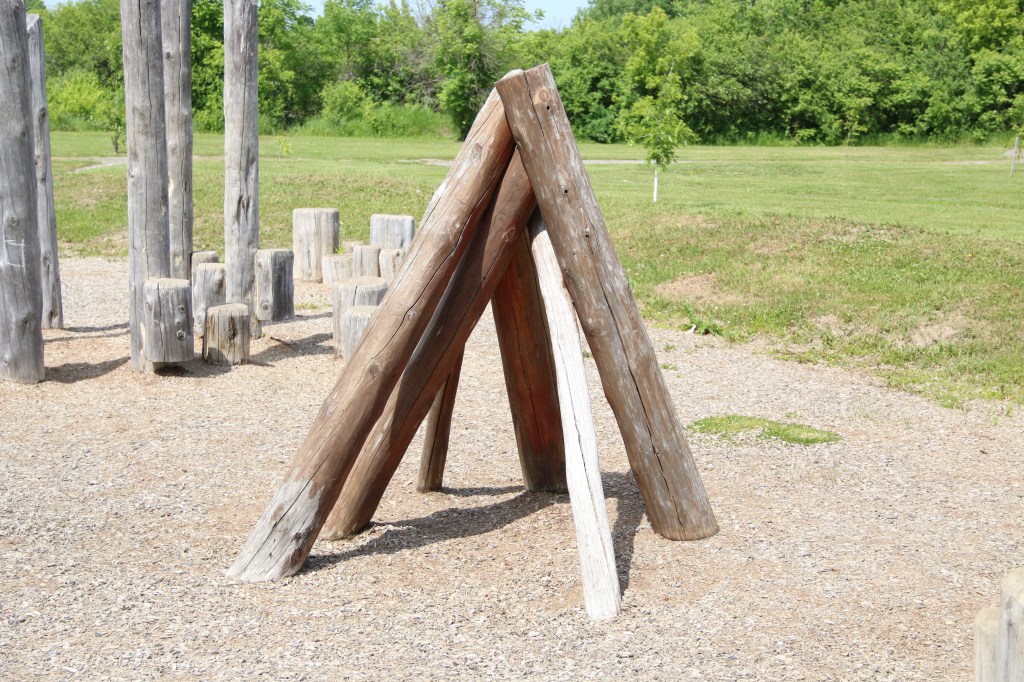

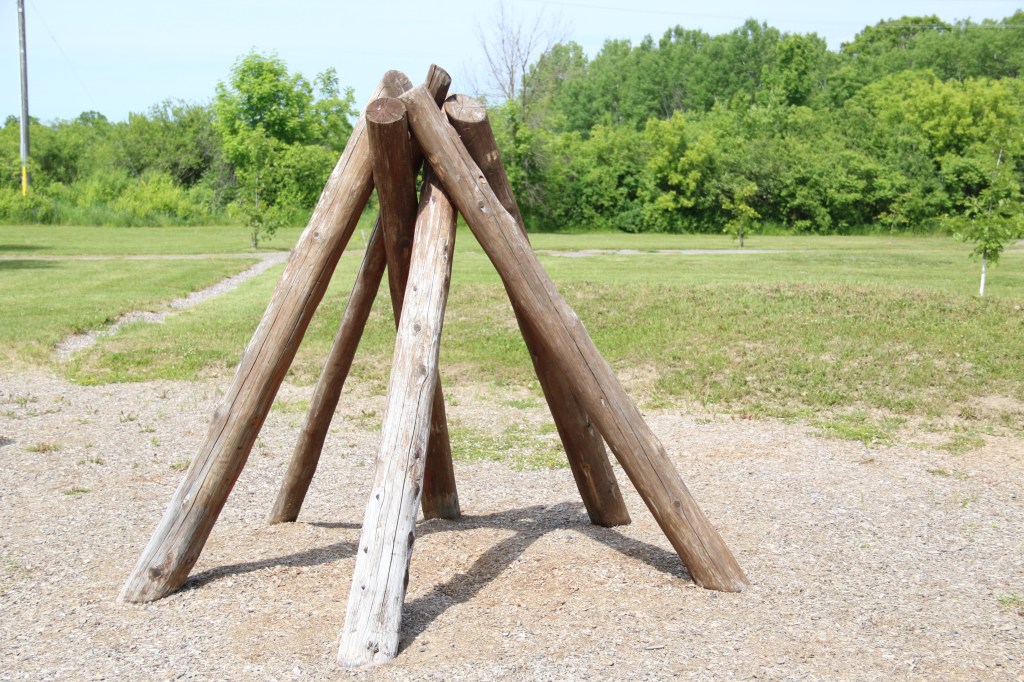


I’m sure this collection of anti-armour, anti-personnel structures was the product of some cutting-edge thinking, and program directors can point to it as proof that they’re at the very top of their game. Hell, there was probably a committee behind the decision to stick it there, likely a committee of consensus. And so they installed a structure that is seen nowhere else in the natural world outside of an apocalyptic war zone. So at the very least, our children will have some introductory exposure to what it’s like to play in an apocalyptic war zone.
When are we going to start looking at his stuff more critically, more closely, even more practically? When are we going to stop simply trusting the manufacturers of this equipment, or the people that may rent it out?
I hate to say this, but experience has taught me that I’m the only one who can truly have the safety of my own children as top-of-mind. It’s not something I’m just going to cavalierly cede to some other person, just because they’re an adult, and certainly not just because they’re a teacher. Because being either one of these things, or even both, is no guarantee that the safety of the children in question has been thoroughly thought out, or that dangers have been identified and avoided.
My children are too important for anything less than that.
 NEWSMAGRENFREW