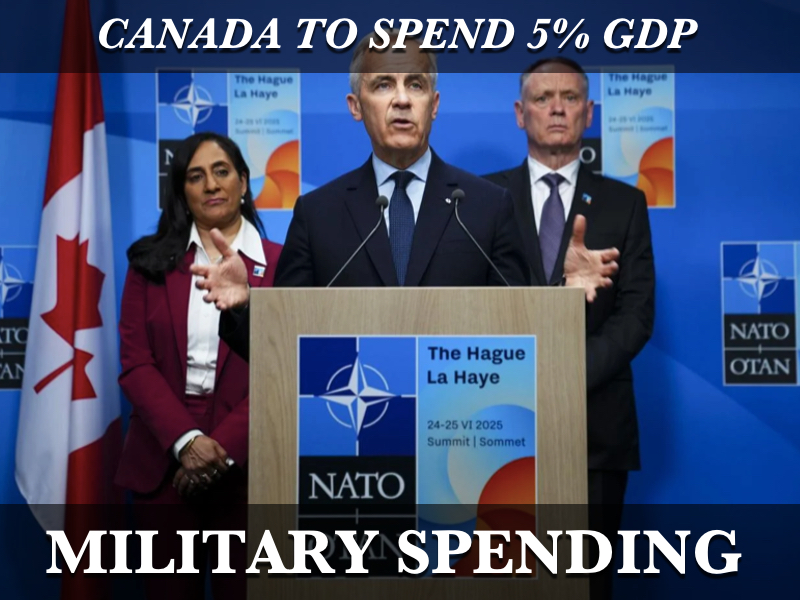
The federal government has indicated that they will begin to spend billions of dollars more on national defence. In fact, billions and billions.
If you think that’s something that should have been done all along, you’d not be incorrect. If you’re someone who wonders about stuff like this, and further wonders where the money is going to come from, you’d not be alone. And if you’re afraid it may come at the expense of social programs or other areas of governmental involvement, and you wonder which ones?
Join the club. Get in line. Here’s your t-shirt.
I suppose there’s another category of person out there, the type that feels government should get out of everybody’s face and simply allow economic Darwinism to be the prevailing thought, then good for you, but sorry, you have no place in any reasonable discussion around the military budget specifically, or the federal budget generally. Go home and count your money, and please try to stay out of the way of the grownups. In other words, stay out of our face.
No matter what, it’s gonna get expensive.
For the longest time, Canada has been criticized for not spending to the 2% GDP — Gross Domestic Product — that NATO members — North Atlantic Treaty Organization — agreed to as part of their alliance responsibilities. The sad part comes from the fact that, after pledging to get Canada to that 2% threshold, the alliance moved forward with a brand new pledge of 5% GDP as a new threshold.
Terrific. We finally announce that we’re going to attend the party, and then they move the party on us.
That new commitment of 5% represents a spend of somewhere around $120 billion to $150 billion every year on the Canadian military, which is a lot of money, and nobody doubts that.
Tying a nation’s alliance spending commitment to a percentage of the nation’s GDP is a bit misleading, because obviously different countries have different GDPs. With a country like Canada, one of the wealthier nations in the world, that percentage represents more real dollars of spending simply because our economy is larger than most other folks. In other words, our 5% GDP represents more actual dollars than another nation with a less robust economy. So we’re not the total laggards that many, including some of our own, make us out to be.
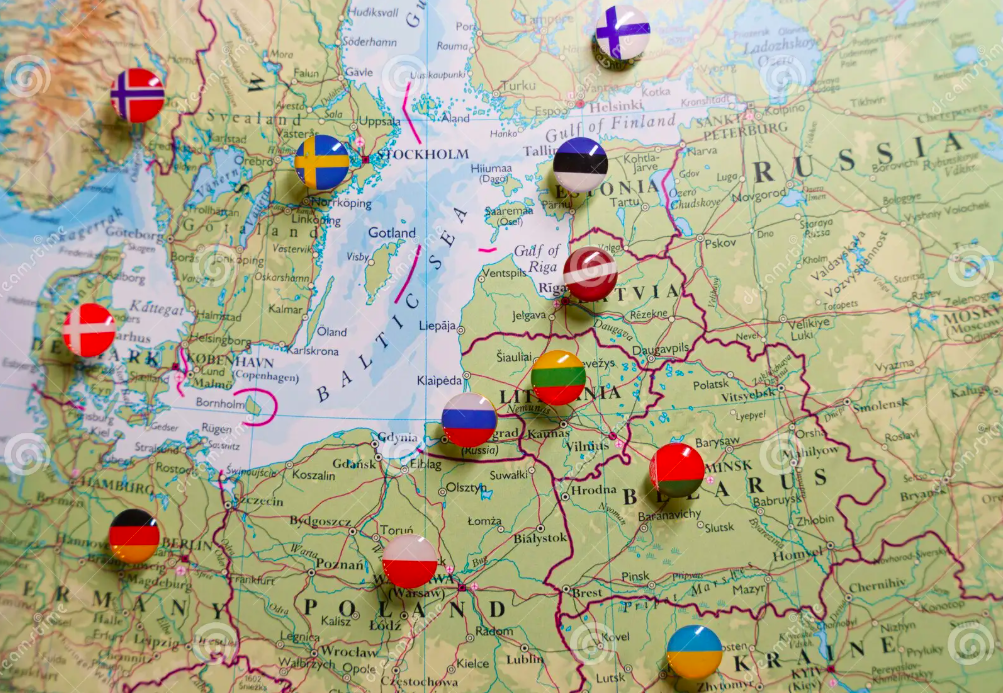
I understand how the attempt was one of proportionality, and that numbers of 2% and 5% are benchmarks and not necessarily absolutes. That said, and the imperfections of the system aside, Canada does fork out cash for its military, it just doesn’t do so in the same manner as, say, Poland, a nation right on the firing line in Eastern Europe. A nation that has felt the boots of foreign occupiers enough that they were prepared to spend 4.1% GDP even before the 5% became the new NATO benchmark. Totally understandable given the dangerous neighbourhood where Poland can be found. Hell, tiny little Estonia spends 3.4% GDP on defence. A look at any map of Europe will help with understanding all of this.
Poland’s population is around 38 million people, roughly the same as Canada’s. It has a GDP of $809.2 billion. A Polish spend of 5% GDP represents $40.46 billion. Canada, by comparison, has a GDP of $2.142 trillion, which washes out to around $107.1 billion, and illustrates the fact that at the same 5% GDP, Canada spends almost three times as much real money, real dollars, as Poland does, yet with virtually the same population. Currently Canada spends about 1.3% of GDP on defence, or around $27.846 billion, meaning that if Canada were to ever hit the old 2% target, that would be $42.84 billion, which is roughly (actually more) than what Poland would spend in real dollars at the 5% threshold.
So we’re not as bad as some people like to make us out to be.
What this money, this Canadian money, should be spent on is a totally different article, a totally different series of articles, each one full of ideas and plans that could be picked apart and debated for years. That’s not within the scope of this article.
The money must, of course come from somewhere. To make an annual spending commitment like this will require cuts to other areas of the government’s service portfolio. To do nothing would be to have the national debt explode, and that’s not a responsible, or viable option. So the cash needs to be squeezed out of somewhere else, or many somewhere elses.
So what we have is a Liberal government that is going to have to manage the economy in a manner more consistent with Conservative Party talking-points, although many conservative economic talking points don’t amount to anything approaching a full hill of beans.
It will be a government that will have to identify and execute a s series of significant cuts, painful cuts, taking money from Peter to give to Paul, that kind of thing. So there’s absolutely no doubt that some government programs are going to be hit, with some being hit hard.
That will make for some difficult decisions. It’s easy to say that you’re going to eliminate government waste, but there are people around who think social programs are examples of government waste. I dedicated the entire third paragraph of this piece to those types. Reducing spending waste should always be a goal, but that’s only going to get you so much, and there’s no way that’s going to be what gets us to our new defence spending targets. No, other things will have to be cut. So programs will be gutted and/or cancelled, services reduced, maybe some money borrowed, and definitely some jobs lost.
It will hurt. For some of us, it will hurt more.
Back in the early 1990’s, our nation’s economic standing was on shaky ground. The freely and recklessly spending Liberals — Conservative Party talking points — were taking over from the financially astute and economically responsible Tories — more Conservative propaganda — who had, despite their built-in and self-proclaimed reputation, somehow managed to wrack up Canada’s debt and deficit to a place well beyond our ability to cope and to remain in good standing with the International Monetary Fund. This its what the Chretien Liberals inherited upon their electoral victory in 1993.
Instead of the reckless spending and socialist waste, the Liberals went the austerity route, and boy did they ever. Chretien, and his finance minister Paul Martin, embarked on a fiscal journey that has not been seen since, two Liberals slashing and cutting and burning, almost a scorched-earth policy where if it wasn’t nailed down it was on the chopping block. Actually, being nailed down was no protection from the cuts as I recall.

Within a few years, Canada’s economic standing had returned to the point where our AAA rating with international bankers was restored and solidified.
Yes, a lot of money was slashed, and I guess one could say, saved. Yes, the cuts were painful, especially if you were reliant upon the programs under the knife. But they brought us to a place of better economic health, which in turn led us to a point where we could make renewed investments in programs, even re-instating ones that were cut, or modifying them and rolling them out under new names.
It may well be that this band of Liberals, the Carney ones, will follow a similar script as their forebears of thirty years ago, the whole take us down to the studs philosophy, the better to build the house back up again.
Cuts are coming. Certain pain will be coming. This time, the money saved will be plowed into something else, in this case the military. It will not be used to pay down debt or to generally get the nation’s economic house back in order.
That will be a key difference, and I don’t honestly know how it will all shake out for us as time moves forward.
But this is much the same as lot of things in life. Yes, we need this thing and we need it badly. We just don’t want to have to pay for it.
Well, thanks to the Russians, and to a lesser and different degree, the Americans, we’re going to be finding out.
 NEWSMAGRENFREW