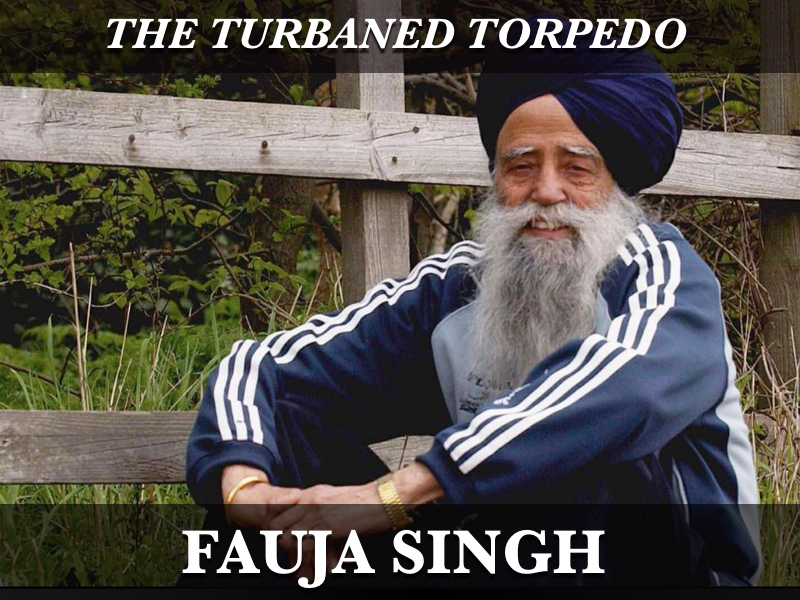
Fauja Singh is generally regarded as the world’s oldest marathon runner.
It’s pretty much a big deal if you’re recognized as being the oldest anything. Hell, it’s good enough to be recognized for simply being old, which is kind of a big achievement in its own right.
But Fauja Singh was noted for marathon running, and at 114 years of age, I’m feeling that his hold on this title will be a relatively secure one, at least for awhile. Mind you, he wasn’t pounding out marathons well into his twelfth decade, although he was still “running” until very recently.
He was credited with being the oldest person to run a marathon in Toronto back in 2011 when he completed the Toronto Marathon at age 100. But Singh has no birth certificate, since he was kinda born before those sort of things made it into the public record-keeping of his native country, India. As there was no record of his birth, there was no way to definitively peg his age, so his achievement is not recognized in some quarters as a result, including the Guinness World Book of Records. Regardless, we know for sure he ran the marathon, and we know for sure that he’s old, in fact mighty old. But because we can’t put a finger on exactly how old, then we’re not going to give him credit for being the oldest anything.
Singh was known as the Turbaned Torpedo, obviously for the fact that, as a Sikh, he wore the turban associated with that ethnicity. And regardless of proof-of-age, there was no denying that he was a runner, so the name stuck, especially in his native homeland of India, specifically the town of Jalandhar, in the Punjab region.
It’s a good story, but a bad story, all at the same time.
In the 1990s, while he himself was well into his eighties, calamity struck Singh’s life. First, his wife died, causing him untold grief. While still mourning her loss, Singh, a farmer, was inspecting fields with his son when a nasty storm blew into the area and caught them exposed in the open. The high winds were whipping stuff around, carrying dangerous debris airborne. It was a significant slice of corrugated metal that totally decapitated Singh’s son right in front of him. If he was grieving before, he was really grieving now.

Singh was, of course, devastated. He was now totally alone in the world, as his wife and son were his only family still left or living in India. His five other children had all emigrated prior to all of this mishap and misfortune, leaving the old man entirely alone and broken.
He eventually made his way to England to live with his youngest son. While there, he joined up with some Sikh athletic associations, associations that contained some Sikh runners, and to be more specific, Sikh marathon runners.
Singh was always athletic, had been since he was very young. He joined his fellow Sikh expats and began settling into running as a place where he would most focus his attention. On and on he plucked away, running, running, and more running. Not away from his past, nor to any place of promise. He just ran because, well, that’s just what he did. Sure, there were benefits in physical, emotional, and spiritual well-being, but he was running to run. It became kind of his world.
In 2012, in the run-up to the Summer Olympics in London, Fauna Singh was selected as an Olympic Torch Bearer, carrying the coveted Olympic Flame along its journey to the Olympic Stadium where it would be used to light the Olympic Cauldron. He was the Turbaned Torpedo Torch Bearer, as distinct a role as you’re ever going to find anywhere.
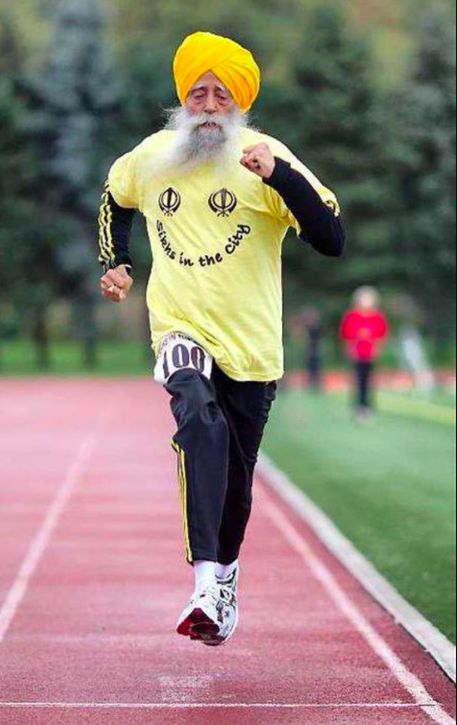
It wasn’t easy, and it’s not for anyone of any age, but Singh ran and ran, racking up the mileage and notoriety along the way.
India’s prime minister Narendra Modi said this of Singh:
“He was extraordinary because of his unique persona and the manner in which he inspired the youth of India on a very important topic of fitness. He was an exceptional athlete with incredible determination.”
Singh’s last competitive race was in Hong Kong back in 2013 at age 101.
His greatest hope upon his retirement from running was that people would remember him. He was very concerned that he would become forgotten once his running career was over. He simply wanted to be remembered.
To not be alone.
Fauja Singh died Monday in his village, back home in his native India, at 114 years old.
He was hit by a car crossing the street in his hometown.
Interestingly, the driver of the vehicle didn’t hang around to take any accountability for the tragedy. It’s ironic that Singh, an accomplished runner late in life, would be cut down by a runner of a different kind.
 NEWSMAGRENFREW