
“Get the hell out of my office.”
When you say something like this to another person, you had better be confident in your own security, in your own authority, and have a pretty healthy and robust understanding of where you fit in the grand scheme of things.
Otherwise, you’re just asking for it.
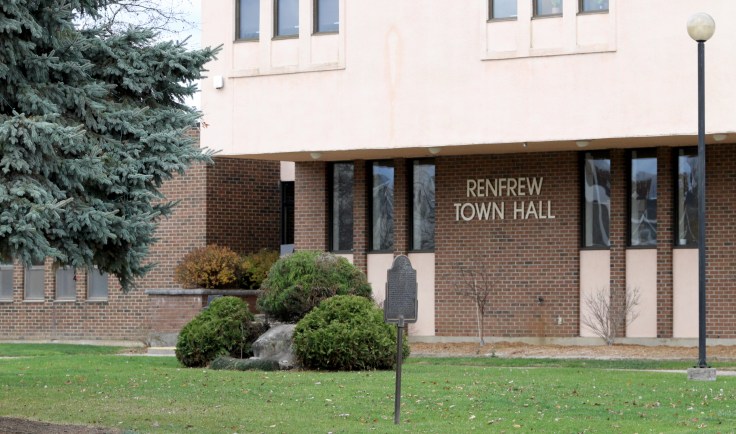
Those words up top, I’m sure, have been used innumerable times by innumerable people all across this great land of ours, but I want to hone in on them because they were said right here in Renfrew, by a Renfrew treasurer, to an elected Renfrew councillor.
The names don’t matter. If it happened once, it’s likely happened many times, with the details different to match the circumstances no doubt. But no matter the context, and no matter the words or the people involved, it represents the same thing in my mind, and that’s absolute insubordination. Others may see that differently, and they’re entitled to that, but my assertions here have merit as well, so they too can enjoy the sunlight of public discussion and discourse. I believe, from my own observations, that the power dynamic currently in place in local municipal affairs right now is that the administrative staff is firmly in charge, and the elected politicians are a mere nuisance to be endured.
This, of course, flies in the face of all interpretations of democracy and the democratic process. But if it’s been happening long enough, and if it’s been accepted by both sides, then institutional memory kicks in and everyone thinks that this is just the way things go.
That this is the way it’s always been done.
That may well be. But that’s not the way it’s supposed to be done. Past practice is no guarantee of good practice or sound practice. And if left entirely to me, had I been aware at the time and possessing the means to do something about it, that blowhard behind the desk would be spending his last day behind that desk. But in a small town, big personalities can intimidate smaller ones, and we’re left with bent and distorted institutional memory.
But it doesn’t have to remain that way.
Dismissal for cause means that a person is dismissed from their responsibilities because they’ve stepped over a line so egregious, that there’s no way their employment can be allowed to continue. Through and by their actions and comments, they’ve brought the ideals of the entity into disrepute, they’ve purposely or negligently done things to undermine the authority and mandate of the entity, or their behaviour and task execution has been been substantially below par.
In my mind, telling an elected councillor to get the hell out your office is walking down this path, just as much as showing intransigence, disrespect, and outright opposition to crucial aspects of the corporation’s mission statement. In the case that I’m making here, that would have to do with efforts, either individually or in concert with others, to subvert democracy, the democratic process, transparency, accountability, and the duty to report.
To purposely, and with intent, conduct your professional duties in a manner willfully inconsistent with the basic tenets of the corporation, in this case the Corporation of the Town of Renfrew.
The names, again, are unimportant, but if you must know, if you absolutely need to find out, then simply reach out to anyone listed on the Renfrew town website, whether they be elected people or hired people. Then just sit back and watch as absolutely nothing happens. If you wish to get a better look at things, make a subsequent enquiry, then sit back and listen to the crickets sing. Want to really dig in? Appear before Council as part of a delegation and be “heard” for your ten minutes, then sit back and watch how you’ll be forgotten by the time the next ten minutes passes.
This is hardly the heady “glasnost” of Mikhail Gorbachev’s day, the openness and transparency they talk about all the time in a major league exercise of lip-flapping without the attendant physical evidence.
They play us for fools, and we willingly play right along, securing their assumption as fact.
Firing somebody for cause is justifiably difficult to do, as I suppose it should be. But difficulty should not be one of the criteria by which we decide to reclaim our spaces, and reclaim our entitlements. World War 2 was a bit of a pain in the ass too, but it needed to be fought because the alternative was untenable.
Civic employees do not have an inherent right to be the people at the top of the pyramid when it comes to authority. Their credentials in public administration do not bestow upon them the golden keys to the town’s property, assets, policy direction, and policy execution. There are inherent checks and balances that are there to prevent this kind usurping of authority, but apparently there’s few out there among us that even know about, let alone do anything with any levers at our disposal to ensure that hired staff don’t individually or collectively launch a coup d’état that sidelines elected democratic authority.
Napoleon Bonaparte, the little corporal who could, makes for a great story in the history books. But it’s not the correct or proper script for a modern-day somebody who may start as a secretary and ends up running the place. In the time of Napoleon, they separated both the king and queen from their heads. In today’s Renfrew, it’s more of an emasculation of the people who are supposed to be the first line of defence against this sort of thing. My use of the word “people” suggests more than one. The word “person” might be more appropriate to our local circumstances.
To fire someone for cause, there needs to be a fairly robust line of documentation to back up the employer’s claims, since the employer is tasked with “proving” the non-compliance, and also must meet a standard of proof that’s perhaps just a tad shy of what’s required in a Canadian criminal courtroom. So it’s not an easy thing to do, nor should it be.
So I’m suggesting we begin the process by issuing compliance warnings, first verbally, then in writing, to be followed by meetings with Council, senior staff and human resources as needed. All separate stages of the process, yet all incrementally adding to a body of evidence that can be used to show non-compliance with important policy directives. It’s a process, and it may take some time, but any employee on the pointy end of the spear is either going to take note and begin with compliance efforts, or they’re going to continue right along running things the way they want to, which opens them up to more aspects of this progressive discipline model. No matter what, at the end of it all, we either get a rehabilitated employee or we acquire additional grounds for dismissal.
Sure, they can bluster and jump up and down and threaten legal action for wrongful dismissal, but why should we be afraid of that? In the end, we’ll win and they’ll end up paying our court costs.
Yell and scream all you want.
And then we can show you what crickets sound like.
 NEWSMAGRENFREW