
Communication gaps, or possibly even a flat-out dearth of information presents itself as a common theme in just about every Council meeting I’ve attended or watched online. And so it apparently goes for the road work being done on two local projects, one on Seventh Street and the other on Stevenson Crescent.
As has happened before, in fact too many times to mention, some unforeseen factor has been uncovered and has led to changes of scope around these projects and the attending increase in costs.
So it is with both Seventh and Stevenson, as projects originally intended to be “shave and pave” undertakings have ballooned in price because of things “discovered” that should have been in plain sight all along.
And Council is getting tired of it, and they’re getting tired with the lack of, or rather the complete absence of information regarding these and other projects. And they’re demanding answers, which made for a bit of a rough night for Andrea Bishop, Director of Shovels and Rakes over at Fort Renfrew. The actual department is listed as Infrastructure, Public Works, and Engineering, with Asset Management thrown in there to make it sound even more interesting.
Ms. Bishop heads up the department where these cost overruns have been taking place. In fairness, the director has only been the director for the past several months, and much of the difficulty inherent in her portfolio predates her and stretches back to days where the good old boys ran Renfrew and mapped it out on the back of a coffee-stained napkin. So all those times excavators dug into existing roadways only to discover unmapped infrastructure and abandoned Volkswagens are times where the flaws and faults of her predecessors come to the surface. It is, after all, pretty easy to blame stuff on a bunch of guys who are long gone.
But what happens today is different, especially if it doesn’t involve the unearthing of things jammed into the ground some sixty years ago by some guy who didn’t feel making any kind of official notation would be needed. Absent those sorts of things, difficulties taking place on her watch are difficulties taking place on her watch, and I suppose the assumption or expectation would be that she would take responsibility for all aspects of her jurisdiction, including communicating with Council.
Council is demanding that many aspects of a construction project, like drawings and test results, be made available to them, and that the flow of information from the director to Council be more robust, more direct, and more timely. We have to remember that not long ago, a municipal director went rogue and it ended up costing the taxpayers tens of millions of dollars. Members of that Council were stung by the criticism that they ought to have done more at the time, pressing more firmly to get that director to be more forthcoming with information. So you can understand how members of this Council, two of whom are holdovers from the last one, would be more insistent on being kept informed.
All this against the backdrop of widespread accusations of staff complicity in making information difficult to access.
For the record, the Chief Administrative Officer Gloria Raybone says that staff directors report to her, and she in turn determines if a report to Council is required.
So what does that mean, then? That it’s she, the CAO, who is mostly responsible for the code of secrecy? Is she deeming information like this to be irrelevant to anything a councillor might be involved with or be interested in? Is it she who makes the determination that councillors don’t have the right to know? Is it she who decides who gets to see what, how much, and when? And if all or any of this is so, upon what authority?
Maybe it’s something different.
Perhaps the directors aren’t being terribly forthcoming with their new CAO. I mean, after all, we’re just getting used to the whole CAO thing, since we didn’t have one back when the gunslinger director was doing his thing. Maybe there’s just not enough institutional memory present for timely sharing of information. Maybe the directors are doing their own bit of gatekeeping as well, deciding who gets to see what they see, and know what they know.
Not for one moment am I suggesting that the folks over at Shovels and Rakes are behaving in any way similar to that other fellow. My position is that they’re being instructed, with all other departments, to keep a tight lid on information, including information to Council. And that kind of direction can only come from higher in the municipal food chain. And there are only three people at that level, one political and two administrative.
As to the road construction on Seventh Street.

As indicated before, Seventh was to be a simple shave and pave, otherwise known as an asphalt rehabilitation. Basically you scrape off the existing and worn asphalt and grade the subsurface after determining that everything is structurally intact and viable with the base. After stomping the base to the preferred grade, the top coat of asphalt is re-applied and Seventh is good to go as at the new Mecca for skateboarders in town.
Except, it seems, that the water main is a dead end.
But no matter, a clever little loop will be utilized that lets us stickhandle completely around that inconvenience. So while a bit of a change, we’re still good to go. Water main loops might add to a project cost, but they’re not deal-breakers.
But here’s the thing.
The construction company awarded the Seventh Street job, McCrea Excavating, are the same crew working the Stevenson Crescent job. And I suppose you can only be so many places at at the same time, so this makes things awkward owing to the scheduling of these projects, not to mention the impact postponed meetings have upon those schedules.
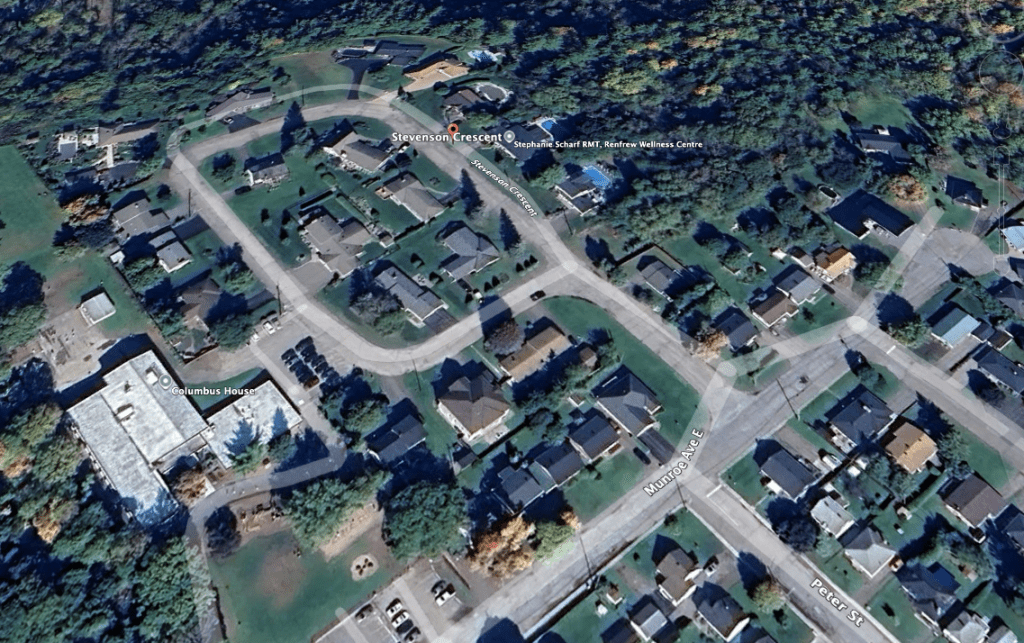
Stevenson Crescent was never meant to be still going on, and what’s happened there is a big factor in what happens at Seventh. The original plan was for Stevenson to be finished this year in time for McCrea to pivot their resources over to Seventh to complete that project before the snow flies.
That’s right. Both were originally scheduled for 2025 completions.
So the councillors wanted to know why they hadn’t been given any kind of informational heads-up prior to receiving all this as information at a regular Council Meeting.
They felt that all information relating to projects such as these, such as design drawings, engineering reports, and the like should be shared with Council. Director Bishop responded that this was not past practice. But there are plenty of things that were obviously past practice that haven’t really withstood the test of time or scrutiny, so maybe the best practice thing, as a justification, doesn’t work so well anymore, especially in Renfrew.
Director Bishop did point out that information such as this is made available on the town’s website once the tender process and all other aspects are approved.
But Councillor Kyle Cybulski didn’t think this was enough. He doesn’t feel it’s appropriate for an elected member of Council to have to daily and actively log onto the town website to check for any new information or documentation on any number of projects that “may” be posted. In his view, councillors shouldn’t have to go hunting for information, it should be pushed to them. In fact, he was insulted and said as much.
The CAO, Gloria Raybone, attempted to mollify the councillor by telling Council that all of this can be simply added to policy and the workflows be adjusted to reflect that change.
Sounds simple. Looking forward to it.
Councillor Andrew Dick referred to a comment Bishop made about “additional questions” that had factored into her report. He wanted to know what these questions were, and who it was who had them, and how is it that these nameless, faceless people have access to information that voting councillors may never know about until it’s too late?
The CAO responded by saying that questions arose from the Cybulski post on Facebook, along with the commentary and questions posed as part of the discussion. Certain names were involved that can’t be disclosed as per rules of procedure, because it could be argued that Cybulski’s post and the attending discussion qualified as an official council event.
Councillor Dick agreed with Councillor Cybulski over the insult of having to dig up something he ought to have access to. And he’s insulted by being told he has to make a FOI — Freedom of Information — request for information, with no guarantee that he’ll actually get what he’s looking for. He says the current level of communication between senior staff and Council is zero.
Reeve Peter Emon advised everyone that it’s something that needs to be fixed, since it permeates every issue before Council and actually takes those issues over. I can see this point as being valid because I’m the guy who set out to write an article about Seventh Street road construction, and look where I ended up?
The reeve suggested the mayor possibly canvass councillors on their information needs and requirements as they see them. Then the mayor and CAO can caucus with themselves and senior staff to see what can be done to bridge the gap between what the councillors want and what the status quo currently is. But the reeve is correct, It’s not an issue that’s simply going to go away.
Councillor McDonald invoked transparency and openness when he suggested that any such exercise be undertaken in the open as an agenda item at a regular Council meeting. What he doesn’t want to do is create yet another crisis in un-responded-to emails.
For the record, the approval to proceed with Seventh Street was passed by Council.
 NEWSMAGRENFREW