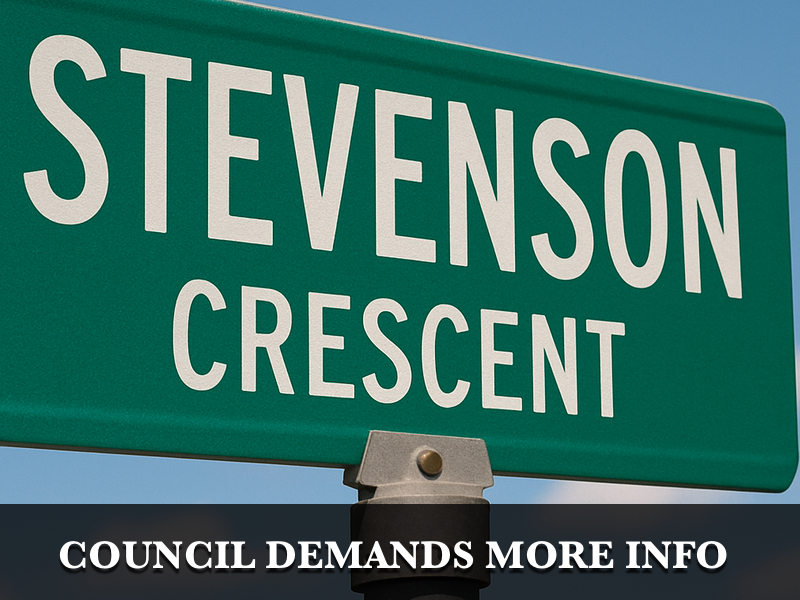
It started out as an Open House at the Information Booth on O’Brien Road.
It was an information session regarding Stevenson Crescent and the road work to be done there. There were charts, diagrams, drawings and all the other public-facing accoutrements on display, with the town itself represented by Andrea Bishop, at the time a manager in the Shovels and Rakes department, and Hannah MacMillan, the communications manager. A third individual, I assume from the engineering company, was also present. Being the only member of the public there at the time, it was kind of awkward, but the three representatives were only too happy to provide details and explanations as part of the Open House.
I’m not an engineer, nor am I an individual particularly concerned with road work here or anywhere else in town, but I think that night represents the top of the mountain for a project that, on paper anyways, looked like a slam dunk.
Stevenson Crescent has since devolved into a back and forth finger-pointing exercise, not because people like to point fingers ( and they kinda do ) but rather as a result of the whole thing fitting into what seems to be a pattern here in Renfrew
A road under construction that suddenly has serious changes in scope because something was “discovered” that probably should have been known about all along, in this case the fact that Renfrew sits atop a great sea of clay, something you get when thousands of years ago your town was at the bottom of the Champlain Sea.
Stevenson Crescent, as a road project, was humming right along, in fact humming so well that it was anticipated to be completed in a single season. This was important because there are significant factors in play, including a school parking lot with bus and drop-off zones smack din the middle of the whole thing. The timing was also important because of the need to not have the Stevenson work negatively impact other projects nearby, either ongoing or completed.
All that said, it doesn’t look good.
It was found, or discovered if you will, that there’s a foundation of clay that sits below the surface of the roadway, and that means that any work done will degrade quickly and have its structural integrity diminished more quickly than had there not been clay underfoot. We can repair it piece-meal, or reconstruct the foundation, both options carrying benefits and risks.
The Stevenson Crescent that exists right now is not what anyone had in mind back in those heady days of the Open House. The little project that could that has turned into the much bigger project that can’t, at least not yet, and can’t without extra dollars flowing from Council.
Some members of Council were incredulous upon hearing this for the first time, mostly because to a man (and they are all men in this case) they felt they ought to have had some inkling of what was happening with the project much sooner, which makes it part of the larger discussion around the apparent reticence of senior management and the mayor to be forthcoming with information.
But for this article, I’m sticking with Stevenson Crescent.
As mentioned, what lay beneath Stevenson Crescent was not what any road engineer would prefer to have beneath Stevenson Crescent. The conditions there were never good for any kind of road with realistic expectations of durability. Yes, you can pave it, no problem. But it wouldn’t be long before you’d start to see the signs of degradation brought about by a compromised foundation.
It’s easy to say Renfrew’s built on clay, but the reality is that clay isn’t the sole foundation upon which we sit. It has its spots, and they’re plenty, but the whole place doesn’t rest on a clay bottom, and sometimes it can probably be a little difficult to sort it all out on a map. Especially when you can’t see through the existing asphalt to see the base.
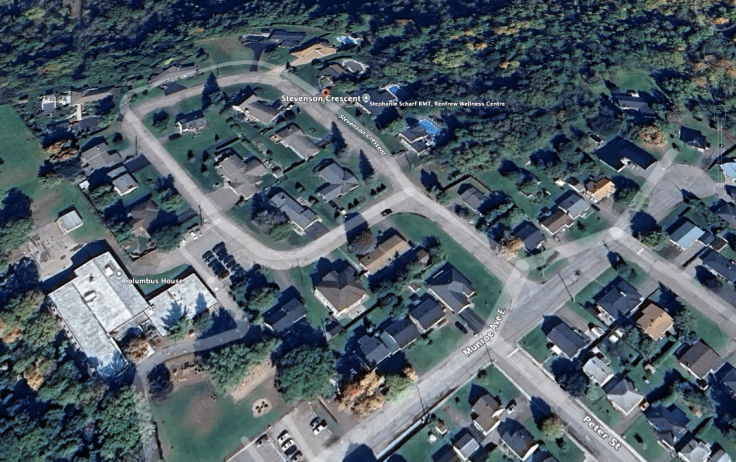
A gathering of engineering and geothermal types involved concluded that a series of bore holes would be sunk to take samples of the foundations along Stevenson. You know, to get a better look.
As a roadway, Stevenson Crescent is not some quaint little cul-de-sac. There’s a bit of road to it as it does its loop around. That’s a lot of coverage area for eight bore holes. It sort of reminds me of that old boardgame Battleship where you guessed grid points then marked them on a board to see where the enemy fleet was. A little hit and miss.
The eight holes were placed in such a manner as to get as comprehensive a sample as possible, meaning that they spread them out, as pretty much anybody would. But with only eight potential sample holes, they had limited intelligence about what was truly underneath, especially if those bore samples came up showing different base compositions.
What further complicated things was that, of the eight samples, only five turned out to be viable, the other three not even considered as part of a random test applied by the geothermal folks, who are sub-contractors of the engineering folks.
And finally, of the five in play, one showed nothing but clay or clay/silt.
Councillors wanted to know why we proceeded knowing the results of the one bore hole and ought to have had questions about the three unreported ones. Further, they wanted to know why additional bore holes were not implemented to get a better look. There was also discussion around geotechnical reports and their methodology and distribution.
Director Bishop appeared to be full-value in terms of endeavouring to make things work moving forward, and indicated a willingness to scrutinize aspects of road construction deals that might normally be left under the sole supervision of the engineering firm, things like geo-testing done by a sub-contractor. She also indicated that additional bore holes may be something worth consideration, and that town staff may need to be more directly present “on site” to get a better sense of all aspects of a project, and further, to be able to report upon them in a timely manner.
Councillor Legris seemed to sum things up when he said the information was always there — the bore hole sample revealing clay — but that it was just never “pushed-up” past the engineer to the staff level where they may have had an opportunity to deal with it. The councillor expressed a desire to find and implement ways to distribute relevant information more widely, to a defined set of people perhaps, and perhaps with conditions attached. But in his mind, this kind of information should bubble to the top a lot more quickly.
And that includes Council.
 NEWSMAGRENFREW