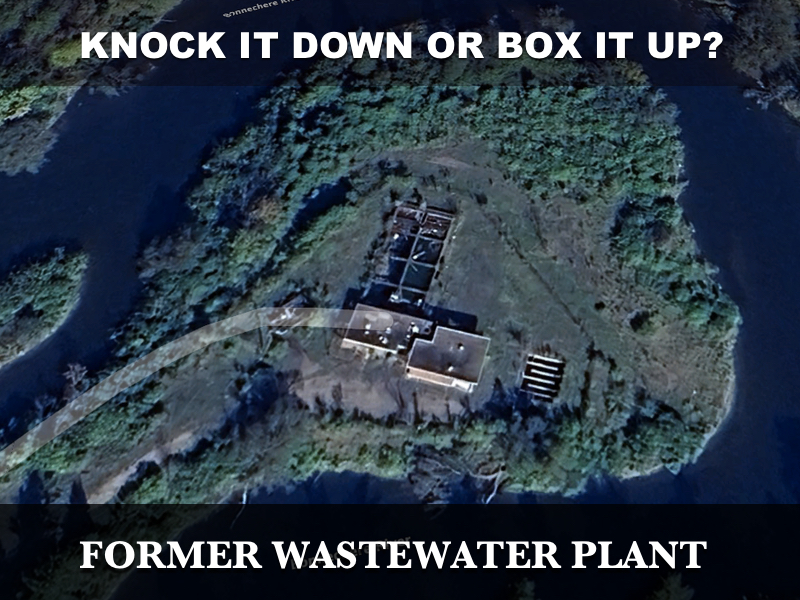
So, what are we to do about that old wastewater plant that’s just sitting there like something out of a really bad Stephen King movie?
Decommissioned some years ago, the facility stands along a bend of the Bonnechere River, and now that it’s been replaced in function by something else, it just sits there, a problem waiting to become a bigger problem. As with all abandoned buildings, you’re going to find broken windows, open windows, degraded material no longer safe for anyone, and three gawdawfully large tanks that were once filled with water, now standing silent, with water without purpose. And as with many other abandoned buildings, there’s almost a siren call that can be heard by anyone who claims membership in Renfrew’s homeless community.
If not handled properly, the property may well be a lawsuit circling over the head of the town, not because it’s ugly or bringing down property values, but rather because it’s unsafe. I know homeless people have a less rigorous appreciation for safety, but their attorneys will have a more rigorous appreciation for the finer points of negligence. Maybe a fellow was so desperate to move in to the joint in the first place, but I guess he wasn’t necessarily planning to topple into an open tank, not having worked out the possible ramifications before taking up residency.
The Town of Renfrew is on it, or at least on it to a degree.
Full-on demolition and trucking the rubble away would be the preferred option in a perfect world, but since we’re still waiting for that perfect world to show up, we’ll have to make do with less-than-perfect options. Full demolition and carting away the memories costs a lot of money, more than we’re willing to spend, which is refreshing to a degree, because this is a case where we don’t want to spend ourselves silly, as opposed to previous cases where we did, and boy did we ever. In fact, we can’t spend the money now because we spent all that other money then, and now when we shake the money tree, nothing but heartbreak, sorrow, and un-mapped infrastructure falls to the ground.
Options run the gamut from pretending the former plant isn’t there to using the magic eraser tool in Photoshop to deftly remove those tanks, hell the whole facility, from any image obtained through Google Earth. Somewhere between those two plans lay a solution, imperfect yes, but something better than the status quo of duct tape and plywood.
There are some established facts here.
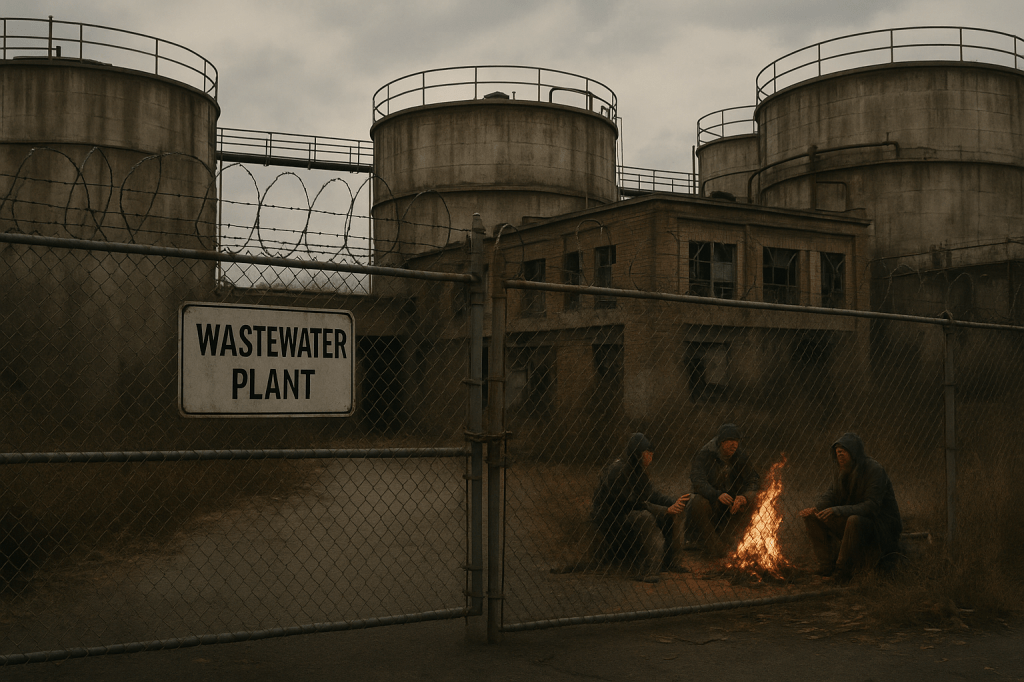
The facility sits behind a seven-foot fence festooned along the top with barbed wire. Where the gates come together, there is a small space evident, but one would have to be some sort of contortionist to get through there, as even racoons want nothing to do with it. So while it’s possible somebody could wiggle through, it would be tragic for an individual to expend the desperate effort to squeeze through only to fall into an open tank. As we all well know, life can offer above-average cruelties when you’re homeless.
Secured behind this fence, those windows, open or otherwise, have all been boarded up with plywood, which may or may not defeat some guy who got through the gate and avoided the tragedy of the tanks. But it’s those tanks that represent the real danger here, as they are large and deep and still have water in them, enough to drown somebody unfortunate enough to have found themselves falling in. So aside from all the property security measures, those tanks need to be solved.
Now it’s entirely possible for the town to save some cash by going it alone and refusing to get hosed by some contractor. If material is needed to fill those suckers up, Renfrew has that material. The town also has workers with large trucks and machinery that they can bring to the fight, and by doing so, Manager Amanda Springer estimates a cost to the town of an estimated $100,500, which is a dollar more than $100,499, because we all know how costs involving municipal work usually roll in to the dollar.
An original proposal had the tanks being filled with concrete and materials present as a result of the demolition of the structure. So if we were to fill the tanks with other materials, it would then mean we have to figure out what to do with the concrete and bricks laying about in a heap, and how to dispose of them.
A full demolition by professionals would cost in the area of $701,600, and I’m assuming that would include removing the demolished materials. A wise man once said that there’s a big difference between $100,500 and $701,600, and Renfrew Council adheres to the advice of wise men. They voted the full demolition idea down by a vote some months ago, so it’s off the table no matter what, unless Carolynn Errett allows some form of procedural gymnastics to bring that option back. That’s something I don’t want to see, mostly because I don’t want to have to sit there and listen to her explain the fine art of municipal procedure.
As to the cheaper plan, it can get more expensive in a hurry. If the town were to do things entirely on their own, getting oversight from consultant engineers, especially involving the filling and compacting of the tanks, might cost as much as $200,000, still well within the wisdom of wise men. It’s also possible to make the site available for Council and regular staff to visit and ensure that security measures are still in place and have not been compromised.
As a bit of a comfort piece, planning guru Eric Withers paid the site a visit, noted the fence and barbed wire, the gap in the gate, and opined that it would take somebody with a superhuman effort to gain access. Withers’ advice is usually accepted as being pretty good by Council, and I have no disagreement with his assessment, mostly because he’s way smarter than me.
Another really cool piece of information was the fact that the town’s Insurance providers say that current containment policies are still within the acceptable risk levels. So we are currently complying with the minimum requirements of insurance.
Boy, when Council heard that, the plan of action became crystallized. Hell, if the insurance guys are okay with the way things are going, then sign us all up for the $100,500 (or $200,000 with professional consultants advising) plan, and throw in a weekly visit by town staff just to make sure.
It’s too bad, especially given the location along the river, that our options are limited and less than perfect, but these are the cards in front of us at the moment.
Not sure I would have done anything different.
 NEWSMAGRENFREW