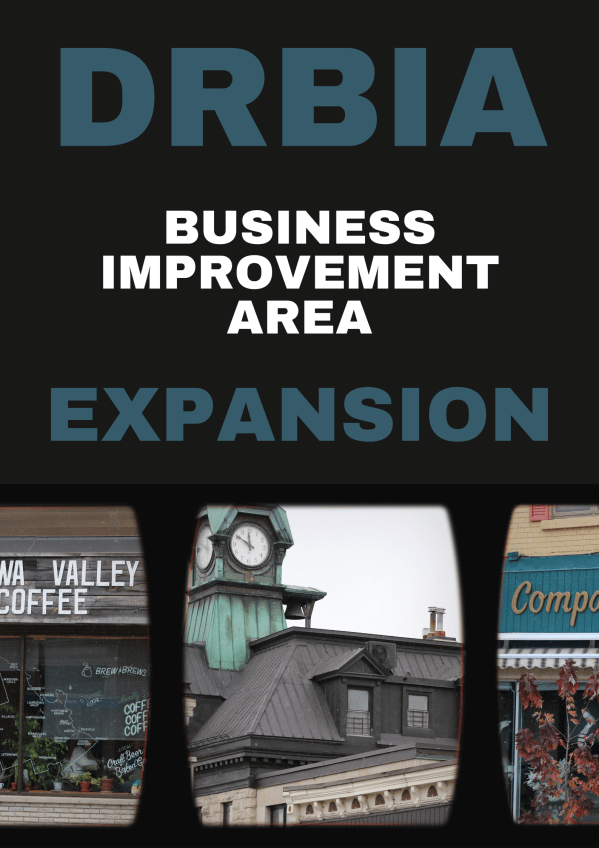
BIA SEEKS TO EXPAND ITS BORDERS

Renfrew’s downtown Business Improvement Area is expanding, pushing its borders outwards into the ancillary streets, or streets secondary to the main drag of Raglan Street.

This is no small thing, especially if you happen to live, and/or do business within this tertiary area that is now to be annexed by this entity that derives its authority through Renfrew Town Council, and through them from the Municipal Act of 2001.

My assertion that the Municipal Act is a deeply flawed piece of legislation is not abated by recent events, and this is just another one of those recent events under discussion. It makes me wonder if the authors of that piece of legislation had drafted it while at their local pub, since it causes as many problems as it sets out to solve, and satisfies the argument that the crafters were either egregiously distracted, had agendas to satisfy, or were just functionally incompetent.

The BIA invasion into the surrounding environs is another one of those seemingly endless staff-driven things that appears before a somewhat perplexed Council for approval, almost after-the-fact, because the timelines tend to be pretty tight.  I wonder what the actual reasoning is?

Is the tax levy that members pay into the organization not enough to fund their projects?  Is it an attempt to broaden their tax base to beef up their financials?

Continue reading “BIA SEEKS TO EXPAND ITS BORDERS”

CANADIAN NEWSPAPERS FILE SUIT AGAINST ChatGPT AND OPENAI

It’s come to light that a group of Canadian newspapers have banded together to launch a lawsuit against ChatGPT and OpenAI, two entities that specialize in using artificial intelligence to generate what could be called “creative’ materials.  By creative materials, I speak mostly about text, or writing applications, and artificially-generated images, although the technology will soon expand to include other artistic endeavours, like video, music, and, well, you name it.

These entities are also referred to as large language models, or LLM’s, and get their capabilities from scouring the internet in the most precise detail and “learning” from what they scan, both in terms of content and style, to the point where they can replicate the work of a real person, and do so in seconds.

The implications, and ramifications of this, are huge.  And to a large degree totally unfair to those people and those organizations who generate creative content the old-fashioned way:  through talent, hard work, and much self-sacrifice.

The reason it’s newspapers leading this particular charge is two-fold.

First, it’s been the news media generally that has been stolen from on an egregious scale, victimized by the big tech companies who would allow that original content to be posted and re-posted on their various social media platforms and other platforms.  Given the rise and popularity in social media, it was only a matter of time before the advertising dollars followed suit, the same dollars that newspapers relied on to provide their product and pay their salaries and bills.  After all, when you advertise in a newspaper, your messaging gets thrown in the trash after a day or a week, depending on the type of publication.  When you advertise online, algorithms ensure that your message will remain alive, and pop-up conveniently everywhere a potential consumer may go, since the algorithm has already determined your surfing and interest patterns.  A much better bang for your advertising buck.

The kicker is that the place that created the original content is forced to lay off staff, downsize its operations, or close completely, thereby sniffing out the source of all that creative work.  So there go of all those writers, reporters, graphic artists, editors, and advertising sales people, all victims to voracious American big tech companies who have literally come in and stolen everything from you to fuel their own breath-taking growth.

Continue reading “CANADIAN NEWSPAPERS FILE SUIT AGAINST ChatGPT AND OPENAI”

Blog at WordPress.com.

Up ↑