There are any number of situations or circumstances where that expression is credible, and one of them seemed to be the generation of electricity, whether that be through hydro (water), nuclear, natural gas-fired, or coal-fired. Regardless of the means of generation, electric power has storage problems that raise the possibility of having a valuable, albeit renewable source of energy being wasted if demand falls short of generation.
Calling electricity a renewable resource makes it sound like it’s clean energy, and there’s no reason why that can’t be true. Hydro-electricity is about as clean as you’re going to get, but it has limitations in terms of its dependence upon sources of moving water, as in rivers, and the enormous costs involved with the construction of generation dams and the lines of transmission that convey the electricity generated to the markets where it will be consumed.
In a lot of things, there’s what we once did, what we do, and what we’re going to do moving forward.
I guess that statement seems to be a reflection of the fact that time doesn’t stand still for any of us as people, and it works that way for municipalities as well.
It’s the old “once we finally get things figured out and solved, something happens to change it” thing. It’s like you finally master your online banking interface, but then they change it to make it “better,” which of course means making it better for anyone not named you.
It’s like that in the garbage business, and by extension, the recycling business.
What was once a Stewardship Model has been replaced by government regulations changing things to a Producer Responsibility Model, which to most of us means next to nothing but to a municipality awash in recyclable materials, as they all are, it means quite a bit in terms of compliance, planning, re-jigging what had already been jigged, and then paying for the whole damned thing. The new regime takes effect on January 1, 2026.
If you thought there was two types of recycling, then you were right. Nothing’s changed in the mixed co-mingled and fibre distinctions, the big choice you have to make once a week when you’re trying to remember which blue box you’re going to lug out to the curb. A blue box full of stuff at the end of the day is usually your answer as to whether you made that choice correctly.
But now there are two other distinctions to recycling, eligible and non-eligible. And so the question arises, what makes eligible eligible?
As simply as I possibly can, things can be broken up into two categories, residential and commercial/institutional/industrial. The first group, residential, is considered eligible, as in edible for continued curbside pick-up, meaning the least amount of change brought by the new government regulations. The second, the businesses and industries that make up the commercial/industrial category, are no longer eligible for this level of service unless the municipality in question decides to take on that additional cost.
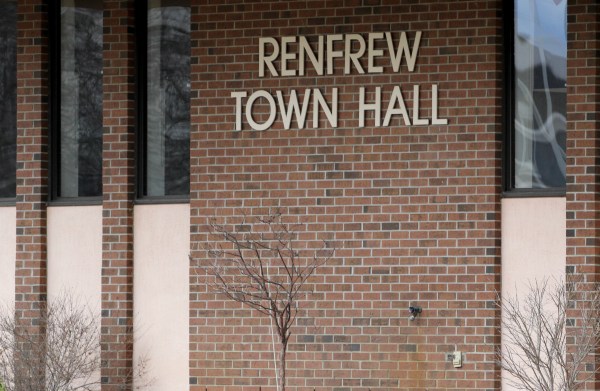
Poor Renfrew. To be saddled with eye-watering debt, cutting or reducing services, increasing property taxes, and now some other gawd-awful thing raises its stupid head to demand more financial resources that you don’t have. It’s a spend-more scenario in an environment of spend-less. It’s enough to make any councillor reach for that forty-pounder of rye they’ve been saving for their child’s Confirmation and putting a tangible dent into the thing. They should just go ahead and pass a bylaw allowing councillors, and only councillors, to drink alcohol during council meetings, just to take the edge off things and steady the hand on the tiller.
Currently, Renfrew makes 319 stops that will now be considered to be non-eligible, including every one of the places operated by the town itself. This is currently done at a rate of $15/stop, but you can be guaranteed that a price like that is on its way out the window. It’s these places that are going to be the problem.
If Council were to determine to continue picking up this stuff from these stops, what would that entail? What would that look like? How would it be funded?
Staff has already undertaken a brief survey of the battlefield, and found that some municipalities are already on the road to compliance, as Renfrew is, but have adopted styles unique to themselves. Some continue to pick it up, and others put the responsibility on business owners themselves to get their recycling to a depot specific to that purpose. In one case, in Mississippi Mills, the municipality was quoted a sobering $65/stop for the service, as compared to Renfrew’s current yet soon to be extinct $15/stop. It’s more than a four-fold difference, but Manager Amanda Springer is of the opinion that whatever cost eventually accrues to Renfrew, it’ll be less than the Mississippi Mills quote. So some small solace there.
The decisions facing Council are those of a short-term nature, and of a long-term nature.
Well, it’s toast, or about as toast as we’re gonna get without having the actual toast in hand.
Ding-dong, the witch is dead.
The witch I speak of is the Carbon Tax, perhaps the most hated thing to waft through the Canadian consciousness since, well, the Carbon Tax. Or maybe the GST, but that’s still with us thirty-five years after it was going to be scrapped, which is what we do here in Canada when we don’t like something, we scrap it.
Scrap gives the impression of something cast away in disgust, almost as if garbage, almost as if we’re absolutely disgusted with it. We can’t just get rid of it, or replace it, or make it better somehow. In Canada, we scrap things.
Pierre Poilievre, more than anyone, can take credit for this, so give credit where credit is due. At least when he sets out to scrap something, as in a tax on carbon, the only thing that suffers damage is the environment. Doug Ford’s anti-carbon levy campaign has cost Ontarians the same environmental price, but also millions of dollars in losses to go along with it.
But it’s not just Conservatives now, it’s Liberals too. The two front-runners for the Liberal leadership. Chrystia Freeland and Mark Carney have both indicated that they will discontinue to Carbon Tax is they’re successful at replacing Justin Trudeau.
In a previous article I referred to the Third Party Report by WSCS Consulting into the Ma-Te-Way situation as a flawed document.
I should be clear that in no way am I questioning the integrity of the authors of the document, nor am I diminishing the level of rigour, depth, and detail that was put into what was, essentially, a very difficult job. I want to make sure that I come across as applauding the work done, and the report proffered.
There can be no such thing as a perfect document because there’s no such thing as a perfect investigator, author, or subject matter, all involving three heavily involving human elements. In the case of this report, it’s the third part, the subject part, that made the compilation of information and the cobbling together of that information more than just your average challenge. It made it virtually impossible to get down to the absolute brass tacks of the issue, although the authors did successfully pull back the curtain on much of what transpired in what has to be the Town of Renfrew’s biggest debacle ever.
One needs to be careful when bandying about allegations regarding others, and that need for care can often lead to an extraordinary level of caution when attempting to report on items that may involve measures of incompetence, negligence, and malfeasance. And sometimes that can lead to a report that hovers around the periphery rather than drilling into the potentially dangerous areas. This report navigates those difficulties about as well as one might hope for.
I had encountered something that was increasingly frustrating about attempting to get some simple questions answered from anyone associated with Renfrew’s municipal government. Frustrating, and almost conspiratorial, although that word might be a bit of an over-reach, since my little local conspiracy doesn’t involve pizza shops, the deep state, or the World Economic Forum. Nevertheless, when you reach out to both political and administrative types within the organization, and you are universally ignored, then it does lend itself to the notion that there is some form of organized obstruction at play. I’ve now backed off that initial suspicion, mostly because I’ve seen all the actors in action, and now believe that any organized effort in that, or seemingly any other direction, would be simply beyond their scope of capabilities.
When I went over the materials for last Tuesday’s council meeting, I happened upon an item listed under correspondence. That item featured an email chain of back-and-forth between a local citizen and senior administrative staff. And it was a carbon copy, albeit featuring different issues, of what I had just witnessed for myself when I had made my own enquiries. Even the staff responses to the citizen were virtually identical, with a boilerplate response modified to fit the circumstances of the issue and the person requesting the information.
In a small way, I felt better, knowing that it wasn’t personal. Bad guys would say that in the movies before killing a guy, that it wasn’t personal, it was just business, which to me always seemed like it would be pretty personal for the guy about to get two behind the ear. Like small comfort there. As in hearing that, the guy’s gonna say “Oh, okay. Completely understand. What a relief. Carry on.”
Still, when you are comprehensively ignored, knowing you’re not the only one brings no significant measure of comfort.
Initially, I had no reason to be suspicious of anything, nor am I suggesting that there would be anything to be suspicious about.
I was simply asking a question, a question I felt entitled to ask, one that would be of some interest to people who pay their property taxes in Renfrew, Ontario.
It’s like standard journalism, the kind that existed before we were left with empty shells purporting to cover “news” at a local level. The kind of stuff that goes beyond the old “cat stuck in tree” slosh. Something that’s maybe more than a short paragraph in length.
But this isn’t about local journalism, that would be a whole other story in its own right. This is about a simple request for information that has been met with opposition, deflection, institutional ambiguity, and just good-old-fashioned bewilderment. It’s like they have no idea how to respond.
APPENDIX: A document attached to a larger document or publication that contains material-in-depth in support of the broader document. Additional information related to the topic. (plural / appendices)
CHANGE ORDER: A change in the terms of a contract that has already started to be implemented. Changes contained in an order may impact the scope of the project, the cost of the project, or both. In short, something came up that was unforeseen after the contract work started that made the terms of the contract untenable for one or both of the parties involved. A change order will reflect the new reality of the project, and the new cost.
MOBILIZATION: The gathering of the people and materials necessary to begin and complete a task. Ideally with a construction project, mobilization occurs once, at the beginning. Projects extending over two calendar years require additional mobilization, one at the beginning in Year 1, and another to start again in Year 2. Mobilization of human and material resources costs money. The need to duplicate it costs even more money.
KEY PEOPLE: Andrea Bishop
Ms. Bishop is listed on the town’s website as the Manager of Engineering and Asset Management. Yet the others present at the meeting refer to her as Acting Director, but no indication of Acting Director of what. It may be the she has taken on the position of Eric Withers, who I believe no longer serves with the town. If that’s the case, Ms. Bishop would be the Acting-Director of Development, Environment and Infrastructure / Deputy CAO, which admittedly, is a pretty impressive title. I just wouldn’t want to have to stitch it onto a staff hoody because I’d likely need both sides, front and back. Or two hoodies.
I’m not sure entirely what her title may be, but I do hope to get it right so that the title accurately reflects the position held by Ms. Bishop. So apologies in advance if I get it wrong.
APPENDICES A TO D: Active construction projects in the Town of Renfrew
Budgets are part and parcel of an effort, by individuals and organized groups, to map out in advance a plan for their money. Having one, or conversely not having one, can be the difference between getting ahead, getting by, or falling behind.
So they’re important.
But a budget is only as good as the follow-up examination and evaluation that comes from comparing your stated budget with the actual movement of money in and out for the same period of time defined in the document.
So it is for the folks who toil as part of Renfrew’s Town Council, whether they be elected officials or members of the administrative staff. Budgets in the municipal sense are set out for six-month periods, and are assessed immediately following the conclusion of those six-months.
Hence the term BUDGET VERSUS ACTUAL. It simply means that the comparison described above is taking place in an open Committee of the Whole.
Facts pay you money. Slogans cost you money. They say “money talks.” Can it speak loudly enough to bust through the wet blanket of misinformation thrown down by Slogan Boy, aka Pierre Poilievre, aka O’l Whiny Pete?
Will people vote with their heads or through their assholes? I’ll have to let you answer that for yourself.
Following is a brief summary of the carbon tax. No, I’m not calling it the “Climate Initiative” like the Liberals would prefer because that just muddies the water. A tax is a tax is a tax, and I’m not afraid of the word. Everything costs money, and we know that. And now it’s the turn of climate change.
Or, you can be a Conservative, which gives you two options: you can lie through your teeth or stick your head in the sand. It’s a really good look for a person with no self-respect.
Anyways, if you want the plain facts, here they are:






 NEWSMAGRENFREW