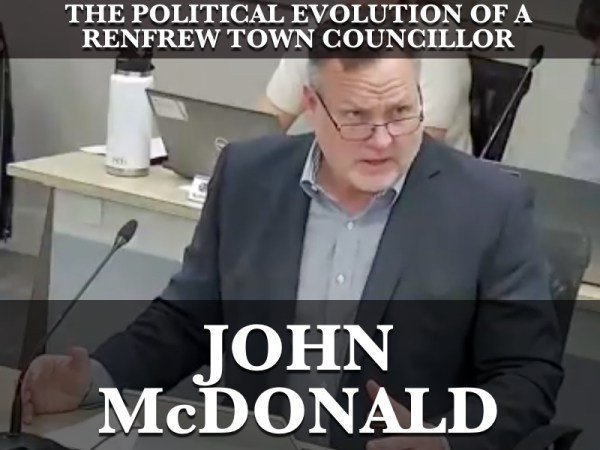
I’m pretty sure that Renfrew Councillor John McDonald has always had game. I don’t think you can be a big-city police officer without having a certain predisposition for getting to the bottom of things, and it appears that trait and that predisposition has transferred to his work on Renfrew Town Council.
All that said, at least from my perspective, the councillor has found his political and administrative accountability game, or has refined it, in the several months that I’ve been following Council.
Being a politician, and being an elected councillor, are not things that are easily done. Like any job or endeavour, it takes a bit of time to sort out the environment, the players, the issues, and the answers involving those issues. You don’t just open a jar of political acumen and pour it out on a plate. Instead, it’s something that’s learned and earned, and if you’re earnest in your reasons for being a councillor, then that learning and earning are important parts of the process.
Councillor McDonald appears to be well on his way.
A number of councillors have made a point of requesting an employee organizational chart for the Town of Renfrew, but they’ve been somewhat stymied by a staff leadership that doesn’t feel inclined to release such a thing, ostensibly because it’s not something they “typically” do.
Which when you get right down to it, is staff-speak for we could if we wanted to, but we just don’t want to.
Which is staff-speak for you’re going to have to try a lot harder to get us to create, then release such information, and we’ll stonewall you until you and the other councillors make us do it through an explicit direction from Council.
I won’t go too much into how impressed I get when somebody tells me something can’t be done, or won’t be done, because, well, that’s not the way we typically do things. A statement like that doesn’t make me want to back off, it makes me want to insist that you go “atypical“ and give me the information that I’m entitled to.
When I was growing up and watching my favourite crime thrillers on television, there was always a point where some mob guy had a gun to some other poor guy’s head and, before dispatching the fellow into the Great Beyond, would offer the absurd comfort by saying “it’s business, not personal.”
I always thought of how relieving it must be that your murder wasn’t a petty personal act, it was just a procedural thing to make things smoother for the bad guys. I mean, thank heavens it’s not personal, right? I suppose it makes all the difference, and offered a soon-to-be murder victim some measure of solace before the Big Bang Theory took on a more, well, personal meaning.
You don’t get that level of courtesy with today’s murderers, and it makes me wonder, where did all the good people go?
Ontario premier Doug Ford has proposed extending so-called “strong-mayor” powers to 169 additional municipalities in Ontario, and the Town of Renfrew is one of them.
What makes a strong mayor out of a mayor?
Simply put, it allows the mayor, as Head of Council, to push forward agenda items without obtaining a majority vote of other members of Council. It’s something usually reserved for large urban areas like Toronto, or Ottawa, or any other densely-populated metropolitan areas.
But Renfrew? And also Arnprior, Pembroke, Deep River and Petawawa? Because they all made the cut, whereas urban powerhouse Douglas got left out, most likely because they’re part of a township government, and I guess we haven’t yet arrived at the point where rural townships require strong mayor powers.
The changes, if implemented, take effect May 1, 2025.
In a lot of things, there’s what we once did, what we do, and what we’re going to do moving forward.
I guess that statement seems to be a reflection of the fact that time doesn’t stand still for any of us as people, and it works that way for municipalities as well.
It’s the old “once we finally get things figured out and solved, something happens to change it” thing. It’s like you finally master your online banking interface, but then they change it to make it “better,” which of course means making it better for anyone not named you.
It’s like that in the garbage business, and by extension, the recycling business.
What was once a Stewardship Model has been replaced by government regulations changing things to a Producer Responsibility Model, which to most of us means next to nothing but to a municipality awash in recyclable materials, as they all are, it means quite a bit in terms of compliance, planning, re-jigging what had already been jigged, and then paying for the whole damned thing. The new regime takes effect on January 1, 2026.
If you thought there was two types of recycling, then you were right. Nothing’s changed in the mixed co-mingled and fibre distinctions, the big choice you have to make once a week when you’re trying to remember which blue box you’re going to lug out to the curb. A blue box full of stuff at the end of the day is usually your answer as to whether you made that choice correctly.
But now there are two other distinctions to recycling, eligible and non-eligible. And so the question arises, what makes eligible eligible?
As simply as I possibly can, things can be broken up into two categories, residential and commercial/institutional/industrial. The first group, residential, is considered eligible, as in edible for continued curbside pick-up, meaning the least amount of change brought by the new government regulations. The second, the businesses and industries that make up the commercial/industrial category, are no longer eligible for this level of service unless the municipality in question decides to take on that additional cost.
Poor Renfrew. To be saddled with eye-watering debt, cutting or reducing services, increasing property taxes, and now some other gawd-awful thing raises its stupid head to demand more financial resources that you don’t have. It’s a spend-more scenario in an environment of spend-less. It’s enough to make any councillor reach for that forty-pounder of rye they’ve been saving for their child’s Confirmation and putting a tangible dent into the thing. They should just go ahead and pass a bylaw allowing councillors, and only councillors, to drink alcohol during council meetings, just to take the edge off things and steady the hand on the tiller.
Currently, Renfrew makes 319 stops that will now be considered to be non-eligible, including every one of the places operated by the town itself. This is currently done at a rate of $15/stop, but you can be guaranteed that a price like that is on its way out the window. It’s these places that are going to be the problem.
If Council were to determine to continue picking up this stuff from these stops, what would that entail? What would that look like? How would it be funded?
Staff has already undertaken a brief survey of the battlefield, and found that some municipalities are already on the road to compliance, as Renfrew is, but have adopted styles unique to themselves. Some continue to pick it up, and others put the responsibility on business owners themselves to get their recycling to a depot specific to that purpose. In one case, in Mississippi Mills, the municipality was quoted a sobering $65/stop for the service, as compared to Renfrew’s current yet soon to be extinct $15/stop. It’s more than a four-fold difference, but Manager Amanda Springer is of the opinion that whatever cost eventually accrues to Renfrew, it’ll be less than the Mississippi Mills quote. So some small solace there.
The decisions facing Council are those of a short-term nature, and of a long-term nature.
He thought it would be pretty cool just to hear his name mentioned on draft night.
Last night was the OHL Selection Draft, where teams from the OHL Major Junior A circuit go through the process of selecting players by which they can re-stock the cupboards. That’s how it works in the OHL, you lose some, you win some. Some of your players get drafted in the NHL Entry Draft, some graduate to other programs, and some retire from the league. They’re replaced at the other end by prospects primarily from Ontario’s premium AAA hockey programs.
One such player involved in all of this is Braeside’s Kaden McGregor, a 5’11” centre playing for the Ottawa Valley Titans AAA program.
He did hear his name last night, in fact before anybody else heard theirs.
Renfrew’s landfill is a happening place, but not as happening as it ought to be, particularly in keeping up with its legislative and policy mandates around the environment.
More than anything else, it’s a staffing issue that presents as the biggest problem, in that the landfill is under-staffed and has been for awhile. And this shortcoming bites into operational efficiency and also presents as problematic when the fellow working there has to take a day off, go on vacation, or decides to go work somewhere else.
This is not the McDougall Museum, where a choice to close the place would hurt and be a blow to the community, but would be otherwise survivable. The landfill is something that can’t be closed, so the option of shuttering the place and locking the gate simply isn’t a choice.
The staffing of any mid to large level corporation is always going to be a balancing act between what’s needed and what’s affordable, and unfortunately, those two factors are rarely in synchronicity with one another.
So there’s always going to come a time when the two need to be resolved with respect to one another. And in Renfrew, that time may well be now.
If my information is anywhere close to being correct, the Town of Renfrew took on close to, if not slightly over, $1 million in additional staff salaries over the past calendar year. It’s hard to root this information out of the budget spreadsheets because all salary information is department-specific, and there seems to be no global information regarding wages and overtime. In short, they make you work for it. But in two departments alone, there appeared to be a significant increase in budgeted salary for 2025 over 2024. Public Works and Community & Recreation Services and Library together posted budget asks that together totalled over $1 million by themselves as compared to 2024. Unless I’m reading the spreadsheet incorrectly, which is entirely possible.
And when you go through the staff roster, you see an awful lot of deputy-this and assistant-that. And when you look at the job titles, you get a sense that things, in some places, are potentially seriously out of hand. I’ve never encountered a jurisdiction with job titles that take ten minutes to say, and adding the word deputy or assistant doesn’t do much to make them any easier to say or remember.
Being a student is serious work if you approach what you do with integrity.
The formula is well understood. Go to school and concentrate on the reason for you being there in the first place, and I’m not talking beer pong here.
Do what you need to do, make the most of the experience, budget your money, and if there’s time and necessity, get yourself a part-time job to help with the bills or possibly enhance the quality of your student life.
You’ve done all that can be asked. You worked a part time job throughout high school and managed to save some money. Maybe your parents are helping you foot the bill for college or university. If not, or if not enough to significantly move the affordability needle, then you apply for OSAP — Ontario Student Assistance Program — for an interest-free loan, and possibly a significant grant, to help you get to where you’re going.
September turns to April and you’ve got a year under your belt, but it’s expensive, and sure OSAP will likely be there for you again, but it’s not like you’re going to be dining out on Oysters Rockefeller with just OSAP.
So you need a summer job. Preferably one that allows you to remain in your hometown, and not have to travel. A job that pays a decent summer student wage, provides marketable experience, and allows you to sleep in your own bed every night with your cat Sparky at the foot of your bed, just like always.
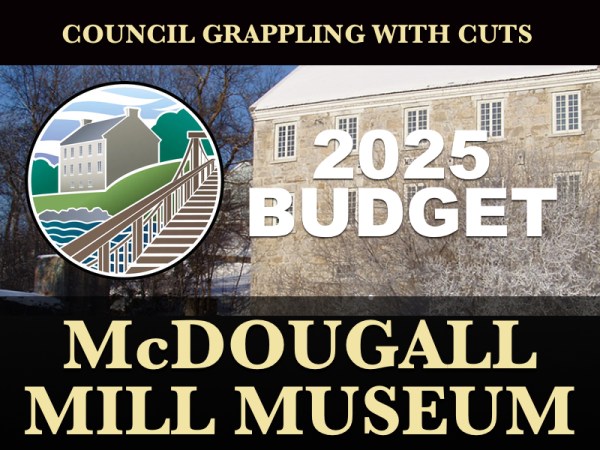
A couple of points are worth considering before leaping to any kind of response. First, the McDougall Mill was one of the very first structures in Renfrew’s history, located at the Second Chute of the Bonnechere River, and from there serving as the focal point for the community that would grow around it. In terms of heritage and heritage buildings, the museum is the pre-eminent historical structure in Renfrew. The fact that it’s morphed into the curation and preservation of important relics connected to Renfrew’s past makes all the sense in the world.
Second, the McDougall Mill’s place in the community is embedded in the town’s corporate logo, and it’s been prominent in just about every effort at promoting Renfrew beyond the town’s limits.




 NEWSMAGRENFREW