“I’m gonna take one.”
That’s all he said as he skated by the bench, the guy with the red armband on his striped referee’s jersey. But he was completely understood.
The game was getting out of control, scrums after every whistle, face-washes and high-sticks the most common features of the game so far that night.
What the referee meant in that short, four word drive-by, is that when the next post-whistle gathering occurs, he’s going to take a single player out of that scrum and give him a two-minute ticket to the penalty box, thus leaving his team with a player disadvantage for those two minutes. And in a crucial, hard-fought playoff game, where the stakes are at their highest, nobody wants to be the guy who ends up being the reason for your season coming to an end, the result of a game lost by giving up a power play goal while you sat and watched. It’s not fun being that guy in the dressing room after the final whistle.
It keeps teams honest and accountable
That referee skated by both benches and cautioned both coaches similarly, and they both took heed of the warning. There would be no more scrums, face-washing and needle work with sticks. Order would be restored, and the game would be won and lost on the merits of hockey talent and skill, and not on thuggery. Or so the theory goes.
As it works in hockey, so too might it work with grocery stores.
I completely understand that there’s not a lot of face-washing and stick-work going on in the produce aisle of my local grocer, and dairy looks pretty safe too. But it does happen, just not in the open, and certainly not amongst the customers themselves. The high-sticks and dirty play happen out of sight, where they set the prices for the products on their shelves.
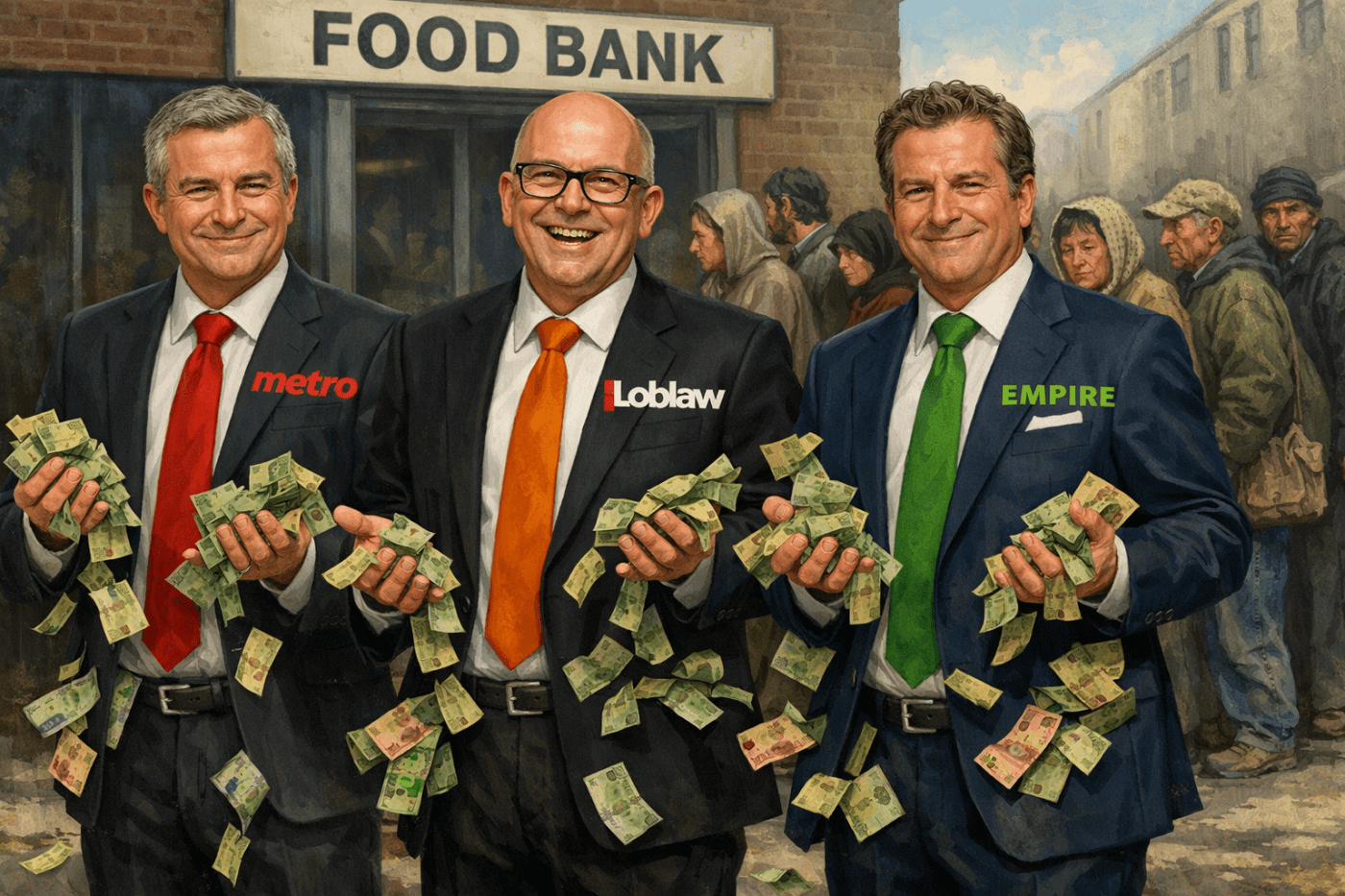
It’s called by various names, price-gouging and profiteering being two of the most prominent. It reflects a common practice in the Canadian grocery industry, that being the incessant cheating of Canadian consumers, although cheating is a rather generous word to use. We’re conditioned to accept that retail theft is a serious problem, and it is, but we all thought they were talking about the customers being the ones doing the stealing. Yes, customer theft is an issue. But what about corporate theft? And if that’s too strong of a term, how about corporate greed?
Evidently there’s nothing that can be done about it, absolutely nothing. Not all of the king’s horses, nor all of his men, are up for this challenge, seemingly.
Governments seem hapless and listless. They create committees and call for witness and stakeholder testimony. They issue conclusions and findings that go nowhere, possibly by intent. It certainly appears to be, as Shakespeare once observed, much ado about nothing.
So that leaves you, the one paying inflated prices for your groceries. What are you going to do about it?
What is there to do?
Governments have threatened legislation that would cap profits in the grocery industry before, but I don’t see any action on that necessarily. Governments can huff and puff, and puff and huff until red in the face, but that’s an exercise in public relations more than anything else. And if the government actually did cap profits, imagine the howling to come out of Corporate Canada?
That doesn’t sound very hopeful. Not much in the way of optimism there.
So then we’ve got to go back to you. What about you? What can you do?
Well, maybe you can start by “taking one.”
Outside of any “mom and pop” operations and chain convenience stores, groceries in Renfrew are purchased locally at any one of three locations, Metro, No Frills, and Walmart. We don’t have a Costco, nor are there any stores from the Empire grocery empire present locally, but the principle works just as well in larger centres where all the grocery monopolies are at work lightening your wallet.
And so you start with one.
For the purpose of making this point, I’ll use Metro as an example.
Could you go a whole week without shopping at Metro? Could you? Really? You could steel yourself to do that? What if that was the only place you’ve ever shopped? Would you boycott the place for a day? A week? What if by doing so, in concert with others, you could eventually shave hundreds of dollars off your monthly grocery bills?
Ya, I said monthly. That’s the degree to which they’ve been ripping you off for years.
What effect would a boycott of Metro have, or any other of the chains? I’m not going to pretend to be some sort of expert analyst of the grocery industry, but I do understand a couple of things about basic economics and market economies.
Number one, it’s gonna get their attention in a hurry. I believe they open their doors every morning at 7 AM. They’ll know something’s happening by 7:30 AM, if it even takes that long. They’ll notice it as they report to work and don’t see the pack of seniors hovering around the entrance waiting for the doors to open, some of the poor folks probably sitting in the parking lot since 5:30 AM, but that’s a different story.
“What’s going on?” they’ll wonder. And then will come the certainty that, whatever’s happening, it isn’t good. The first phone call to corporate will go through by 9 AM if it takes that long. There will be scratching of corporate heads and gnashing of corporate teeth. And that was Monday.
Imagine the nature of those discussions when the same damned thing happens Tuesday? Then Wednesday? And so on for the rest of the week?
Meanwhile, over at No Frills and Walmart, they need traffic control in their parking lots. National media send reporters to the scene. A chopper hovers, but we’re not sure who it belongs to. The floor space in the stores is jammed with humans, and nobody’s ever seen anything like it. Product is flying off the shelves and out the door. The cash registers are humming, indeed, they’re singing. The store manager confers with the franchisee. Serious statements like “It’s busy today” are bandied about.
And then the little alarm will go off in their heads too, and they’ll have a WTF moment of their own. They’re aware of the whole “if it seems too good to be true it’s probably because it’s too good to be true” thing.
And the phone calls to corporate will start here too, in those two places, because you’d have to be absolutely blind not to think that something is seriously out of whack in this scenario. And if they have any kind of strategic thinking available to them, they’ll probably figure out that at some point in the future, perhaps even in a day, maybe a week, it might be their turn to show up to work at a deserted store.
The changes will begin to appear in the first week. Prices at Metro will begin to creep down in an attempt to get their customers back. And as soon as that happens, the dominoes begin their fall, with prices being reduced at all competing grocery stores as well. Ironically, when the prices at Metro fall, the employees may actually be able to afford to shop at the same store where they work. Maybe the Food Bank doesn’t have to be an option this week. Unfortunately for those same employees, Metro would lay them off without thought if the company thought the protest would last beyond a time they were willing to tolerate.
And speaking of food banks, what effect would price drops have on their operations and the long lines outside their doors? Might those lines be reduced as people find they’re able to afford their groceries better than before?
As consumers, we have a stick to wave around, and we have to be resolved to use it or the BIG GROCERS will continue to simply trample all over us. So it brings me back to the question: Can I really go an entire week without shopping at a certain store? And if I could, what impact could that have? Whatever the answer to that question, I already know whatever impact it might have would be close to zero if I attempted it on my own. Absolutely zero.
But if you do it as part of an organized group, the impact will be real and substantial. And the beneficiary is you. You’re not doing this to save children in Africa or to rebuild some foreign spot ravaged by natural calamity. You’re doing it for you. And your family.
What if somebody had the whatever-it-takes to set up a local Facebook group or page, where people could sign-on to a pledge to fight back against the corporate greed of Canada’s major grocers, the greed that’s been costing you thousands of dollars over time? Would you sign-up for that? Would you pop your name up there in a public space so others can see it and take heart, possibly encouraging them to join the effort as well?
Would you do that to save yourself thousands of dollars?
What if that same Facebook page served as a watchdog to prevent against grocery creep, where the prices start slowly rising again when they think everyone is looking the other way, as we almost always do? What if we could keep them honest by having our very own price comparison features locally? What if that very same page could be used to direct consumers to the locations where their dollars will travel the farthest?
This is a noble fight for a noble cause, that cause being you.
All you have to do is be like that guy at the start of this story, who skated past both benches with the same message.
“I’m gonna take one.”
 NEWSMAGRENFREW