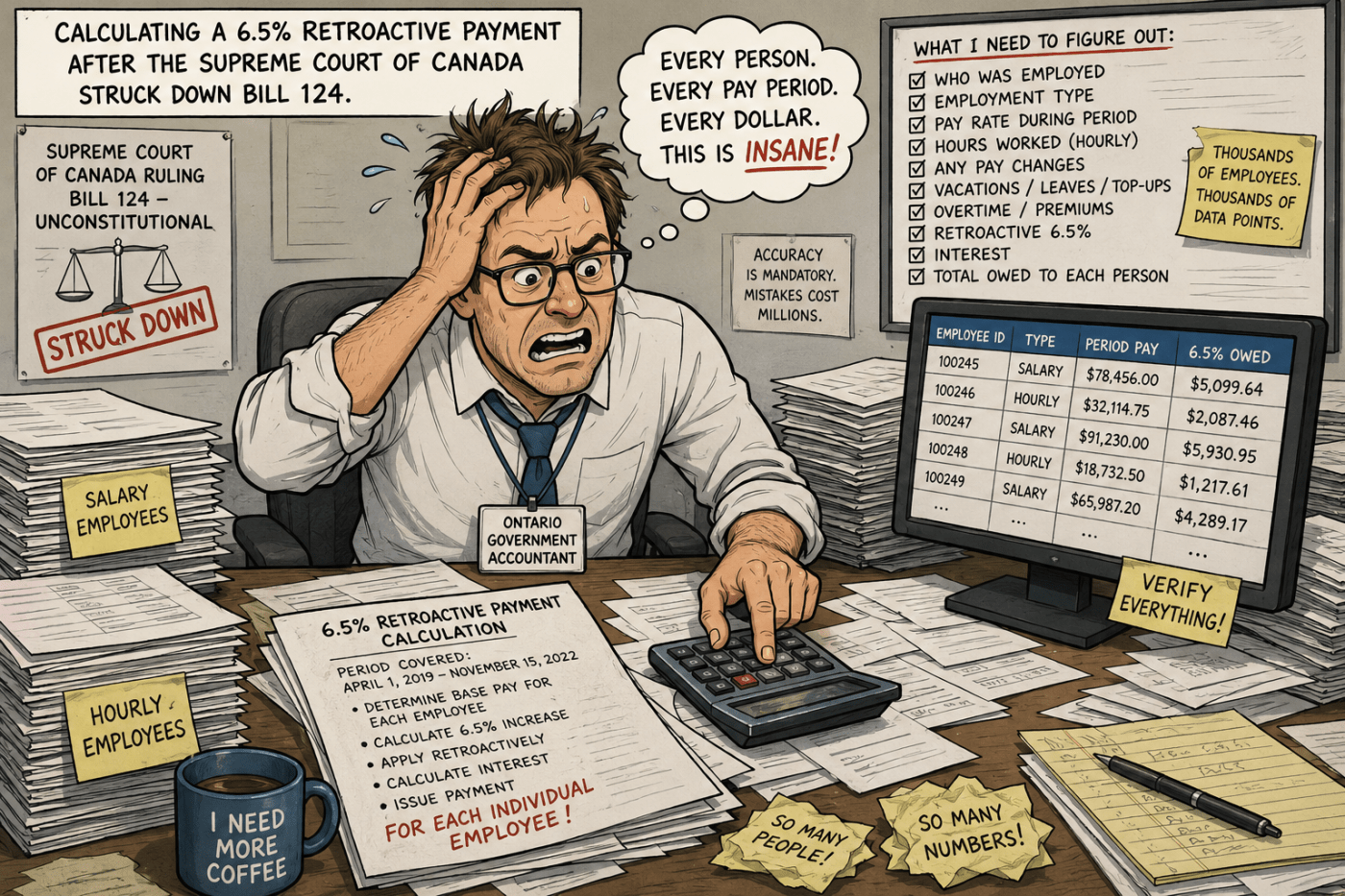
It’s been well-documented that the CLRCS Executive-Director has had little to say about the status of the Labour dispute between the agency she fronts and its unionized workforce, the members of OPSEU Local 472.
The status of these negations can be accurately represented by the number zero, which is perfect, because that’s exactly how much effort she’s put into this whole thing, now approaching the end of its fifth week.
That’s intentional.
But what little she did have to say was telling.
First, she was steadfast in refusing to discuss wages. Okay, that’s fine, since negotiations regarding wages were never in her hands anyways, that issue being handled at a provincial level much higher than her pay grade. But I suppose it made her sound steadfast and firm, something that may come across as an attractive trait in a lead negotiator.
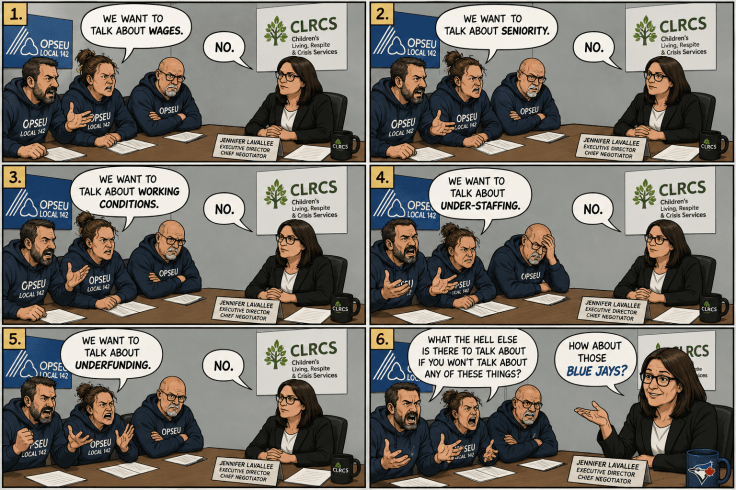
Secondly, she indicated she wasn’t interested in talking about seniority, working conditions, short-staffing, inadequate funding and opportunities for promotion and/or advancement. Which is pretty much all the issues.
Steadfast and firm is one thing. Steadfast oppositional obstructionism is another.
If somebody sees any sign of good faith in any of this, let me know in the comments below.
Except there’s no comments below.
Good faith involves talking to one another, not telling the other party that you refuse to talk at all. She, and anyone backing her up, knows this. They break this tenet of the collective bargaining process willingly. It’s a choice that she, and by extension they, make freely with their eyes wide open.
But the third thing she said, or maybe let slip, was her assertion that a $0.35 cent/hour raise workers received back in 2024 was, in fact, their 6.5% payout under the terms of the Supreme Court decision to strike down Bill 124, a provincial government attempt to limit the collective bargaining rights of public-sector workers.
It’s on this last point, if that was actually said, where the rubber leaves the road.
Calculation of that compensatory 6.5% retroactive pay is not a simple thing. There are a lot of moving parts. Some public-sector workers are paid via salary, while others work at an hourly rate. So right off the bat, 6.5% means different things to different people.
Also, a worker’s pay, or rate of pay would have to be identified for the time period covered by the ruling. During that same time period, an employee’s pay may be impacted by promotion or demotion, or as in the case of teachers, raises that come with experience/training/educational enhancements, putting them into a higher notch on the salary grid. So for the folks responsible for the calculation of all of this and how it’s impacted by that 6.5%, all I can say is better you than me and best of luck.
Nothing happening after February of 2024 falls under the scope of Bill 124 anyways. So if the employees got a modest raise in 2024, was it simply a raise, and not connected in any way to compensation owed as a result of constitutionally-flawed legislation? Or was it an actual attempt to do that very thing, compensation for the 6.5% owed to the workers as part of the court-mandated settlement? And if, for the sake of argument, it was an attempt to settle that retroactive pay issue, how could every employee receive exactly the same amount, as in 35 cents an hour? Does every single employee make exactly the same amount of money? Were they all there between 2019 and early 2024? Making exactly the same wages all along? What about things like statutory-mandated vacation time?
In short, what exactly is that $0.35 tied to?
I ask because I truly don’t know.
My goodness, an executive director would know these kind of things, would they not? And wouldn’t they have done a much better job of explaining that to their employees? Wouldn’t the reason for the wage increase be indicated on worker pay stubs or some other type of payroll document? Wouldn’t workers have been formally informed?
i ask again. because I truly don’t know.
So far as I can determine, in every case that I’ve studied, these retroactive payments, once identified, were made in the form of lump-sum payments. I can see no evidence of anyone attempting to, or being authorized to incorporate them into the hourly rate of pay.
And how, exactly would a 35 cent/hour raise represent 6.5% of anything?
Some math on the back of an envelope has me taking that $0.35/hour and multiplying it by a 40 hour work week. I multiplied that by 52 weeks in a year (not a perfect assumption) to get a yearly estimate of how much money that would represent. In theory, a worker continuing employment in this organization for another 20 years would receive in the area of $14, 560 through a scheme like this, and that doesn’t sound too management-friendly, and it’s a hell of a lot richer over time than the payout I got. Similarly, in the opposite direction, a worker who only works for an additional two months, for whatever reason, including possibly poor treatment by management, would only be able to realize $112 of whatever they might be entitled to. I presume that by terminating their own employment with the agency, the agency’s assumption would be that any additional entitlements would be forfeited, as they would be linked to an hourly rate that the employee no longer works at.
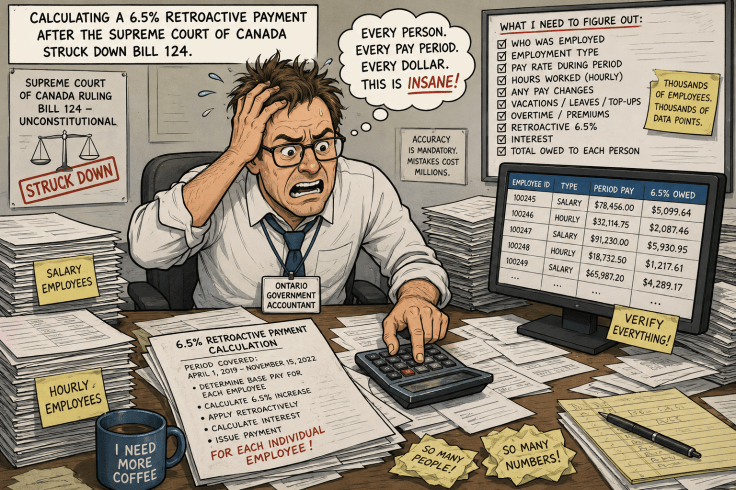
And that’s the thing. Where is the calculation that arrives at a dollar amount for each individual employee? And once identified, why wouldn’t this be paid in a lump sum directly from the province?
This makes me think that the 35 cent comment from the executive director, if in fact it was actually made, was really just some bad gas escaping. Because aside from that, I truly don’t see the validity of it.
Now sure, my calculations are a bit on the rudimentary side. A professional accountant would have better envelopes to work with, profound intrinsic knowledge of how money works, and fancy algorithms to aid in the effort. That shouldn’t be a problem over at CLRCS because it appears to have at least a couple of accountants on the Board of Directors, not to mention another money person, Ann Blimkie, as the Finance Manager listed as part of the management team.
Surely such people would understand that retroactive compensation is not something one addresses through modifications to the hourly wage package.
The 6.5% retroactive payment does not impact the operational budget of Community Living. It’s exclusively a responsibility of the government of Ontario. Its payment would be implemented through the agency’s regular payroll program, but it would more than likely be a lump-sum payment, maybe even a direct-deposit into workers bank accounts. That’s how it worked with other public-sector employees.
So if she did, in fact say this, then I have to ask:
“What, honestly, are you even talking about?”
GRAPHICS SUPPORTING THIS PIECE GENERATED BY ChatGPT

