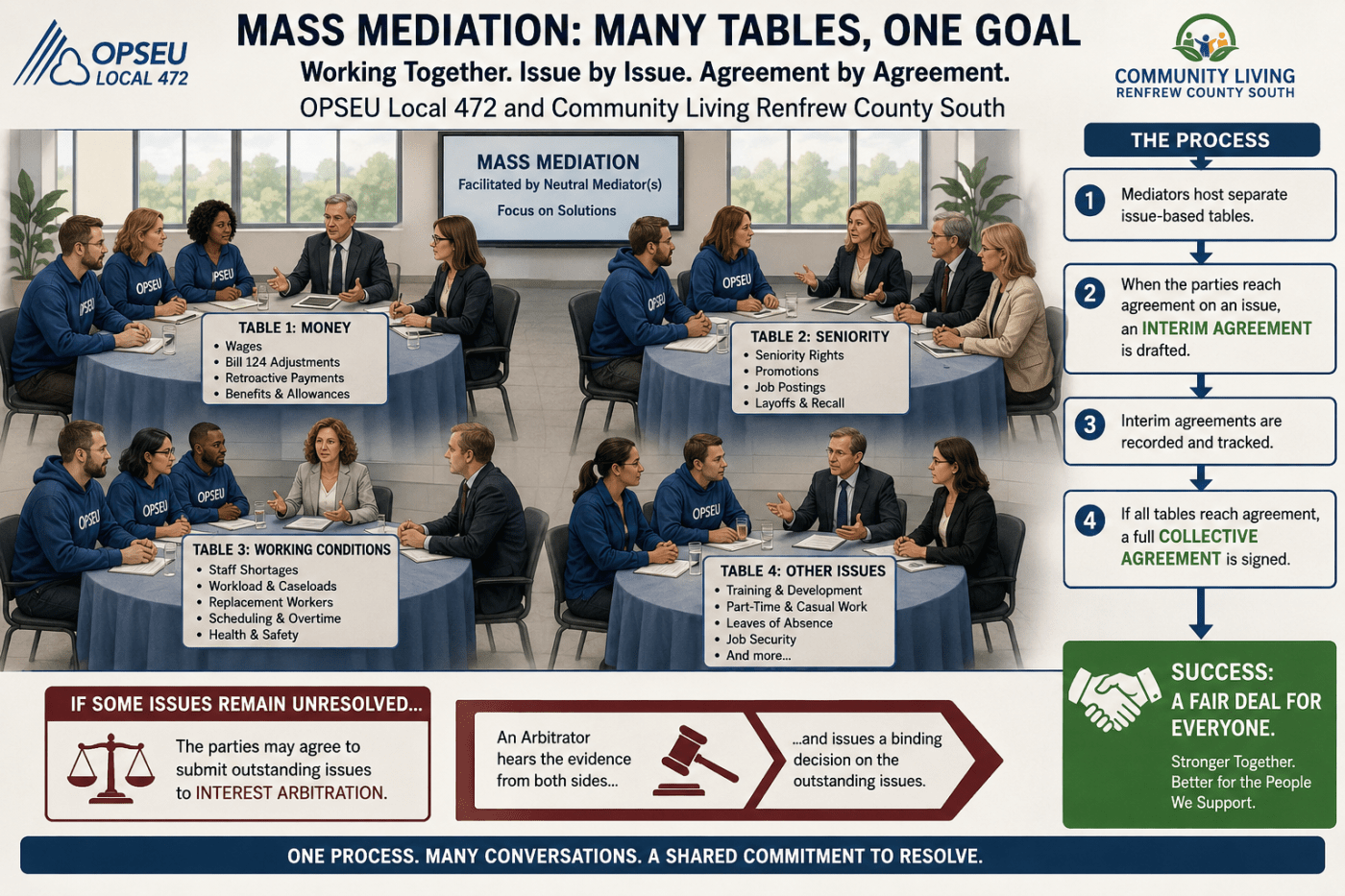
Mass mediation is something OPSEU has proposed as a means and manner of finding a solution to the labour dispute still underway after eight weeks of disruption. What it amounts to is an intensive, and comprehensive effort at mediation that takes place at several tables with mandates on specific issues, rather than a single table that negotiates all issues at once.
As a means of bringing parties together to hammer out agreements, it sits between the two other big ones, those being conciliation and arbitration. As such, it may well represent the best way to get to the bottom of all this, and so credit must be given to the union for proposing what appears to be a fair-minded middle ground in the dispute resolution process.
Conciliation is next to useless, especially if either or both parties decide that bluster and hardball tactics are the way to “negotiate.” To be a ministry-appointed conciliation officer is sort of like being the commissionaire of an abandoned government building: so long as you can stay awake, nobody can say you’re doing a poor job. But aside from that, you have no real function other than to show up and try not to light the place on fire.
A person in such a position would have absolutely no standing in a dispute that features a government that insists its not part of it, but then throws their weight and money around in such a manner as to prove that they decidedly are. Not much a conciliator can do other than hand out the lyrics to Kumbaya and hope for the best. Such a person would be walked on getting between the two parties of this dispute. Also, the fact that this conciliation officer is “ministry-appointed” raises suspicions in some people around fairness, since the government is involved, it shouldn’t be naming the conciliators in any labour dispute it’s part of.
Arbitration is different. It’s about as close as we can get to putting the negotiators of both sides on a plane with a single tank of gas and telling them they can’t land until they have a deal. Not so much negotiating at gunpoint or anything like that, but still, an arbitration process has far more teeth to it than either conciliation or mediation. The arbitrator has absolute power here, and if he/she makes a decision on the resolution of an issue, then both parties are bound by that decision.
Also, both parties would have to agree to arbitration. Or the government could reconvene and legislate everyone back to work and mandate arbitration to settle remaining differences. These two points are why we won’t likely see arbitration as the way things go in this dispute.
There is no way in the world, in my opinion, that the government would allow this thing to go to arbitration, and that’s for the simple reason that, not only would they lose (again) but they’re more than likely to get clobbered. And another humiliating loss of face is not something needed by this provincial government, although they do have a demonstrated tendency to shoot themselves in the foot. It’s like they just can’t get past their anger. Sort of like pissing against the wind. It might feel good in the short term but turns out to be no hell in the long.
There is no mass mediation device in the Ontario Labour Relations Act per se, but there are mechanisms within the legislation that essentially allow for such a thing, so it’s absolutely possible and do-able.
One of the positive attributes of such an approach its that a timeline of sorts is built in. Rather than negotiating on and on with no results over a long period of time, mass mediation may take place over the course of several days, perhaps even a week’s worth, perhaps even two. There would be, in effect, several tables rather than a single one. Those single “tables” would be assigned specific issues to work on, and nothing else. An expert and impartial mediator would hopefully be able to guide the two parties to an agreement, perhaps a compromise, on that single issue. If there are too many issues in the dispute, then these tables can discuss a “package” of issues that are related to one another. Money stuff would fall into this, since the money and where it goes is a big part of all of this. So in this specific dispute, money issues could include wages, Bill 124 adjustments, retro-active pay, and promotions, just as an example.
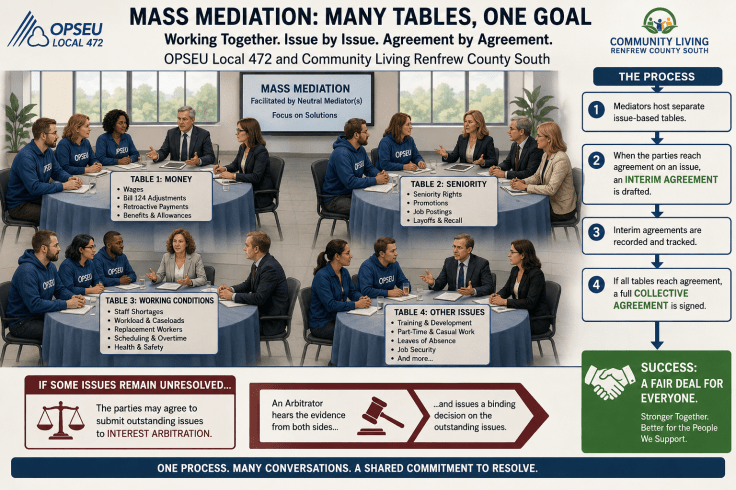
There are a number of approaches a mediator, or mediators, could take in this scenario.
There can be joint-bargaining sessions, private caucuses with each side, smaller-sized working groups to deal with specific issues, continuous exchanges of proposals and counter-proposals, and drafting any interim agreements when and if those specific issues are resolved.
Think of such a thing happening simultaneously at other tables with other negotiators and other mediators present working through other categories of issues. All of them hopefully arriving at solutions that can be written up into interim agreements, culminating in a general collective agreement once it’s all stitched together.
If there is an issue or topic that couldn’t be resolved, then the opportunity exists to have those issues dealt with via arbitration.
This process, if I correctly understand it, strikes me as a very reasonable and good-faith way to bring this thing back under control. I think there’s likely to be an enhanced “trust” factor with a mediator, probably more than what you might get in a conciliation officer. And from another perspective, it offers a realistic opportunity for the two sides to agree to the elements of resolution, rather than having the terms imposed on them through arbitration, or just as bad, reaching no resolution at all.
I fear that the management side, or the government side, may pause on the presence of a mediator, probably because a mediator is harder to ignore than a conciliation officer. While not having the sharp teeth of an arbitrator, a mediator still has more bite than a conciliator, and thereby has a better chance of bringing the parties together on some common ground.
I think it’s safe to say that we all want the best for everyone involved, so long as that “best” was arrived at using principles of fairness and good-faith. OPSEU proposed this, and it’s a good idea, better than anything put forward to date. OPSEU’s demand of having the mysterious “funder” present is also legitimate.
So it stands to reason, then, that if the other party refuses this offer, they’ll be putting themselves squarely in the crosshairs of an increasingly frustrated public. And if this thing ever did end up in arbitration — and it won’t — the simple fact that management/government walked away from such a positive proposal would likely be held against them when and if the arbitrator came down with a decision.
But again, never discount the possibility of the Conservative government shooting themselves in the foot. It’s an acquired talent, but one they’ve taken to well, over and over again, to the tune of hundreds of millions of dollars.
And if this turns out to be the case, then I feel my critical clarity would be re-energized.
 NEWSMAGRENFREW