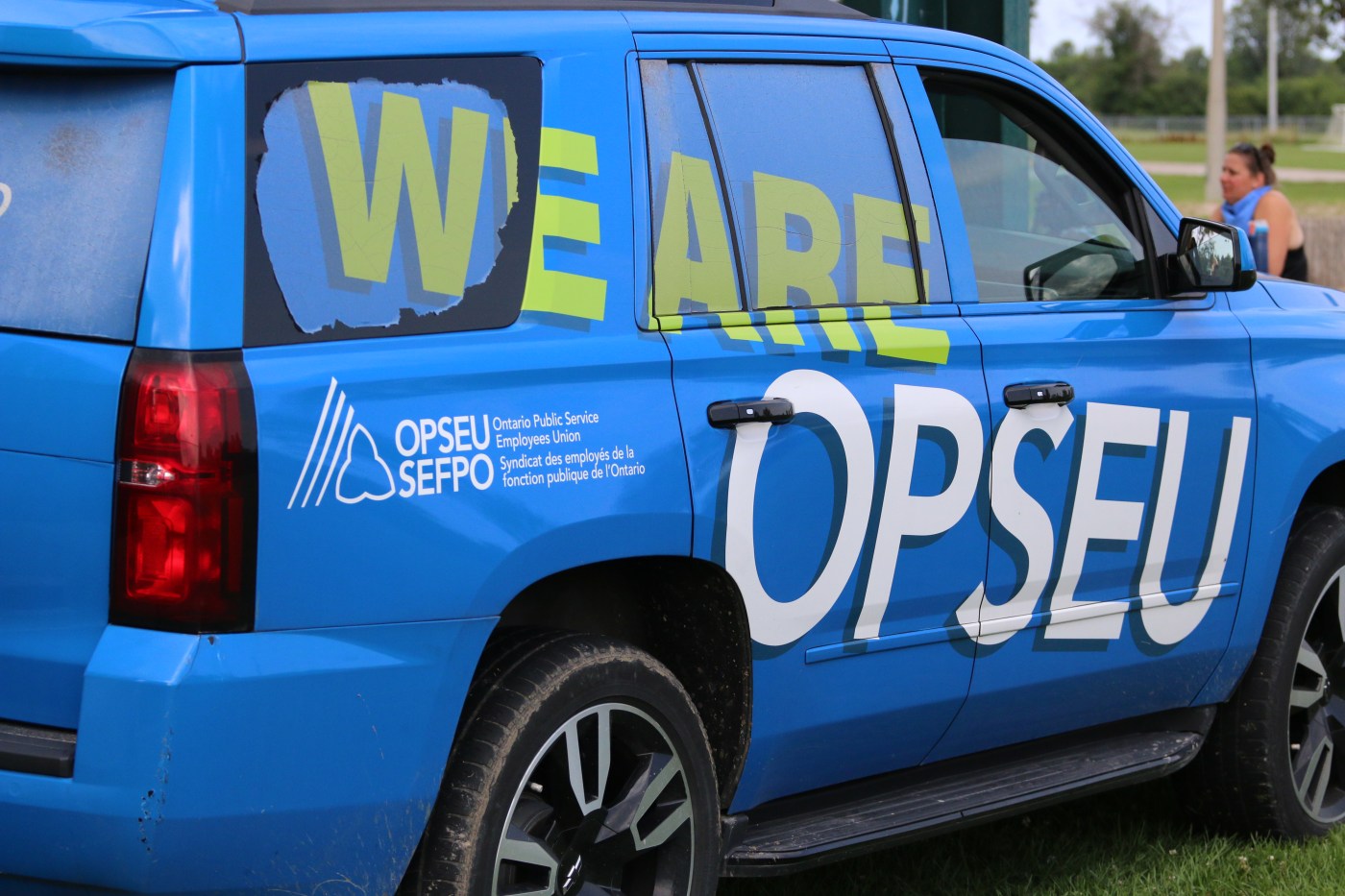
OPSEU Local 472 issued a media release late in the week, perhaps Thursday, and the release touched on two main points of contention: the back-and-forth issue of mediation that seems to have energized everyone, and the Bill 124 remedy, which seems to have energized everyone as well.
On the mediation front, the union has offered to “front” the cost of a new private mediator, one William Kaplan, apparently the best of the bunch if you’re picking up what the union is throwing down. Whether he is or he isn’t, it’s up to the employer to decide if they want to take the union up on this offer, and at the time of writing, I have no indication that they have or even intend to. Management tends to pause when the word “private” prefaces the word “mediator,” mostly because they likely fear a loss of situational control if they move away from “ministry-provided conciliation officers” and mediators working for the Ministry of Labour, and therefore government employees. Managers may feel that they’d be giving something up, perhaps leverage of some sort, by allowing mediation to happen out-of-house with a private mediator.
When your bargaining position is built upon a rickety foundation, I guess wanting to keep as much control over things represents a compelling strategy in the absence of any other strategies offering greater credibility.
What does the union mean when they say they’re going to “front” the costs for the mediator? Does that mean you’re paying for the whole shebang? Or is it saying you’re going to provide the seed money to get things started? Sorry I have to ask. Words are important, and can often be misunderstood. The responsibility for that message clarity belongs to the person delivering the message, so clarity is important. And in a situation where communication has been an issue right from the beginning, I just want to make sure I’m understanding correctly what’s being said.
In some positive news also gleaned from the release, it appears that both sides in the Community Living Prince Edward and Brockville and Area Community Living Association disputes are planning to meet with a mediator of some sort in the coming days. As the release stated, there are plenty of non-monetary issues that can be hashed out to a degree without Big Daddy Doug being in the room.

The second major item was the union’s response to the so-called Bill 124 remedy.
I posted an article on Tuesday that featured a document sent via email by the Executive-Director through a closed email chain. The document was intended as “proof” that the issue had already been “settled” and featured signatures of signing representatives for both sides.
And it apparently kicked over a hornet’s nest.
OPSEU Local 472’s response was delivered by local president Shannon Waddell and contains the following passage:
“The union and the employer negotiated a Memorandum of Settlement (MOS) in 2024, that addressed Bill 124 wage restraint legislation being repealed. Throughout this strike the union has been clear that we are fighting for additional funding for these services. That settlement was not funded by the government at the time and has led to less money being available this round for wage increases. As part of that MOS it specifically addressed if there was additional Bill 124 funding that it would be available for wage increases. The total impact of that wage reopener was .35 cents.”
Shannon Waddell
So what does this mean?
And I have to drill down on a couple of specific parts of that.
“That settlement was not funded by the government at the time and has led to less money being available this round for wage increases.”
What does this mean specifically?
Please understand that we’re not all local presidents of a union or managers of government-funded agencies. There are problems that come from speaking in institutional jargon, and that again has to do with the ability of your audience to understand you.
So when you say that “the settlement was not funded by the government at that time,” what is meant by that? Were they supposed to fund it? What is important about the timing? It suggests that the government provided funding of something at some point, but doesn’t specify what the funding was intended for or when the funding may have been in place or not in place. It doesn’t help Jane or John Public to figure out what it is we’re talking about. Hell, I don’t even know what we’re talking about when it comes to this issue, something I find incredibly frustrating.
If I take a stab at it, I believe the point is that the terms of the settlement, or Memorandum of Understanding, or Letter of Understanding were all agreed upon in the absence of government funding that would be specific to the terms of the understanding? Meaning I think that, without government money, the agency had to use house money, or operations money to meet the terms of the agreement articulated in the understanding? And that because of that, the agency no longer has the money for regular raises?
As part of that MOS it specifically addressed if there was additional Bill 124 funding that it would be available for wage increases. The total impact of that wage reopener was .35 cents.”
And then there’s that whole $0.35 again and what it represents, which at this point I still don’t know. I’m not an accountant, but a lot of the management and Board crowd over at CLRCS are. Can there not be a better explanation of what these 35 pennies represent and how they were arrived at? We can all speak speak English, right?
“As part of that MOS it specifically addressed if there was additional Bill 124 funding that it would be available for wage increases. The total impact of that wage reopener was .35 cents.”
Shannon Waddell
There is a clause, or paragraph, in that letter of understanding that explicitly says that if the government were to come up with additional funding related to a Bill 124 remedy, that the parties would agree to come together and talk about how such funding would be distributed.
Aside from being able to drive a five-ton truck through that clause, I have to ask a question: Has the government come up with additional funding that’s Bill 124 related since 2024? And honestly, if they have — I’d have trouble believing this but anyway — isn ’t there some sort of previously designed and provincial level process around how this money would find its way to the workers? Why would a Bill 124 settlement need to be “negotiated” at the local level?
And the parties felt that they would have no problem getting together in good-faith and reach a mutually beneficial solution around this issue? At present they can’t agree to what day it is, so on that point alone, that clause is supported by nothing but hot air and gases. It’s presence in the document is an exercise in wishful thinking if anything, perhaps a reflection of some jointly-held idealism on the part of the signatories. The sheer open-ended nature of that clause renders it a solution to nothing in the absence of genuine good will.
And while I’m at it, I again express my complete shock that there’s not some centralized process provincially for the identification and distribution of the Bill 124 remedy to workers. To me this is nothing short of government negligence, which unfortunately I find to be not shocking at all. They’ve demonstrated their negligence time and again on the developmental services file.
Those retroactive payments are not something that should be part of any collective bargaining process. They are, or ought to be, independent of that process. And yet, to me, and it this case, it appears Bill 124 somehow got entangled with other money, like the COVID pay-bump and regular wages.
There are plenty of smart people to go around and clearly I’m not one of them. But I hope for patience, as I’m only a taxpayer wanting to know how the money I cough-up to the government is getting thrown around.

