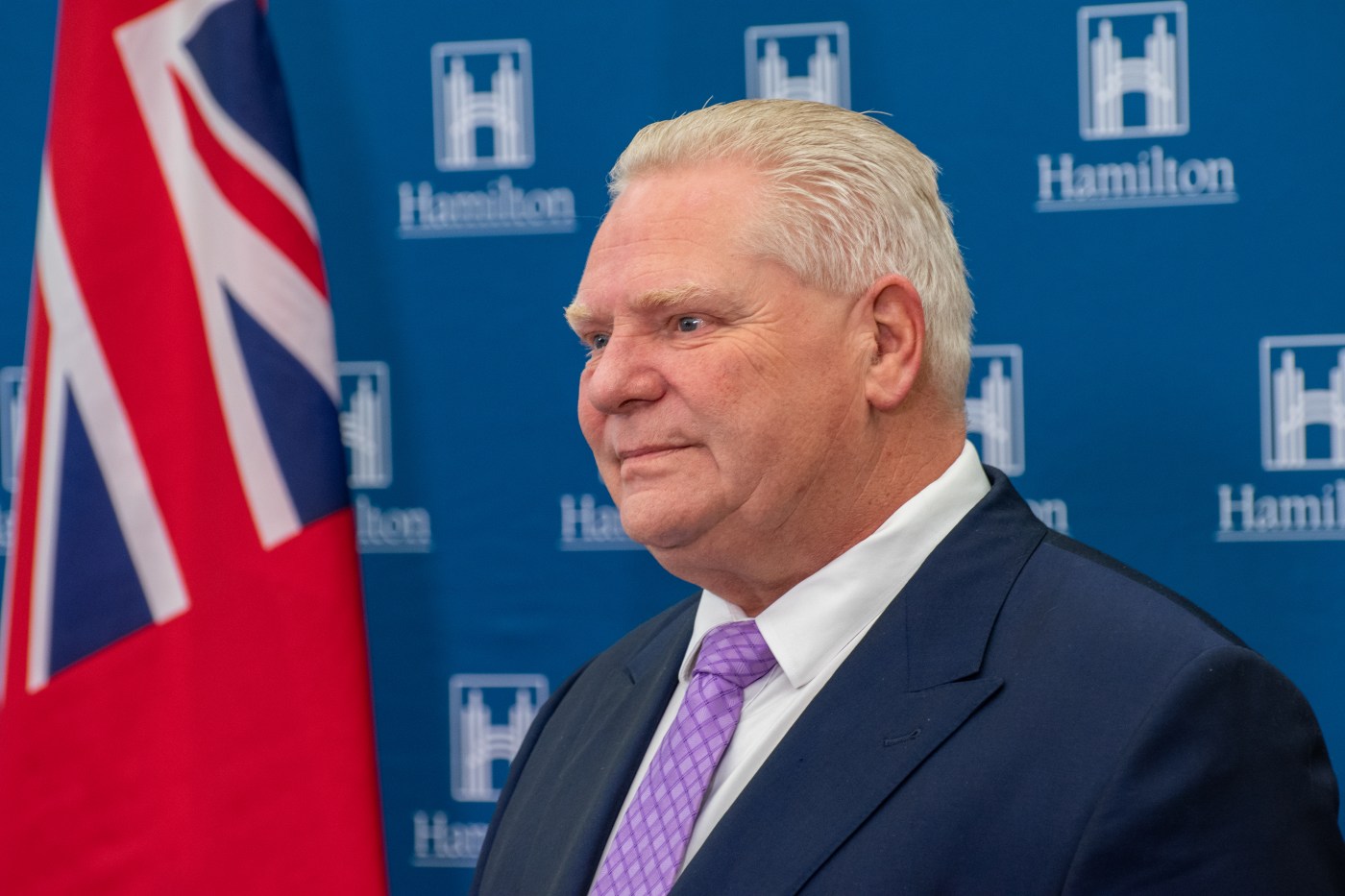
Is the writing on the wall for the Doug Ford-led provincial government in Ontario?
It’s hard to answer that definitively, but there’s no question that things are lining up against the premier being able to hang on to his job past 2028, which is generally viewed as the next chance for voters to go to the polls in a general election. I mean, he could go to the polls early again, like he did two years ago, but I don’t know if that would work for him as well this time, that is if persistent polling showing him tanking is to be believed.
There’s a shelf life for all politicians, especially those that occupy the top post. Ford isn’t stupid, and while he might not like it, I’m sure he’s aware of the history around political longevity of governments of any stripe. I also don’t believe he’d be interested in being defeated at the polls, as that would be calamitous to his self-esteem and pride. And so I look for him to resign before Ontario goes to the polls next to select a provincial government.
All this being said, never underestimate hubris and folly as key actors in the thinking of any politician. When you get to those heights politically, it’s often hard to picture yourself as losing an election and losing power, no matter what the polls say. There’s always going to be a little bit of the Fuhrerbunker mentality, just like Hitler in his final days, ordering around armies that either didn’t exist or had already been defeated, all while his generals stood around trembling or were busy getting the hell out of Berlin.
My point here is that, while in some degree of trouble, never underestimate the desire for survival, even if it’s based upon the flimsiest of notions.
Would such a person, in such a position, and under existential political threat, make every attempt to survive by attacking the points of dissent directed against them?
Would such a person in such a situation make the decision to enhance funding dramatically to areas where dissent has been strongest? Like maybe in the area of developmental services?
My answer to that is, at best, perhaps. Ford hates unions, and he’s riven by ideological fervour on this point, so it’s somewhat difficult to see him caving on this because he’d take it as a personal loss of face. But then again, he’s demonstrated often enough his ability to shoot himself in the foot, so one never knows. I know losing an election would be an even bigger loss of face, so I suppose he might be able to climb down from his war on unions in an attempt to save himself and his party.
And it’s not just him, it’s what happens after him, and there will be an after him. When he’s gone, in what state will we we find Ontario’s Progressive Conservative Party? Will it lie in shambles and ruins because of the premier’s stubbornness? Because I could give you the names of seventy-six other people, all Tory MPPs, who would definitely not want to see that happen. This is their livelihood, and these are their jobs we’re talking about here. I’m not sure how crazy these Tory caucus members would be in going down with the Titanic with Ford at the wheel.
Nothing concentrates the mind of a politician more wonderfully than the prospect of electoral defeat. At some point, these 76 legislators are going to stop being mere passengers and will take on a more active role in their own affairs and their own political futures. That’s when we’re going to start hearing the equivalent of “Hey! There’s ice ahead!” Or “For God’s sake, Captain, slow down!” And if those shouts are ignored, they might need to come up with a plan to replace the captain. Whatever the mechanics of it, Conservative MPPs don’t want to end up on the seabed just so that the skipper can go out on a blaze of glory.
Ford’s overall dilemma seems to a failure to balance expectations with realities.
He won a strong third majority in early 2025 by arguing that he needed a mandate to protect Ontario from U.S. tariff threats, using President Trump as a convenient political boogeyman, and it worked. But just a year later many voters seem to be judging him less on tariffs and more on everyday affordability, housing, health care, and ethics issues.
As I’ve indicated, several recent Ontario polls show a sharp drop in Ford’s personal approval compared with election night. One Angus Reid survey showed his approval falling from roughly 48% after the election to about 21%, while other polling suggests dissatisfaction has risen substantially. He’s lost 27 points in his personal approval rating. The party itself is down as well, but not as badly as the premier himself.
These issues involving affordability are interconnected and reinforce one another, creating a growing perception that the government is not delivering on affordability and public services. Included in that is developmental services and chronic underfunding.
Housing costs, rent, groceries, insurance, and everyday expenses remain the dominant concerns for Ontario residents, and the polling seems to suggest that fewer Ontarians believe the government has been effective at making life more affordable. That’s tough for Ford when affordability consistently ranks near the top of provincial issues.
Ford has made housing a signature file of his, but his government is under pressure from all sorts of directions. Home prices remain high in many markets, rental affordability is not the greatest, housing starts have not met targets, and the Tories still carry the political baggage and damage from the Greenbelt controversy a couple of years back. Even though the Greenbelt land-swap was reversed, it damaged public trust and remains a major talking point for those who argue the government is too close to well-connected developers.
It hasn’t gone much better for him in health care either. Emergency-room closures, shortages of family doctors, long surgical wait times, and staffing pressures continue to hurt the government. As we speak, the federal government is looking for accountability involving $3.2 billion of federal funding for health care in the province, yet nobody seems able to pinpoint where any of that money went. Sort of reminds me of the $4 billion the Tories say they spent on the Ministry of Children, Community, and Social Services last year that seems to have evaporated into a black hole. All this against a backdrop where health care has emerged as a major area where voters have expressed significant dissatisfaction with the government.
That jet aircraft controversy didn’t do the premier any favours, and neither have all the stories emerging of Tory entitlement with expense account scandals at the same time when many households feel financially squeezed. Polling continues to show that concerns about transparency and ethics continue to impact perceptions of the government negatively.
While this is happening, the government is facing increasing criticism over their proposed restrictions on freedom-of-information access and other governance changes. Now they’ve got it so that major Cabinet-level decisions are out-of-sight of the rest of us, shrouded by changes to the freedom of information laws. Maybe this isn’t the issue that’s going to have everyone going for their torches and pitchforks, but it sure as heck contributes to voters having a broader impression that the government is becoming less accountable after eight years in power.
Ford got elected mostly because of Donald Trump. And yes, the people of our province love it when our premier takes on the role of Captain Canada and lambastes that reprehensible crook south of the border. But as time passes, so too might passion, and there’s a very real possibility that voters many decide to judge Ford more on economic issues than international political bluster. Economic issues affect the pocketbook of voters more readily than calls to man the barricades against American invasion. If Ontario voters slip into the very real phenomenon of Trump Fatigue Syndrome, — I just made that up I think — the premier may have lost his most potent political weapon.
The real and unavoidable problem for Ford is the fact that he’s been premier for eight years now, which brings on symptoms of Government Fatigue Syndrome — I made that up too, at least the naming of it — where the public starts to go shopping for something new in their political leadership. Before, Ford cast himself as a political outsider who was going to come in and give hell to the elites. But after eight years, he himself has become the establishment, with the Torys and their political friends the new elites. And all of those political problems I’ve discussed above are all problems that the swing-voting public will blame on the incumbents, as in the Conservatives.
One interesting thing to observe going forward? The Liberals, as in the provincial ones.
They’ve been in the political wilderness since they suffered their catastrophic political collapse after fifteen uninterrupted years in power at Queen’s Park. Since that time, the party has been mired in third place with only a handful of seats, even losing official party status when the PCs decided to change the rules so they could deny the Liberals that status and the things that go with it. Another case of the over-the-top pettiness of the premier and his government.
The Liberals have thus far been unable to elect a party leader to the legislature, and that’s not a good thing for them. But there are two things that seem to offer a bit of a silver lining. First, the Liberals got more of the popular vote than the New Democrats did in the last election, yet because of the way the ridings are distributed, came away with far fewer seats than the NDP. At face value, that may not come across as a silver lining of any sort. But when you pair it with the fact that Ontario voters seem intent on never electing an NDP government again — never is a long time — it points to something that may emerge as a threat to the NDP, and thus to the Tories as well.
Conservatives win when Liberals and New Democrats split the centre-left vote. But in elections where it comes across as a two-horse race between the Liberals and Conservatives, the NDP vote tends to collapse with large dollops of it going to the Liberals as voters scramble to keep the Tories out of power. Strategic voting is the term.
After eight years of Tory rule, and with a long shopping list of political problems — all of their own making — a revitalized Liberal party with a new and elected leader might pose a significant threat to the provincial Tory government. And Tory MPPs know this.
One final thought.
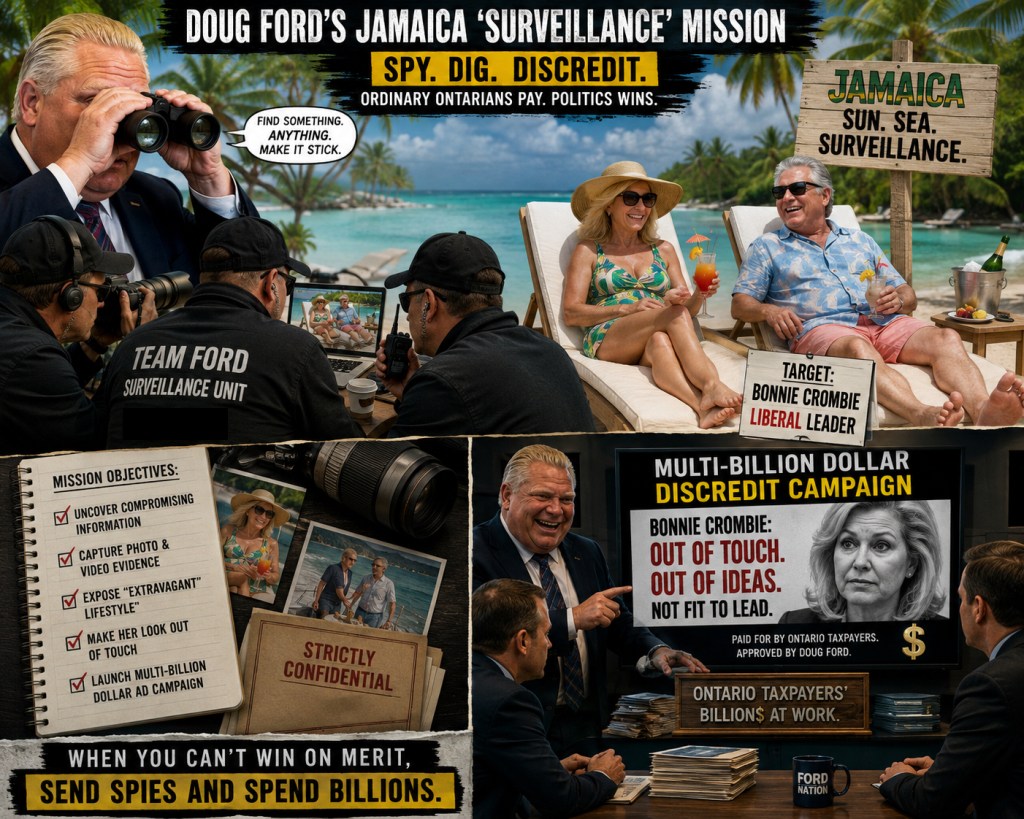
The Conservatives have been busted again, this time for a surveillance mission directed against former Liberal leader Bonnie Crombie. Upon her selection as Liberal leader, Ford and his political cronies started sharpening their political knees to undercut Crombie wherever possible. It’s personal for Doug, as in he viscerally hates Bonnie Crombie.
Crombie joined her husband for a Caribbean vacation in Jamaica. Unknown to them, the Tories sent a surveillance team down to “watch” her, a term likely more in tune with hoping they could get some dirt on her on some Jamaican beach. It appears part of the mission was to get photographic and video footage of Crombie’s “extravagant”lifestyle and then use it in a multi-million dollar ad campaign to discredit her in the eyes of “hard-working folks,” those people Doug says he fights for but actually spits on daily. To me, that’s an awful lot of effort to go to for an unelected leader of a third-place party without official party status.
It shows two things. First, he premier can be the most petty of the petty. And second, no disrespect to the NDP, but the premier is far more concerned with the Liberals.
It also seems to be a poignant reminder of the security guards and private investigators currently dogging developmental services workers currently on strike for thirteen weeks.
The active surveillance of political opponents has a dystopian feel to it. And it’s a terrible political look.
It’s the latest thing the premier has to struggle to find an answer for.
FEATURED IMAGE VIA WIKIPEDIA COMMONS
STORY ILLUSTRATION VIA ChatGPT AND MODIFIED IN PIXELMATOR

