I received an email recently from a buddy of mine discussing the poor voter turnout in Renfrew elections, something his research has indicated as being a worsening problem as time goes by. I asked if I may use his questions as the basis for an article on that topic, he agreed, and here we all are.
My thanks to Shane Lambert.
FROM THE EMAIL
“Interesting as always. One thing I’d be curious to get your thoughts on is turnout.
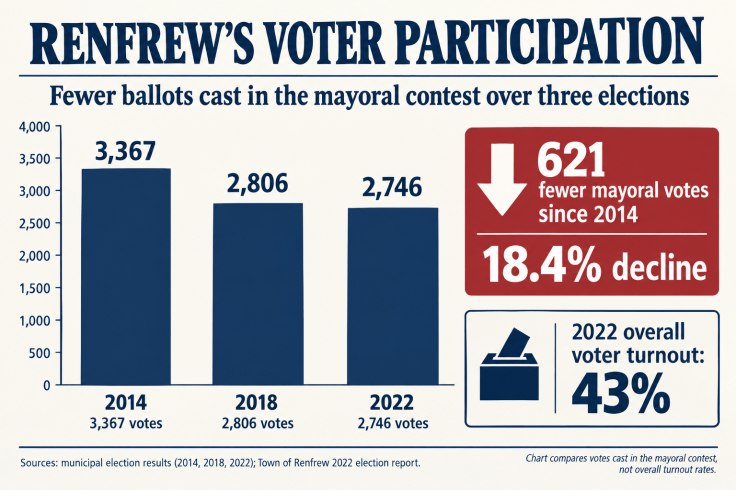
I went back and looked at the last few mayoral races. There were roughly 3,367 votes cast for mayor in 2014, 2,806 in 2018 and only 2,425 in 2022. So we’ve actually seen a pretty significant decline in participation in the mayoral race.
Why?
Is it apathy? Satisfaction? Or have people simply lost confidence that voting changes much?
That makes 2026 particularly interesting to me. Given everything that has happened over the last four years, could this election become something of a referendum on the current council? If turnout suddenly increases, I’d be very interested in where those additional votes go.
Then there’s the crowded mayor’s race. With this many candidates, we could theoretically have considerably more people vote and still elect a mayor with a relatively small percentage of the overall electorate because the vote gets split so many ways.
You’re right that 12 votes matters. I’m almost more interested in the people who didn’t vote at all.
What happens if they show up this time?“
Shane Lambert
THE RESPONSE
Okay, so that’s some more serious thinking about Renfrew’s municipal election, and it’s yet another guy from Horton Township that has a big interest in what’s happening politically in Renfrew. Anyone who has ever spent any time at the Horton Dump would understand that something as basic as a landfill site can become a hotbed of political discourse, most of it going in the same direction.
Maybe there’s just something in the water.
Mr. Lambert’s questions and observations are all incredibly valid and lay at the foundation of a political truism in democracy: you need voters to vote. And every percentage decline in the turnout of eligible voters measures the exact same percentage decline in democracy wherever it’s happening. So it’s definitely something to be concerned about.
Low voter turnout allows for the possibility of highly organized, motivated and ideological candidates to show up and take the blue ribbon for themselves even though fewer than 50% of the electorate voted for them. These are people that usually pack the loudest voices, and are also usually sewn together through shared or perceived grievance or discontent.
I’m not going to suggest there are any candidates in this race that fit that description necessarily, although Cal Scott might come to mind in a pinch, owing to the very obvious determination and intensity in his look. But ideologues? No, I don’t really think so. I’m sure all candidates have an ideological bent to some degree, but I don’t think we’re at the point where we have anyone who represents a threat to anything owing to their world view or the way they do their thinking.
In a somewhat less dramatic take on the problem, low voter turnouts also make it possible for a marginal candidate to sneak up the middle in a crowded field and then cause nothing but turbulence and trouble for the council of the municipality. Think of Lisa Robinson down around Peterborough. A troubled and angry woman backed by a loud minority and causing trouble way out of proportion to her or their actual strength. And a horrible drag on that community’s council.
Something like that would be the absolute last thing Renfrew could use right now given the condition of its finances, taxes, and well, seemingly everything else. And the municipality needs no marginal candidates either, or hobbyist candidates, or candidates running interference for others, or candidates intent on simply ruining the campaigns of rivals.
We’re in grown-up territory now, and if we’re not, we sure as hell better get there quickly. Renfrew doesn’t need any personal agendas to clutter up what’s in front of us. And we need to find people who really do put Renfrew first ahead of themselves, something that can also come up in the form of what’s known as NIMBY — NOT IN MY BACK YARD — where elected politicians can sabotage initiatives they feel might negatively impact themselves, their owned businesses, or their current situations.
A much more robust voter turnout, while there are no guarantees, would certainly make it more difficult for negative scenarios such as these to take place.
As Winston Churchill once put it, democracy is messy and a terrible way to run things. Except that it’s better than all the other ways to run things.
Shane asks where everybody went last time out? What was/were the reason(s) behind the low turnout in 2022? He also did some research and found that voting for mayor has been in steady decline for the last several election cycles, and what does that mean?
I’m not any kind of resident expert on this stuff, but I know for a fact it means something, and since I’m not sure of the meaning, it might be helpful to find out.
I can, of course, give something approximate to a somewhat educated guess.
Shane pretty much answers his own question when he talks about voter apathy and voter disenchantment with the electoral process and politicians generally. Those two would be at the top of my first guess list, as there are definitely large pockets of both within our eligible electorate, and sometimes these two things feed one another and can be summed up in the following made up sentence:
“Politicians are a bunch of lying crooks who don’t care about me or us. So why should I care about them? It’s all rigged anyways.”
Education is in no way a cure or a means to ward off stupidity, but in my experience studying numbers from my own campaigns, the people who tend to support, generally, the political world-view inherent in that statement above tend to be those possessing less of a formal education than perhaps some others. That’s not some privileged elitist thing to say. People have different levels of education and there’s nothing wrong with that. My mom didn’t make it out of Grade 8 and she wasn’t stupid, not by a long shot. And I’ll bet she secretly voted for Pierre Trudeau simply for the fact that my dad hated him and she hated my dad.
Also, if you find yourself swimming against the current in a lower socio-economic class, then apathy is going to be rampant as well. Again, people such as these don’t see themselves in politicians, but in fairness, that’s because they don’t bother to look mostly. And what can be done about that?
In 1999, in a provincial campaign, I and my volunteer group hit a neighbourhood that would be classified as somewhat lower class economically speaking. Within an hour, we had lawn signs planted all up and down the street on both sides. When we left, and feeling awesome about our achievement, we all looked back and saw nothing but our signs prominently displayed. Like man, we owned that place!
The election came and we lost, by 645 votes across the entire riding of Renfrew-Nipissing-Pembroke. What the hell happened? What went wrong?
I did the requisite post-mortem of the results, going over the numbers polling station by polling station to see if I could figure out my failings. I checked out Renfrew, of course, and when I saw the numbers from the poll where that neighbourhood voted, I saw that the number of voters was much lower than the number of eligibles. Plus, we lost that poll specifically when we had assigned it to our column. It meant one of two things. That neighbourhood didn’t support us that night, and they may not have supported anyone at all. And those that did vote went over to the opponents column. So what in the hell were they all taking lawn signs for?
I guess they must have felt it was something to be excited about and perhaps it gave them the sense of belonging given their neighbours seem to be doing the same thing, so why not them?
But vote? Get outta here, the game’s on, or maybe Surviver, you know, something way more important than democracy. Plus that very night, the brand new Walmart Superstore opened its doors for the very first time, and that must have pulled a lot of the vote away right here in Renfrew. So in retrospect, a case can be made that we may have lost that election by virtue of what happened in Renfrew alone.
How do you approach this, let alone solve it? Short answer is you don’t solve it per se, but rather you solve it by incremental degree. And it’s done by executing what I call the ground game, also known as the grunt work.
You go door to door, either alone or with support, but you make yourself available should anyone have a question for you on the doorstep. Look them in the eye, shake their hands, give them some attention. Ask them if you can count on their support. If yes, ask them if they’d like to demonstrate that support with a lawn sign. You take note and record the address and attempt to get contact information, whether that be email, text, or both. And then on election day, your team goes back at them again via phone, text, or email reminding them that it’s election day, asking them if they’ve voted yet, and whether they might need transportation or child care in order to do so if they haven’t already. In short, you make an absolute nuisance of yourself. A polite one, yes, but a nuisance none the less. Because it’s important.
Think about it. You’ve invested time, often years, to position yourself as a candidate in an election campaign, and you’ve strategized, planned, and executed on most of it. You’ve spent an awful lot of money on signs, ad-buys, and campaign literature. But with all that investment, you’re not going to knock on a door? Winning elections takes effort that extends right up until the finish line when the polls close. A dedicated ground game can certainly help with that.
It doesn’t help explain away the neighbourhood that offered to plant all our signs, but it certainly will help to get the vote out, or at least your vote out. And, by the way, back in 1999, our campaign didn’t do any voter tracking that day in Renfrew, and it may have played a big role in costing us the election.
Mr. Lambert asks the question of, if there is a higher turnout, even a significantly higher turnout, where do all those votes go? It’s a good question.
In my experience, a large voter turnout means one of two things, in short that people are really excited about something or people are really mad at something(s). I’m going to suggest that the latter is in play here more so than the former, and if that’s the case, then there’s good theory backing up the idea that it will be a vote for change, which of course is going to be problematic for all incumbents, especially if they’re on shaky ground with the electorate in the first place. The same may apply to those with previous council experience.
Also with incumbents, a lot of their voting support is entrenched, as in that support is often spread out among friends, family, associates, co-workers, and the like. If there’s any truth to this, then incumbent numbers may well not change all that much from 2022, and in some cases may have already hit their ceilings. That’s not to say that they can’t make a positive connection with a more motivated electorate and gain additional votes as a result. But in a time where there’s much anger and frustration in the land, incumbency isn’t necessarily the advantage it sometimes is. Name recognition can go both ways, good and bad.
There are also new candidates in the mix, and these candidates will bring along with them their own little voting bases drawn from the same types of people, only ones specific to their own lives. It’s here where it’s possible to divine some excitement in a campaign. If there is an impression out there in a newly attentive electorate that there is a candidate generating excitement, then that could express itself in relatively large numbers for one of the newcomers.
There are two other factors that should be mentioned.
First, in the race for council, voters are entitled to make several selections and vote for more than one candidate. Some voters use all their votes, while some choose to vote only for the people they feel matter most. After all, you don’t want to be the voter that used all your votes only to find that the guy you really wanted in there lost by a single vote to another guy you wasted one of your freebies on simply because you felt you were doing your civic duty by using up all your markers. A little cynical, perhaps, but my god, strategic as it comes.
The second thing is also interesting. Why the hell are people seemingly not voting for mayor? Is it a huge dissatisfaction with current/previous mayors? Again, the numbers are a little skewed because voters have several choices to make in the race for council but only one vote for mayor. So a vote for mayor is reflected as a one person-one vote thing, while at the same time, in the other race, it’s one person-several votes. That’s why if you were to add up the numbers of the 2022 council race for the councillors, the total would exceed the numbers of eligible voters who actually voted. So it stands to reason that the mayor vote numbers would be less because of this. But that being said, it does appear that a significant enough number of people showed up to vote last time, but decided not to vote for mayor at all.
And again, it most assuredly means something. I just haven’t sufficiently worked it out yet.

