I’ll speak in generalities, as I’m no expert. I’ve done no research to prepare for this, but I’ve done quite a bit in the past, and I’ve both written and produced video on the subject.
I’m talking about homelessness, something we all witness as a blight that has fallen upon cities and towns all over the province, some worse than others. Everyone seems to have a reaction to it, and that reaction is understandably negative in nature, especially if you happen to live in a place where you encounter homeless encampments on your way to work or school every day.
We got into this mess on our accord, mostly through indifference. Ours is a crime of omission of sorts, if not paying attention to something can be stretched to mean something in the area of omission. By and large, we choose to look the other way.
The smoking gun of this crime is in the hands of the provincial government, and not just this one, but all the ones previous dating back to the 1980’s. And their crime?
Saving us money.
I’m going to tell you right now of an inescapable fact of government. When any government says it’s going to cancel a program or programs to save taxpayer dollars, what they are actually saying is that we’re all going to pay more in exchange for less and be totally worse off than before, likely even generating a cause and effect that ends up hurting society and costing far more to clean up and make right again.
Every. Single. Time.
The homeless population is not some amorphous blob of humanity knitted together by common stories. It’s not that at all. There are distinct populations within that blob that allow us, should we ever want to, to look at the blob through the lens of its component parts. Rather than simply painting everyone within it as a loser, we can actually look and see how these people got to be where they’re at.
To be sure, as in any population, there are bad people in there. Violent people. Abusers of all sorts. Can’t just simply whitewash that fact. These are the people we tend to see the most, or cause us the most chagrin. Chugging about with their stolen shopping carts or cruising around on the bike(s) they’ve stolen and then abandoned. Shuffling around at night like a bunch of zombies from The Walking Dead, trying car handles and walking off with anything not nailed down.
These are the ones we see and complain about. In fact, they kind of frighten us.
But there are others, of course. Mental health is a huge contributor to this population, as is substance addiction, but those are two subsets within the blob. There are also people in there for strictly negative economic reasons such as job loss, disability, or poor education. Then there’s the guy who has a job, but sleeps in his car every night at Walmart so as to be close to a washroom. He’s a guy with no money left for lodging after he pays his spousal and child support. Put simply, life put him here, and while it may well be partially his fault through his own actions, I don’t think society is well-served by having him, or her for that matter, living in their cars. And while not living in the homeless encampments, living out of one’s vehicle strikes me as qualifying as homelessness.
Back in the 1980’s and early 1990’s, the Ontario government decided yo save us all a wad of cash by shuttering many of the province’s psychiatric hospitals. What they chose not to do was think through what would be the aftermath.
Where do hundreds, even thousands of psychiatric patients go after they’re turfed out of an institution designed to, if not help them, then keep them off the street so as not to be a danger to themselves or others? I do understand that the psychiatric hospitals of the day had a reputation for being something a horror writer might choose as a setting, and that’s true. But what needed to happen was institutional reform, not bulldozing the places into the ground, almost as if to remove the evidence.
And so most of those “patients” ended up exactly where anyone would end up after being cut loose by society: on the street. And meshing into the blob along with the druggies, the drunks, economically-disadvantaged, disabled, and the guy in his car.
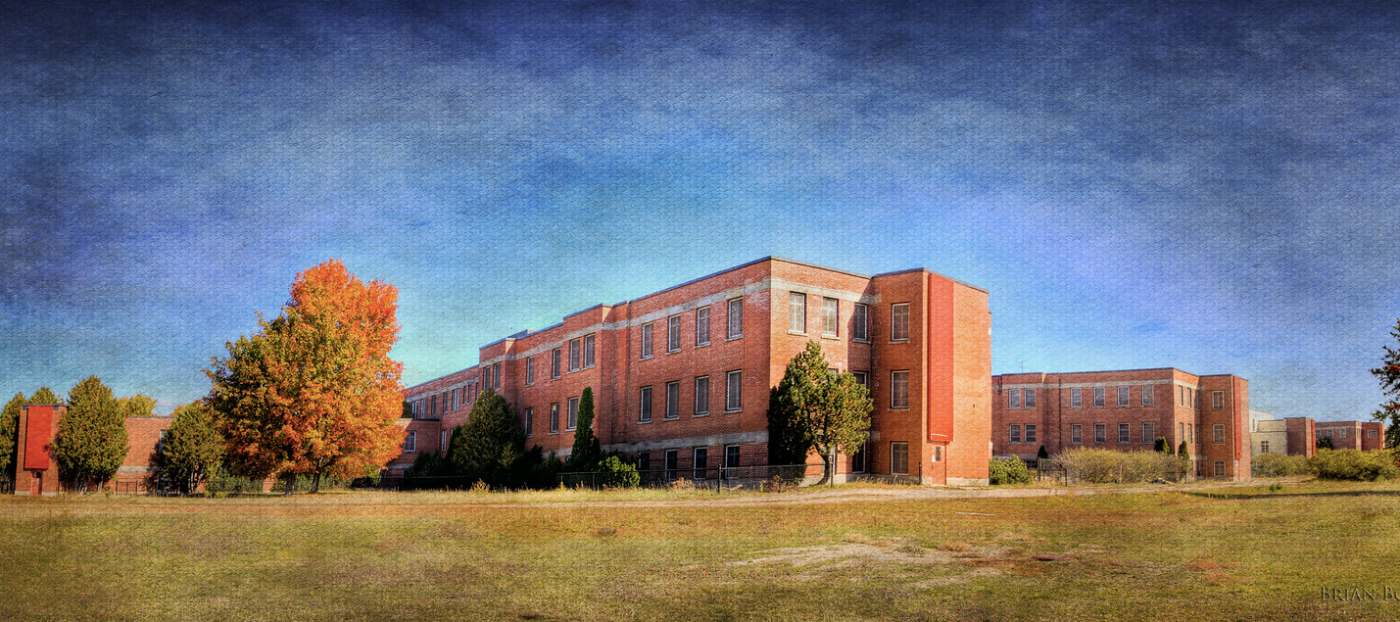
I come from North Bay, and we had one such hospital on Highway 11 North, just north of the city. It was a big one, with lots of people inside, and lots of employees too. Known by locals as “The Psych,” the place closed down and, presto, it began. I saw my first body lying on a Main Street sidewalk not long after, and I choose the word deliberately even though the “body” belonged to someone still alive and breathing.
It’s since gotten worse, much worse.
North Bay has been taken over by this scourge, and it has indelibly stained the Gateway City. Encampments are everywhere, and all the detritus of a homeless population that doesn’t give a fig spills over into what was once a beautiful city. Now it’s shopping carts, discarded needles, stolen bikes, and human excrement locals face when they go out shopping, walk the dog, go to school, or anything else that has a resident going out in public.
In perhaps the most egregious example, the Near North District School Board had to erect a fence around Chippewa High School to provide separation between students and a significant homeless camp that exists right beside the school.
There’s a Facebook Group page called North Bay Crime Beat, and another called North Bay Complaints. I would imagine similar groups could be found in other impacted cities. Scrolling through the group pages, one encounters a litany of posts that involve the homeless population.
Two things really strike home for me.
City police are being dedicated to rounding up shopping carts and an absolute pandemic of bike thefts. I can tell you, cops don’t like being put on shopping cart duty, or the Cart Squad as some like to call it. Further, police have other responsibilities then being cart collectors, and they’re a pretty expensive form of cart collection if you ask me I know shopping carts are pretty expensive pieces of equipment, and it does involve theft, but in reality, nobody gets charged with anything it seems, shopping carts, or bikes, or both. Not the greatest use of a police officer’s salary.
What’s it like to see somebody rummaging around your property at night through your security camera? Or trying to enter your home? And what if it’s a regular occurrence? What if you’re elderly and alone? Again, a police matter theoretically, and they try their best, I’m sure, but trying to keep up with this is like playing Whack-A-Mole at the Renfrew Fair.
My point is, why do these threats even have to exist in the first place? Is this all the money we’ve saved over the years working for us?
Police, fire, ambulance, hospitals, social services, all stretched to the maximum dealing with homeless-related situations. Again, big salaries, expensive equipment, all intended to deal with problems of a different sort, but now having significant resources drained away to deal with the swamp.
A scenario.
A homeless person is acting erratically in a public space, causing concern to other residents, possibly threatening in both word and potential action. Perhaps someone has been hurt, possibly the homeless person. Several citizens call 911. All sorts of stuff gets scrambled in response, with police arriving first, followed by fire rescue and an ambulance.
One way or another, this person is going to be put into a type of custody in that they may need to be restrained despite their injuries. They’ll be loaded up into the bus and the ambulance will whisk them to North Bay Regional. The person is admitted and he stays there for a month. Does somebody have a calculator out for any of this? Because we just spent hundreds of thousands, if not millions in public-sector salary to deal with this person. The hospital stay itself is expensive beyond imagination in terms of staff, salaries, equipment, bed availability, and a host of other things that make hospital stays pretty pricey.
One person.
Now multiply by all the other persons in similar circumstances province-wide, a number I don’t have, but I bet it’s a lot larger than any of the rest of us are going to be pleased with.
I’m not here to preach from a position of moral superiority or strength. There are all kinds of arguments I could make around this topic, arguments rooted in Christian beliefs and the argument that we’re all called to help one another. Aside from possibly being labelled a woke reactionary member of the Radical Liberal Left — I love the language conservatives have created for themselves — I can attack this issue on the axis of money, as in affordability to the taxpayer.
Money talks, and if we’re spending more money trying to fix a situation that some of us started, maybe we can start having a conversation about how we can do this better and even less expensively?
And not have the facts on the ground that we currently do. Clean this shit up for everyone’s benefit. Deal with the homeless problem and save money in the bargain.
So what if I pull all the mental health cases out of the homeless population? Would that help all by itself? What percentage of that population does mental health make up? I don’t know exactly, but I bet it’s a percentage large enough to make a noticeable difference on the street.
I‘m not suggesting we should re-introduce the House of Horrors up on Highway 11, but perhaps we could build a somewhat more enlightened facility that’s a little more therapeutic and a lot less padded rooms and jail bars. I’m not the expert, but surely we can come up with some form of institution province-wide that doesn’t smack of a Stephen King novel.
In fact, there’s actually a psychiatric component to the more recent North Bay Regional Health Centre, which is welcome, albeit on a much smaller scale than The Psych.
It’ll cost money, to be sure. But over time it will cost us much less than having municipal police rounding up shopping carts or responding to incessant calls for service involving homeless people. Same for all those other agencies, the hospitals, and the jails.
Now that we’ve pulled the mental-health crowd out of the pile, let’s go get the druggies the help they need. Again, it will require investment, but again, that investment will remove them from the street, to their benefit and the benefit of all others. There are experts in the social services and social agency fields. Let’s ask them to come up with something and then invest the cash needed to make a significant dent. As with my argument above with mental health, I believe this will be far cheaper in the long run and would help remove pressure from agencies and institutions already bursting at the seams. And it’s more people off the street.
In their turn, let’s identify as many sub-sets of the homeless population and deal with them. Let’s go in there and dig out the runaways, the disabled, the economically disadvantaged, the drunks. Let’s find a solution for these people too. Maybe it’ll cost money.
So what? it’s money better spent, both morally and economically.
One of the biggest hurdles in the way of making any improvement to this situation has to do with a mindset by many among us that these people need to be managed from a punishment and law and order point of view. That’s it’s a criminal justice issue. That’s wrong-sighted in my opinion, and it pretty much looks in action the way things do right now. It’s easy to get all tough and threaten crackdowns, politicians waving red meat in front of their anger-inclined audience of supporters. It’s these people who are costing us the most money because they simply get in the way by inserting their anger into a situation that has a bit more nuance than that. Their core belief is that these people are all on the street of their own volition, that it’s their fault, they deserve it, so piss on them, they’re getting what they deserve. That kind of attitude has caused trouble for as long as there have been people walking the earth.
It’s also a very expensive and counter-productive attitude.
We can do things about this, and while our reasons may differ, that doesn’t matter if we make a significant dent in the homeless population across Ontario. So if the motivation to do something comes from your morale character, then awesome. But if it comes from a cold, hard, impersonal calculation of costs and savings? Well that’s also awesome.
And if you can come at it from both of those points of view, then that would be extra cool.

