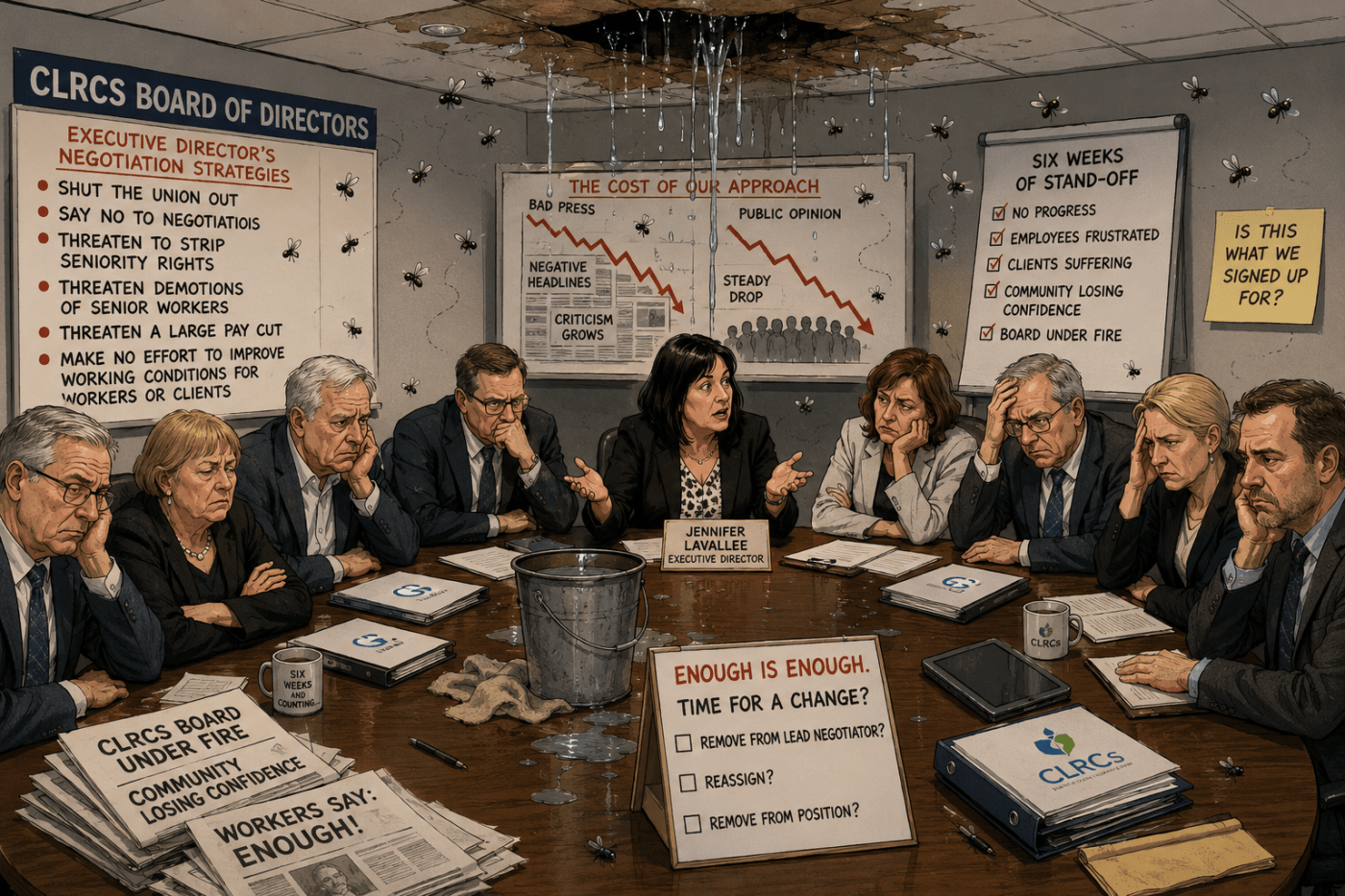
To hear the government tell it, the labour dispute between Community Living Renfrew County South — CLRCS — and Local 472 of the Ontario Public Service Employees Union. — OPSEU — is a matter solely between the employer and the union.
That, generously put, is just not true.
And they know it but say it anyways, even with a straight face, something populists like them seem to thrive upon and take pride in. To them, Conservative MPPs, deflecting truth is an art form.
There are reasons why this strike is still going on, and there are reasons why there are other groups on strike against similar agencies also involved with tending to the needs of disadvantaged Ontarians.
Aside from what I consider to be questionable tactics on the part of executive directors across the province, including those seemingly employed by our very own person right here in Renfrew, the number one reason this strike is happening, and why strikes in this sector tend to drag on more than in others, is the simple fact that the provincial government doesn’t come anywhere near funding these programs adequately. And what funds are available, they appear to be quickly gobbled up by managers and administrators. It seems precious little trickles down to the clients or the workers who care for them. And all of this seems to have the approval of Boards of Directors in each of these little kingdoms, volunteers who may be inadvertently serving as cover for the executive directors who really seem to be calling the shots.
The government saying they’re not involved is not just disingenuous, it’s flat-out dishonest, and it removes an awful lot of credibility from anyone spreading that notion as gospel truth. Loss of credibility on a government level, but also a commensurate loss of credibility at the personal level for anyone who chooses to sing from that song sheet.
I have some simple questions:
- To what extent, if any, is the Board of Directors involved with the formulation olf bargaining strategy on behalf of CLRCS?
- Does that same Board have oversight responsibilities over the Executive Director?
- Does the Board of Directors have power of leverage or influence over the Executive-Director, and by extension her negotiation strategy?
If the answers are none, no, and no, then it would appear that the Board is not a direct party to the negotiations, not that there are any negotiations. But if that were to be the case, then it begs yet another question.
As in what is it you guys do, anyways? What’s the point of a Board of Directors in the first place if it has no real traction with the folks who actually run the place? Surely such an august collection of people wouldn’t be putting their names forward just so that they can be used as a pretty window display, giving the picture of an organization well and responsibly governed, and one that is governed justly.
If you do have that traction, then why would you seemingly let the management class dip heavily into the bag of coins the government hands you every year, treating themselves to competitive executive salaries, while your employees languish far behind workers in other, similar sectors? To make that optic even worse, it appears that our own executive director has put forward demotions and pay cuts for those same workers while she, herself, basks in the light of what is known as the Sunshine List.
It’s a bit of a disconnect, don’t you find? Maybe a lot of a disconnect if true.
So, another question. Is it true? If it is, maybe just say so and defend the rationale behind it. Or do you feel that, if true, then that disclosure would be a tough sell in the commnunity?
What could possibly be so attractive about appearing to beat up on workers and vulnerable clients?
The silence around all this is deafening and I believe it works against them mightily. It gives the appearance of complicity in the strategy adopted by the Executive-Director.
Surely Board members must see the problems and hurt all of this has caused, but nothing appears to be said. Surely silence in the face of that means something. It’s what it means that’s confusing to the rest of us. But yet nobody says anything, making it harder for community members to work it out for themselves.
At what point do you become concerned, possibly even embarrassed by the position you find yourself in, a position you may find uncomfortable and awkward? When does it finally hit you that you may be totally on the wrong side of this?
You have options.
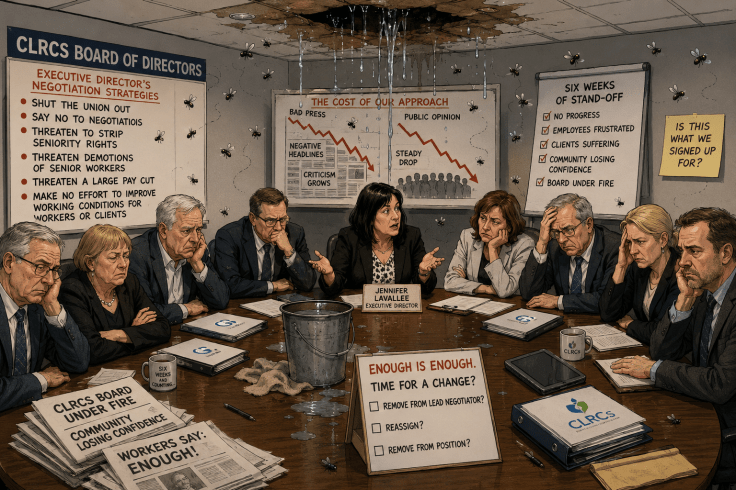
Oversight is not the same thing as rubber-stamping, especially rubber-stamping really bad policy. Nobody should need to have that pointed out to them. It is , at least to me, pretty self-evident.
If you have any influence, imagine the good press that would result from getting your Executive-Director to the bargaining table with a wllingness to actually bargain in good faith. That would be a huge positive step, and one welcomed in the community. Imagine the freshness that would come from showing people that you have a desire and willingness to come to a fair agreement with your employees.
Maybe you can get your Executive-Director to stop threatening everyone with loss of seniority, demotions, and pay cuts. Try to make her understand that threats don’t represent good-faith bargaining. Try to point out that things like integrity, honour, fairness, and respect are good traits and not any kind of weakness. Others view these characteristics positively. They don’t like the look of bullies, and many aspects of her approach to all of this has the appearance of bullyism, if I can make up a word on the fly.
Can you simply replace her as the lead negotiator?
This situation will require courage on the part of someone, or group of someones, to bring to a fair conclusion, and transform it from the current train wreck it appears to be.
It may well be that we’re looking for a hero to step forward, or group of heroes.
And you never know exactly where such heroes come from, but they’re often ordinary enough people who step up as the situation requires.
Maybe even surprise us.
 NEWSMAGRENFREW