It troubles me to report on this.
Part of my efforts to cover the work disruption between CLRCS and OPSEU Local 472 involve me talking to people, that is people who have some sort of stake in the eventual outcome. That will have me making attempts to speak to people on either side of the issue, although I’ll admit to not having very much exposure to the management side, probably because they likely think that I’m some hack working for the union. They’re wrong about the union part.
That said, I’d be more than happy to speak with any representative management might like to throw out there, but again, I don’t have a lot of confidence of such an outreach taking place from that quarter. But the invitation still stands.
Imagine, another invitation to talk that will likely be ignored. More than likely outright scoffed at. But I get it.
If I were them, I wouldn’t really want to talk to me either.
Oftentimes, I find myself talking with stakeholders of another type, the families of developmentally-challenged adults who are the clients of Community Living Renfrew County South.
Some of these people are forthcoming and are willing to speak on the record, or even agree to do a short video interview. These are people with plenty of experience with the system because they spent many years having a loved one within it. So they’ve seen all the ups and downs and the lefts and rights, the good, the bad, and unfortunately even the ugly.
But for every one of this type, there are several others, equally experienced and for the same reasons, also willing to talk, but wishing to do so without attribution. And then there are the others who just don’t want to talk at all.
I don’t think this has the scientific or statistical veracity to issue any kind of broadly conclusive statement, but I will say that, of the people I’ve spoken to, not one has thrown their hat in with management. I know, statistically, that there are people out there who would support the Executive-Director, I mean there must be, right? It’s just that i haven’t really been able to find anyone who skews that way. If they’re out there, I’d truly like to meet them so as to satisfy the notion of balance in reporting, or more accurately, commentating.
Even the people with absolutely nothing to say seem supportive of the striking workers, but would prefer to not be public with their own opinions.
Unfortunately, by not saying something, they’re actually saying something, something concrete and profound.
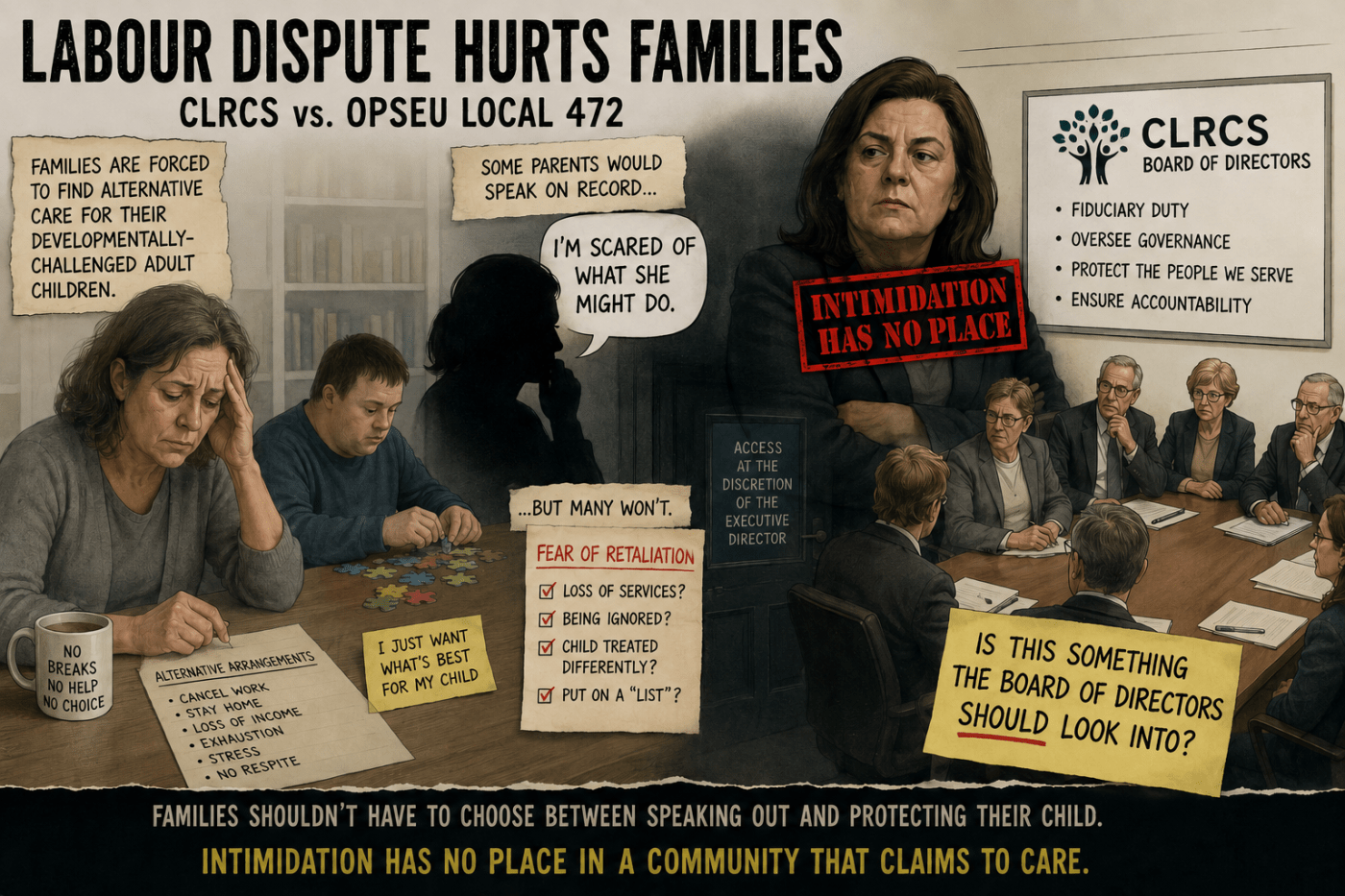
Many have indicated that they’re not talking because they fear retribution from the Executive-Director.
You read that correctly, as hard as it was to write it and see it in print.
They’re afraid that their children may become targeted by a vengeful Executive-Director after the fact, when this is all said and done. That they may wake up someday and find out that their child no longer qualifies for services, or for certain services, or may have their access to services cut back or cut off altogether.
And so what are the rest of us to make of all this?
I had someone reach out to the families currently with clients receiving services from Community Living. I wanted to know, aside from the periodic emails regarding the strike, if Jennifer Lavallee had reached out to them individually to ask them how things might be going. After all, these clients are all in a new world right now, with replacement workers, reduced supervision, and reduced services. To say they’ve been impacted negatively would likely be a huge understatement. After a couple of days had past, I got my answer.
Zero.
Admittedly, not every single person was able to be contacted. But of those who were, and there were more than several, the response was the same. Nothing. Zero. Crickets.
What combination of factors would make something like this acceptable?
Deflection, intimidation, and retaliation. More words to go with this dispute-related vocabulary, to join favouritism, nepotism, and cronyism. Other words that have been thrown out there by people I’ve spoken with. Six words with terrible connotations, if they’re all true. Or even if any are true.
It’s easy to toss words like that out there yet harder to prove them to be true, and that needs to be said. And I do understand that emotions get raised during strike actions, especially ones that go on for many weeks. So yes, the temperature is raised, and that’s to be understood as well.
But that said, I’m talking to a lot of people, and it’s not like they all come from the same place or even know one another. Some of these folks live in what seems to be isolation, caring for their adult children alone in the absence of developmental services. Their world is absorbed in the here and now, so it’s not like they have a lot of time to be reading blogs or attending rallies.
But almost every one of them said the same thing or something very similar: that they’re afraid of the Executive-Director.
How can this possibly be? Especially in an agency tasked with delivering services to developmentally disadvantaged adult-children. The picture that comes to mind right off the hop is of someone at the head of the operation who serves as the guiding focus towards a positive experience for all concerned, be they clients, families, and employees.
Yet from what I hear, that’s just not what the situation is here. In fact, in addition to the fear they allege to have, they also have a deep-seated suspicion of the Executive-Director and her motives, let along tactics.
Is this something a Board of Directors might want to look into?
FEATURE IMAGE RANDOMLY GENERATED USING ChatGPT
 NEWSMAGRENFREW