I’d like to loosely discuss the Board of Directors of Community Living Renfrew County South. And I should be able to do that without eliciting a wave of hysteria form anyone over on the management side of this labour dispute.
My goal is not to disparage or discredit anyone. I’ve already made clear my opinion that the members of this Board are all exemplary human beings, at least so far as I’m ever going to know. But I’m a critical thinker, just the way we were all taught to be, so you can’t get all bent out of shape when that critical thinking is directed your way.
Critical thinking isn’t employed to embarrass or ridicule anyone here, but rather it’s an attempt to simply not accept everything in front of me as established and unalterable fact. And so this process involves asking some questions.
And there are people around who don’t like that.
When faced with questions that may require awkward answers, the response is to circle the wagons and dig rifle pits, thereby adopting a fortress mentality of defensive thinking, a mentality that does nobody any good, no matter what side you might find yourself on.
Any questions I have do not relate to the character of the person. I believe we’re all fine people, and all of us want the “right thing” to happen here. It’s just that, for whatever reasons, we can’t seem to agree about what the right thing is or how to get to it.
Inherently. There is no good nor any evil attached to any of this, but it it’s important to note that, the more closely people adhere to a certain philosophy or ideology, the harder it is to move them off those positions, thereby making compromise difficult.
I’m simply wondering if the composition of the current Board of Directors for CLRCS has had an inadvertent role to play in the length of this work stoppage, now entering its eighth week.
To be honest, I don’t know what role, if any, the Board of Directors plays in negotiation decisions. They are, after all, volunteers, so maybe they’re more of a paper tiger kind of Board, window dressing that doesn’t reflect the reality of what’s on the store shelf or in the back room. But again, I don’t know this, mostly because nobody wants to say anything that might help make that clear. The agency organizational chart shows the Board in an oversight position over the Executive-Director, which is kind of weird given my suspicion that Board members were actively recruited by that same Executive-Director. All, you have to do is look at the requirements for Board membership displayed on the CLRCS website. It’s right there that you might be able to begin seeing my point.
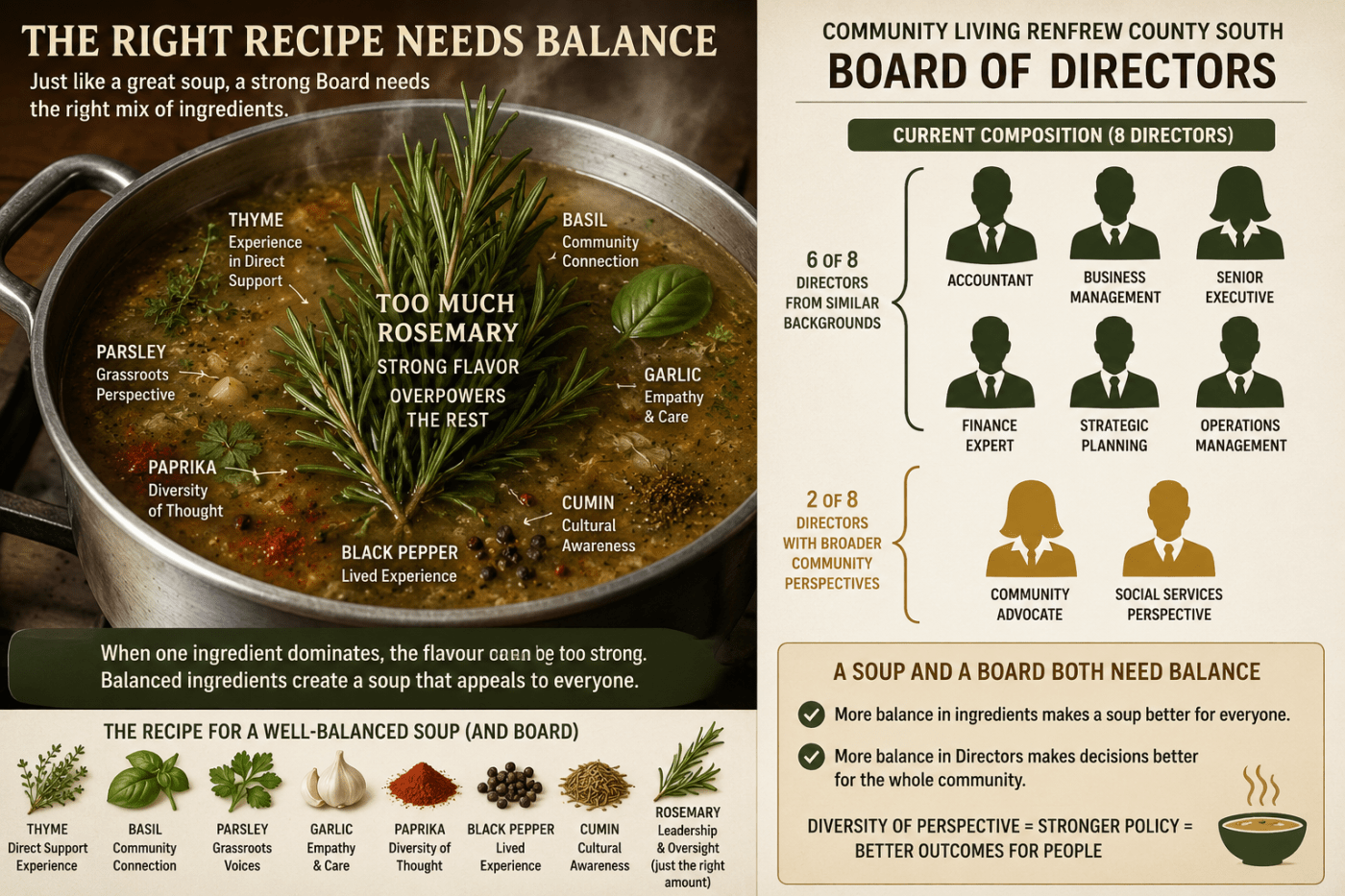
Because the so-called requirements significantly narrows the field of possible candidates for Board membership. Aside from a single criterion that lists experience in the areas that this agency operates in, all the other criteria are aimed at accountants and managers, executive class types. So, in short, it’s my view that this Board was constituted specifically to be a management-heavy Board. Fully six of the eight Board members fall into this category of management, accountant, or human relations types. To me that’s kind of top-heavy, and it wouldn’t surprise me in the least if this Board, or at least 75% of it, shared the same world view as the Executive-Director. Which would mean that, if they do have any sort of power or leverage, they’re likely not going to use it, seeming content to come across as de-facto rubber stampers of the actions or inactions of the Executive-Director herself. I know from research that the Board president, himself, takes an active role in labour relations with the entity that employs him, and I doubt very much that he’s overly imbued with a point of view that would be friendly to anyone involved in organized labour. I can’t say experience like that necessarily influences anything happening in this fight between CLRCS and OPSEU Local 472, but then again, I can’t necessarily rule it out either.
Maybe I’m wrong, but with nobody on that side saying anything, one can’t be totally sure of anything. And then again, maybe I’m right. Maybe I’m actually making a legitimate point.
Admittedly, there’s no such thing as a perfect Board. It’s just like the perfect soup or pasta salad, everybody’s grandma or mother makes the best, but all those soups and salads are different. And the differences come through the ingredients used and their proportion to one another. Too much of this or that, or not enough of this or that changes the balance of the dish. Some people might really like Sally’s soup, while others may hate it. All it takes is for somebody to throw dill or dill pickle in there and it changes everything.
Not to be overly simplistic, but as it works in the world of herbs and spices, perhaps it also applies in the area of Board compositions and make-up.
Herbs and spices can be categorized in several different ways, like origins, flavours, heat-invoking properties, and intensity. Too much of one or not enough of the other makes a real difference in the outcome of the final dish.
I’m going to suggest that, when this current Board of Directors was hammered together, it was done with a view to having a certain type of individual seated, a person with a background and qualifications as an executive or senior manager. Meaning that the Board seems to have been purposely constructed to put in place people who would support the Executive-Director. It appears that their role is to back up management first and foremost, and perhaps not so much to consider or weigh the possibilities of any counter-arguments or competing world-views. To date, I’ve heard nothing to the contrary. All I hear is how I’m somehow disparaging these people, something I seem to accomplish through the simple act of asking questions. Maybe if they answered these kind of questions there’d be no need to look so intently at any if this.
It’s my position that there’s too much rosemary in the soup. A very strong herb that overpowers all other herbs if used incorrectly.
I’d like to know who came up with the list of Board member requirements on the website. Where, or from whom, did those requirements originate? Did Moses come down from a mountain somewhere with tablets listing these requirements? Or do they originate at a more local level? And if that’s the case, then where at the local level, or more properly, who at the local level is responsible for this?
It’s not an accusation, it’s a question.
Don’t get me wrong, I have no problems with accountants and senior managers. I know many of them, and by and large we’ve been able to co-exist rather happily to date. But I don’t know if I’d want to have a barbecue where 75% of the people present are accountants or senior executives, just like I wouldn’t want 75% of any other single type of person, especially teachers.
Too much of one thing skews the experience.
I’m not faulting anybody on that Board ol Directors for being an accountant, money person, or senior manager. They’re all, great people. I’m just saying we might have too much of an emphasis on the same type of professional person and less emphasis on good old-fashioned community membership that reflects more broadly what the community looks like. There’s a place for business leaders and executives, but so too is there a place for other kinds of people as well. Maybe people who could be stronger advocates for the “people” part of this dispute, the human aspect, rather than folks who simply hew to the bottom line. People who may not be aware that their efforts to shut out a union appears to make them look like they’re doing everything they can to make bad government policy work, rather than making an effort to change bad public policy so that it better matches up with the goals of the agency and the needs of the people that it services.
Everybody knows that serious underfunding from the provincial government is the root of all the problems between the parties right now. You’d think that would bring us together in common cause, but sadly it doesn’t. We seem to have one party that’s willing to accept the fact of program underfunding, almost as if it’s a done deal and can never be changed. But there is nothing in this world so absolute as to be impervious to change.
Some of us see a world that we want to improve wherever and whenever possible. But others appear content with the status-quo, even if it’s patently unfair in tone and action. These types would shrug their shoulders and accept the bad rather than make any attempt to make the bad less so.
Goodness, we wouldn’t want to offend the provincial government, right? They’re the ones who pay the freight, albeit it through their inadequate funding. The same dwindling stockpile of cash that leads to management concluding that contract-stripping, seniority-stripping, and wage-stripping of unionized workers is the way to go, while at the same time manages to find a pool of cash to give the Director a 10% raise of her own?
Which leads to another legitimate question: Who made the decision that a 10% executive raise in the face of reduced government funding and increased operational costs was a good idea? Does the Executive-Director have the power to hand herself such a raise, or is this the hand of the Board of Directors at work? I’m just asking who or what group of people thought it would be a good look to give an Executive-Director a 10% raise in the face of all the financial challenges facing the agency? Seems a little inconsistent to me.
Might be too much rosemary in the soup.
If I’m being critical here, it has less to do with the Board members themselves and more to do with the person or persons who put this Board together in the first place. Upstanding community members every last one of them.
Just maybe too much of the same thing.
 NEWSMAGRENFREW