Documentation is important. Recently, I feel I got some, albeit indirectly. Nevertheless, it was Important.
An email from Executive-Director Jennifer Lavallee landed in the inboxes of clients and client families, people connected to Community Living Renfrew County South through active participation in agency activities and supports. In other words, their children are the direct clients of the agency and its mandate.
The email was very sure of itself, and I don’t mean that as a criticism. It was definitely addressing union talking points, and assertively countered those talking points in what struck me as a confident manner. So the tone of the message sounded less defensive, at least that’s what I feel I noticed.
But what made things different for me was her attachment of a document that claims to be a Letter of Understanding between CLRCS and OPSEU Local 472 as to the remedy required after the repeal of Bill 124.
I have no reason to doubt or question the veracity or integrity of the document. The signatures are there for anyone to see.
I’m not a lawyer, so there’s that. But I do know how to read.
And if what that document says is true, and if I’m reading it correctly, then in my opinion, the union local reached an agreement on a Bill 124 remedy, the terms of which are laid out in the document. I still struggle at the uniform application of $0.35/hour to all employees, even at different wage rates, but I still see it there in print. I’ll not pretend to understand the mathematical process that arrived at these figures, or how they work or apply to the situation. But still, I can read, and I see those final numbers.
Numbers agreed upon.
The document I saw seemed to strongly indicate union agreement with the payments and wage adjustments as set out in the agreement that included the negotiated resolution of what was referred to as the Bill 124 Wage-Reopener issue.
Two statements catch my attention:
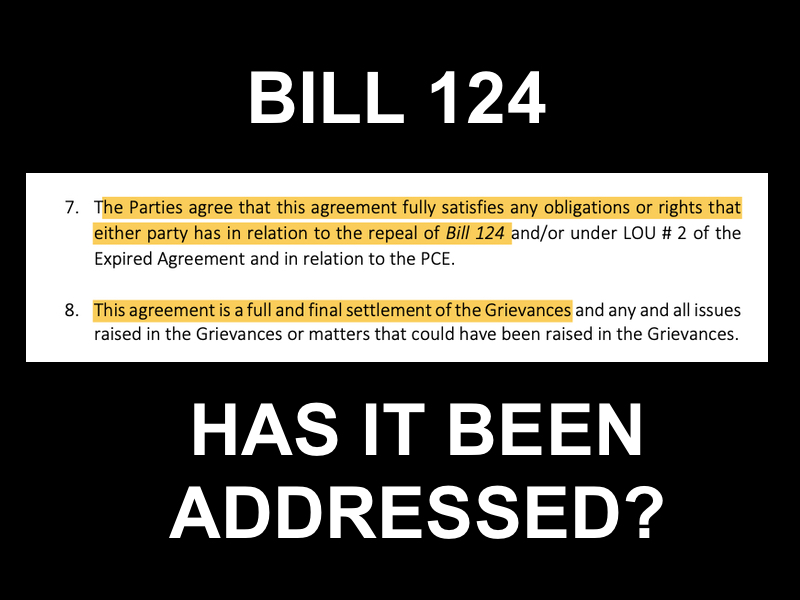
- “The parties agree that this agreement fully satisfies any obligations or rights that either party has in relation to the repeal of Bill 124”
- “These payments are the full and final settlement of the Grievances”
This is pretty definitive language. And it’s not a terribly long document. Anyone signing the document would not have missed it. It’s difficult to interpret in any other way than to take it as an agreed-to resolution of the Bill 124 remedy.
Also, if I read it correctly, the only way that this issue can be re-examined or re-visited is if the provincial government were to provide the agency with additional Bill-124 related funding. I’d be surprised to see that, but if it were to happen, the parties agree to sit down and talk about how these new funds would be distributed.
Terrific. More talks. And more non-talks. More politics from all sides.
I could go into a lengthy interpretation of this document, perhaps paragraph by paragraph, clause by clause, but I think anyone interested could get the information they need through my highlighted copy posted below.
As I said, it’s not a lengthy document, and despite some legalese here and there, still gives a pretty solid impression that an agreement was reached between CLRCS and OPSEU 472 regarding a financial resolution of the Bill-124 remedy.
I honestly had no idea it was up to each union local, of any public-sector union, to be negotiating Bill-124 remedy settlements on their own, independently of some higher organizational authority. I’m surprised this kind of thing isn’t part of some overarching provincial delivery framework featuring a common and consistent formula that’s easily understood.
If this document before me was intended to be easily understood, then I’ve failed in that regard, because I still don’t fully get it. While blessedly short in length, it’s also critically short on definitive language. An attached appendix providing some insight into how this “remedy” was calculated would have been helpful.
As it stands, it appears to be a document that both sides can now fight over after the fact in terms of how it’s interpreted and what it actually means. More money for the lawyers and consultants.
Nevertheless, despite whatever shortcomings it may have, the document is signed by both parties. So whatever it means exactly, it was agreed to. It seems to be a valid agreement.
As it stands, unless presented with an explanation that provides greater clarity, I feel I can no longer criticize the agency, nor its Executive-Director on this point.
Again. I won’t pretend to understand how the amount of $0.35 / hour was arrived at, but the salient point is that it seems to have been agreed to and signed-off on.
 NEWSMAGRENFREW