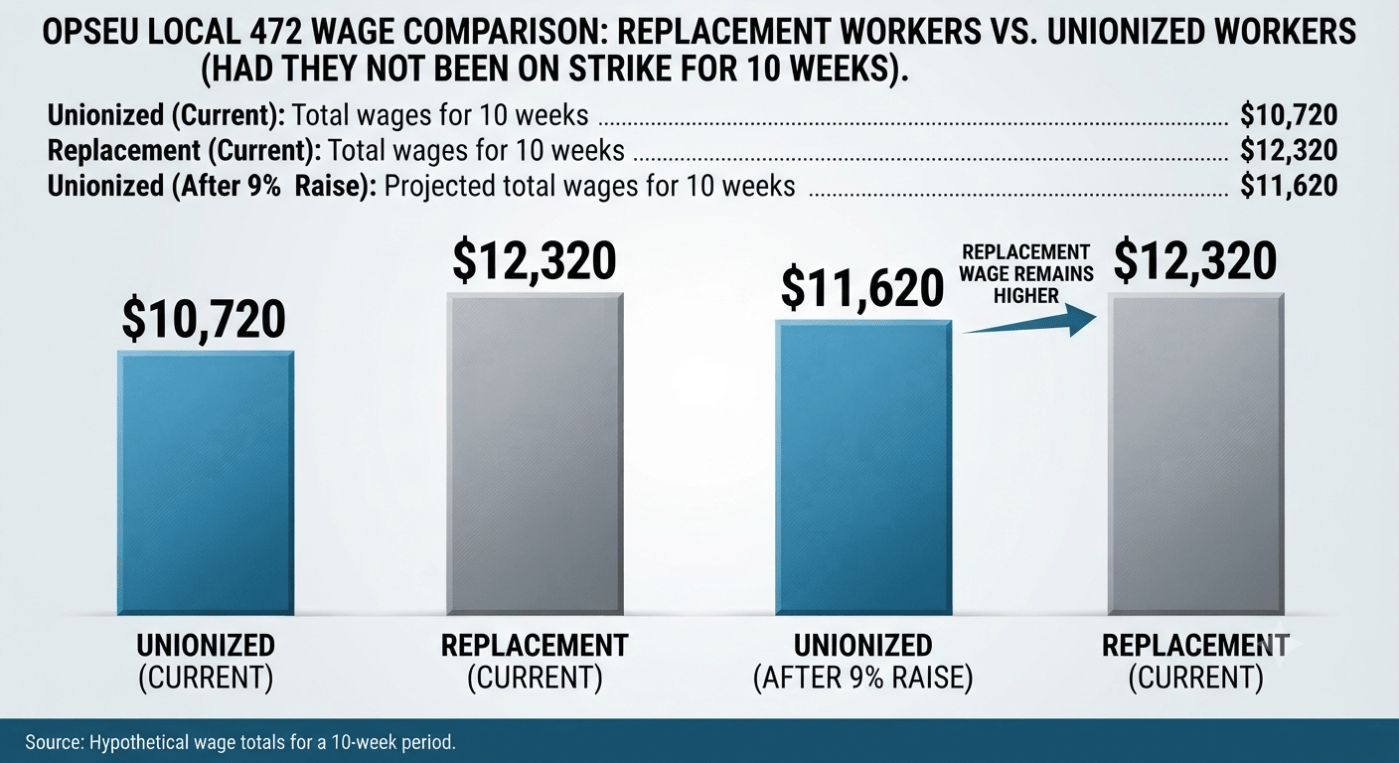
According to CLRCS Executive-Director Jennifer Lavallee, there’s no money to provide raises for her striking workers.
So that got me thinking. Maybe it’s time to take stock of how much this labour dispute has cost us, the taxpayers, in dollars and cents.
Although the strike has now reached its twelve week mark, I’ve arbitrarily selected a ten-week period to make a comparison between wages earned by replacement workers over that ten-week period and the earnings an OPSEU Local 472 member would have earned had they worked those same hours.
This is an imperfect exercise as there are a lot of moving pieces involved. Different workers have different qualifications and different experience, so they don’t all make the same money. Some work days, and some work nights, and some do both, with the hourly rate being influenced by a premium of about $4.50 / hour being added on to the hourly rate for overnight shifts.
As imprecise as it may be, I believe we can still see the broad strokes of the painting by performing this cost comparison exercise.
First, some assumptions affecting the numbers.
I don’t believe the replacement workers are being paid any differently, one from the other. They all make $4/hour more than the workers they’re replacing, but there’s just no way they’re being paid anything more than what a Level 1 worker might make, so I’ve used numbers that reflect the earnings of a Level 1 worker.
I don’t believe any replacement worker would be compensated at the hourly rate of a Level 3 worker who has enhanced education, training, and experience built into their hourly rate. There’s just no way. And if they were, then that would just skew the data in an unfavourable way for management
I don’t even know if the replacement workers would receive the premium for overnight shifts, but I did allow the premium to be inserted into the calculations for their hourly rates. For the sake of argument.
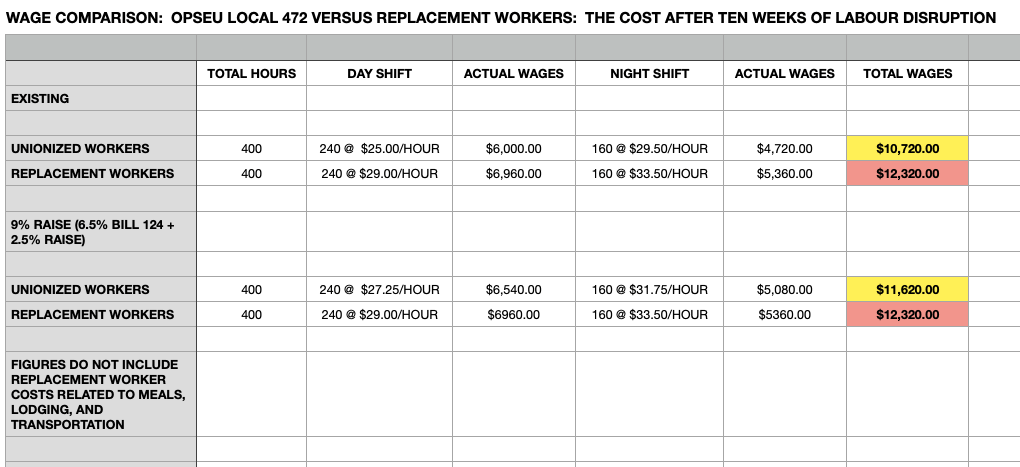
Based upon a 40 hour work week (you have to start somewhere, so overtime isn’t factored into this), 400 work hours have gone by in that ten-week period. For the sake of argument, I’ve arbitrarily assumed that workers would work both day and night, so I’ve further assumed that each worker would have two overnight shifts a week, which results in 160 overnight premium-influenced hours per employee over the same period. Again, these are not perfect assumptions, but with nobody feeding me information, I have to start somewhere. So I have to preface these assumptions with the old “for the sake of argument” thing. As I said, you have to start somewhere.
So there will be no perfection here. But there will be something, and if any of you out there have the precise numbers, then go ahead and do your own calculations. While your results will differ from mine, I’ll bet the big picture will look pretty much the same.
As I said, broad strokes.
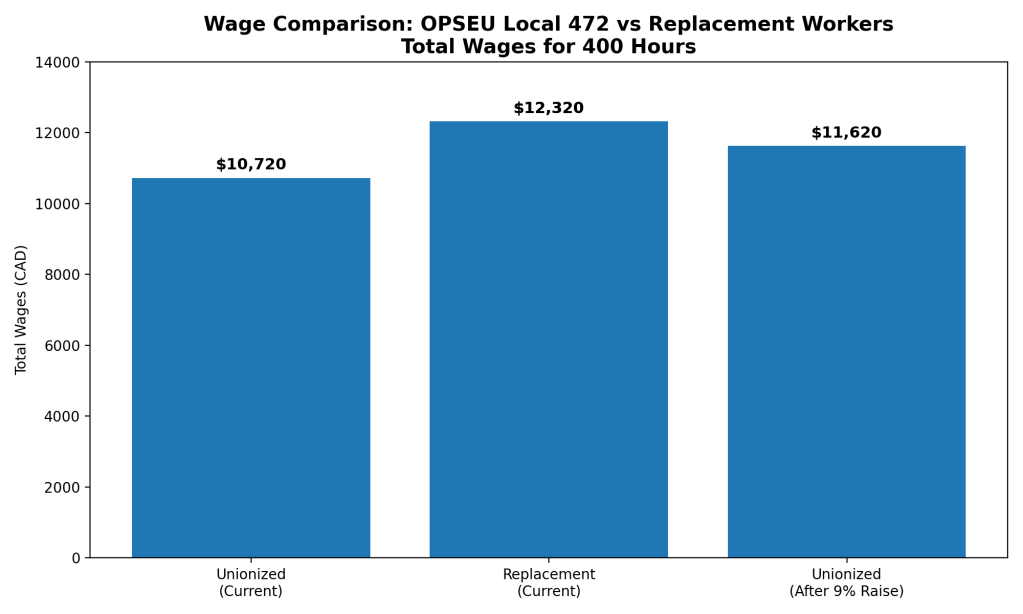
I apologize in advance for having to speculate here, but it’s not like the management or government side of this whole mess has been forthcoming with information of any sort. And nobody really feels terribly comfortable talking about their wages, so information contained in the table and the attending bar graph are good-faith estimates based upon what I’ve learned from asking as many people as I could. Hardly the most scientific, but you work with what you have. It’s not like I’m on anybody’s speed dial when it comes to this stuff.
So the numbers presented aren’t perfect. But that aside, conceptually they remain relevant.
Another important point to make is that there is no way of knowing how much it’s costing the government to put these replacement workers up in hotels, to feed them, and to transport them to work sites. As well, I have no information of the cost of all the private security and investigative personnel that have been hired, along with their attending expenses. Having that information would result in a very pronounced differential in costs when comparing replacement worker earnings with those of OPSEU personnel had there been no strike at all.
I provide two scenarios:
- A comparison that reflects no changes from the status quo.
- A comparison that reflects the workers receiving their 6.5% Bill 124 remedy along with a modest 2.5% wage increase, for a total raise package of 9%. There’s a dispute between the parties as to the validity of the 6.5% retroactive payment involving Bill 124. In light of this, I’ve included the 6.5% to maximize the Level 1 union workers. As including this percentage yields a higher wage result for the worker in this scenario, it stands to reason that it not being included, for whatever reason, would yield even less money for the unionized worker, and therefore a more negative differential as compared with the replacement workers’ wages over the same time period.
One final important point to make. The replacement workers are unlikely to have the qualifications of the workers they’re replacing. That’s me speculating, but I don’t think I’m too far off the mark.
All this said, I’ll just let the numbers speak for themselves.
And remember, Jennifer said that there’s no money. So I don’t know if the wages are coming out of her operational budget or if they’re being paid by that mysterious entity known officially as the “funder,” which everyone knows is the Ford government when you rip off the mask.
With that, I leave you with my results.
FEATURE IMAGE GENERATED VIA GOOGLE GEMINI
INTERIOR BAR GRAPH GENERATED VIA ChatGPT
TABLE IS ORIGINAL
 NEWSMAGRENFREW