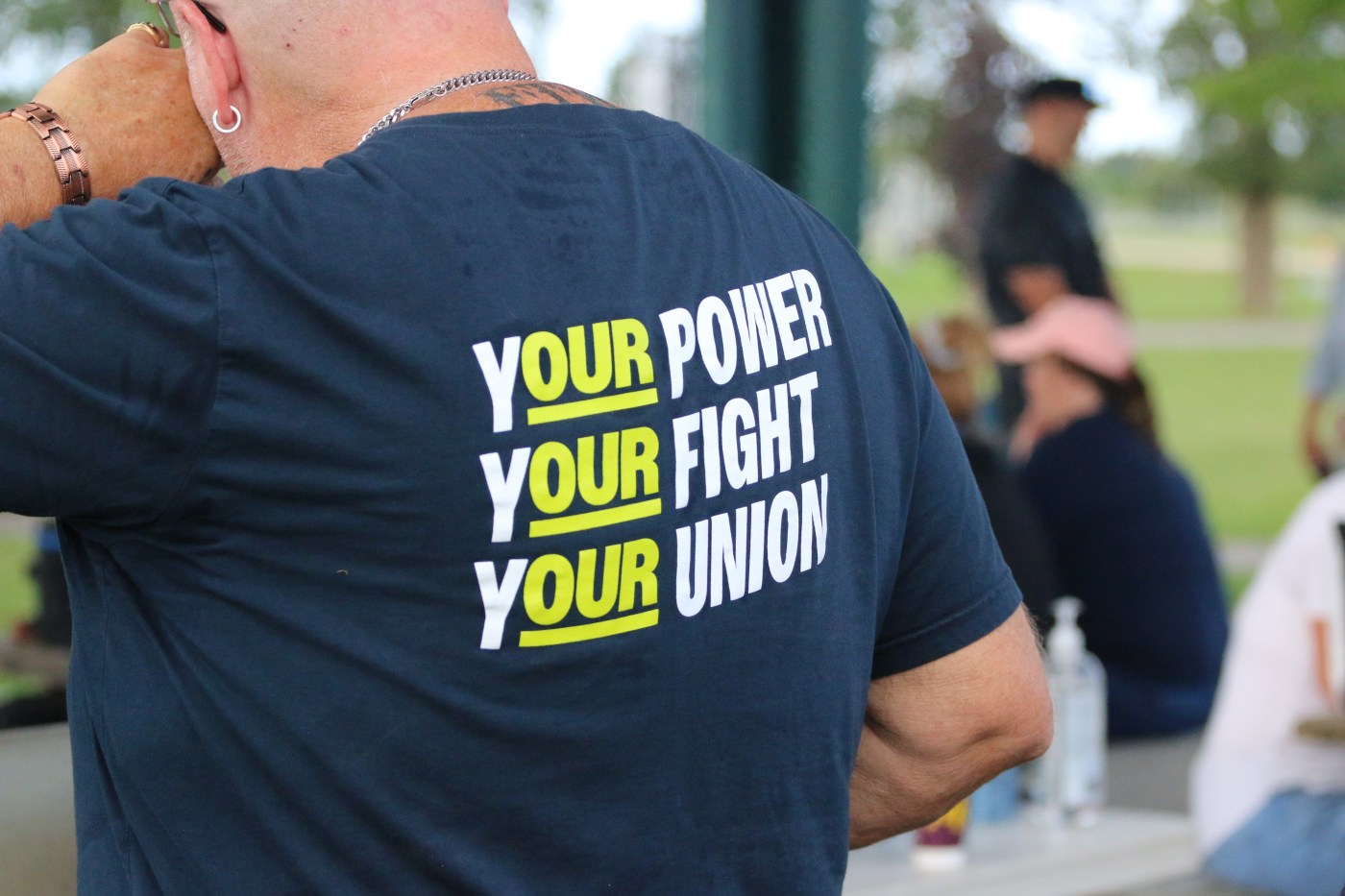
There’s a pronounced human story as to what happens when you and you’re employer are locked in a 12-week labour dispute that just doesn’t seem to have any end in sight.
Being on strike and walking a picket line are not generally things that most people want to do, and in truth, not something a lot of people have ever done or experienced in their lifetimes.
I personally have been on strike and walked picket lines twice, but never for any length of time even close to the multiple weeks spent on the line by members of OPSEU Local 472. My greatest stretch was for perhaps three weeks, maybe two. But even though it amounted to a couple of weeks each time, there were still a lot of things learned from the experience. People things primarily, and I guess that makes sense when you have over 80 people involved in a very challenging strike action.
You see a lot of people. People at their best but also people at their worst. It’s unavoidable. And if I could begin to see the storylines develop after only two weeks, I can imagine what things might be like after twelve.
I’ll begin with the simple and obvious assertion that 12-weeks plus on a picket line is emotionally and financially exhausting.
It’s not necessarily like that at the beginning. At the start, there’s a whole range of feelings and emotions, fear and anxiety being right up there among them. But you kind of have that fight or flight thing happening at the start, with the adrenaline fueling a critical sense of solidarity with your fellow impacted workers. The first few days walking the line can actually feel exciting, even energizing. You’re together with familiar people but in an unfamiliar context. Cars go past and motorists honk, everyone cheers and waves, and all kinds of people wearing purple OPSEU shirts wave signs and flags singing their tunes of solidarity. Your clients and their families even show up
But twelve weeks is a very different proposition. Twelve weeks is not two weeks. I think I can safely say that, to a degree anyway, after twelve weeks, the novelty tends to fizzle out.
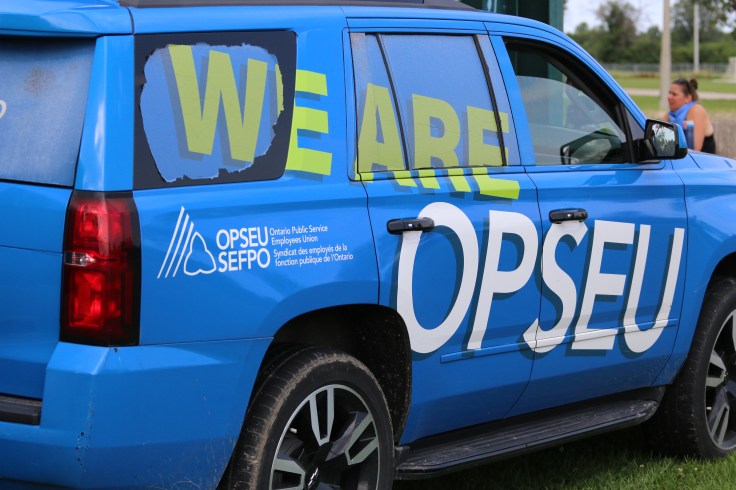
After the first week, being on strike becomes your new routine, your new job as it were. You get up in the morning and do all the morning things you always do. Then it’s put on your strike outfit, grab your sign or flag, and off you go to gather with the others, either picketing in front of the office, doing visibility marches along the main street, or attending hard/soft/informational pickets at other locations. It’s exciting in a sense, but that excitement doesn’t necessarily last long. You do this and then you go home, except that when you do go home, you do so without a regular paycheque.
And there’s always that psychological uncertainty that creeps into you. Along with the most-asked question in labour disputes: “How long is this going to last?” As the weeks pile up, you’ll hear that question a lot.
The financial pressure of being on strike is perhaps the most obvious challenge facing workers. A striking worker hasn’t simply lost a day’s wages, they’ve lost over three months of regular wages that could be once counted on, budgeted with, and planned with. So the cumulative affect of a twelve-week strike can be more than considerable.
Things don’t go away or simply disappear when you go on strike. The mortgage or rent still comes due every month, car payments need to be made, groceries bought, hydro and other utilities, insurance, and child care expenses paid for. When the strike started, you probably did what everyone else on the line did, and that is to estimate the financial struggle the strike might represent to your monthly budget and pocketbook. Maybe you had to dip into savings, and maybe you thought you had enough of those to tide you through the work stoppage. But after twelve weeks, your heart becomes broken as you watch those hard-earned savings dwindle and even disappear. Maybe you’re dipping into a line of credit to help you along. Now that you’ve burned through your savings, you can now start racking up debt. What looked like it might be do-able back in June might not look so good in mid-August, and now we’re going into the Back to School period, a time of the year that can be expensive when you have schools-aged children yourself.
It all adds up to the very real and very common possibility of financial struggle. And it can lead to a very real question: “Can I afford another month?”
That’s got little to do with the union’s strategy or leadership direction or your fidelity to your cause. It’s just a very real and honest human question.
Then there’s the possible impact on solidarity.
After twelve weeks, people can start showing emotional and even physical exhaustion. Your fears and anxiety can pile up and start closing in on you, and maybe you’re not the happy person you once were earlier on in the strike. Maybe small little annoyances become major flare-ups as emotions begin to rule over logic. You can start to get critical of your own leadership, maybe even beginning to question some of their decisions, tactics, and strategies
But on the other hand, a lengthy strike can also result in stronger relationships among workers and peers, having spent far more time in the company of one another than they normally would. Several weeks of sharing common frustrations is one way that this happens, but also several weeks means several jokes, laughs, little dance moves, and picnic barbecue breakfasts and lunches. As well, you tend to be in the company of people who share the same type of financial anxiety you do, and talking about that can help, either by being an understanding and empathetic listener as well as someone who might provide advice on how to navigate the strike financially.
In short, the picket line can become a very strong social community. We have to remember that this isn’t a little two-week adventure that will be remembered fondly some day as we bounce our grandkids on our knees. It’s a twelve-week marathon with no end in sight. That makes it a signature life-event for these people. Sort of like going to war.
Perhaps the greatest impact of a prolonged strike is the impact that it has on a worker’s spouse, partner, and family. Because it’s not just the worker on strike, the entire household feels it, mostly in terms of money and scheduling.
When you’re not bringing home a regular paycheque, your spouse or partner is going to feel the pinch too, as will your kids if you have any.
Purchases will be postponed or given-up on altogether. Vacations can be cancelled as they may now represent an extravagance. Cutting back on groceries is a thing, and pray God that your car doesn’t need repairs of any sort.
You can dip into your savings and go into debt as well.
What’s it like to go home every day after being on the picket line for twelve months only to be met with the same question every single night: “Any news?” And imagine what it’s like to have to answer the same way, day after day: “No. No there isn’t.”
And what about friendships? Especially in places the size of Renfrew or Arnprior.
Workers may well have friends, even close family, who don’t support the strike. Some may have friends or co-workers who work for Community Living as well, but aren’t participating in the strike.
Because people are involved, political disagreements can also creep in to friendship and familial relationships. And there will be plenty of questions and commentary from those sources as well. Perhaps even uncomfortable questions and commentary. In some cases, potentially even hostile or non-supportive commentary.
I just wanted to point out a very obvious fact that being on strike is absolutely no joke, but rather a tremendous and un-sought challenge that goes to the very heart of a worker’s, well, everything. It’s emotionally draining and physically and financially demanding. And, at times, very discouraging.
In days gone by, invading armies would surround fortresses and cut them off from food and water. Sometimes they’d put on an even bigger show by lobbing projectiles and combustibles over the walls. Once the food and water dries up, it’s either surrender or starve.
It’s truly unfortunate that our province and our premier, and evidently management at government-subsidized agencies, seem to be adhering to the this same simple, barbaric, and medieval strategy.
Locally, after twelve weeks, the rank and file of OPSEU Local 472 seem to be going about the business of being on strike as well as any other group I may have seen in the past. Their morale appears to be good, and in the time that I’ve spent with them I can only report on what appears to be widespread positivity in the face of a seemingly endless situation. All that positivity in people who very likely may be experiencing some, or all of the challenges I’ve mentioned in this article.
It’s difficult to have anything other than admiration for these people.

