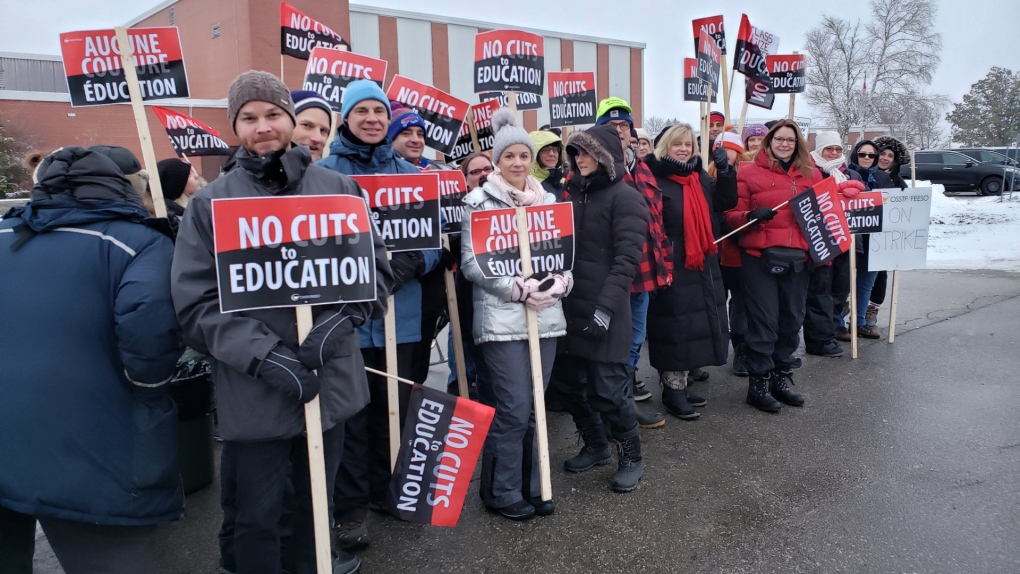
I can’t say for sure, but I recently came across information that may turn out to have a silver lining attached to it, a silver lining that both sides of an ongoing local labour dispute may find encouraging.
In less than two weeks, school will be back in session and teachers and educational workers will once again be on the front lines of our education system. But why would this have any affect on a labour dispute one way or another?
Because those teachers and other educational workers are returning to work without a contract.
And when you watch this beginning to develop, you see all the same signs and hear all the same words, as both sides position themselves for what may well become the inevitable: a full-on strike featuring 160,000 teachers and an additional 55,000 support staff.
Already, both the union and government negotiators are beginning the long slow dance that will, I expect, sleepwalk both sides to the inevitability of a strike sometime during the 2026-27 school year. If not this coming school year, then certainly the next.
As well, statements issued by either side display all the hallmarks of a large fight brewing between the parties.
Two things to remember here.
The Ford government is highly ideological, and part of that ideology incorporates a visceral hatred of public sector unions. The Tories will talk all day about how they’re a union-friendly bunch, but that’s all horse-hockey and they know it. Sure they like unions, as in private sector ones, like steelworkers and autoworkers, the ones they don’t have to pay salaries to. Those are the “good” workers in the government’s eyes, not the “bad” ones they employ themselves. The Tories love the private workers for their votes, but make no mistake, they still hate unions of all kinds on principle. They just hate the ones they have to pay themselves the most.
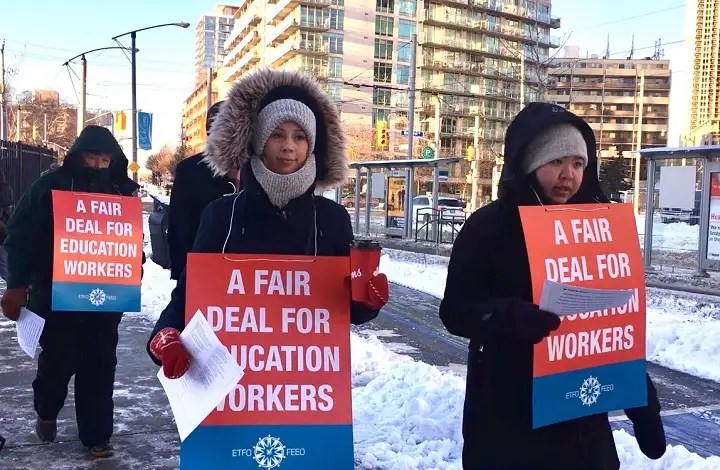
This Conservative provincial government has fought these two sectors, teachers and educational workers, twice already, as both those groups had strikes in the past six years since the government first took power. But two things wrecked it for the government on those two occasions. First, COVID-19 came along just as the teachers were doing their rotating strikes, and when that calamity struck, the government did a quick retreat, not wanting to fight a two-front war against striking teachers and a national pandemic at the same time.
The educational workers themselves hit the bricks a couple of years later, and that’s where the Bill 124 imbroglio got started. As you recall, Ford’s government slammed home legislation limiting public sector workers to a maximum 1% pay raise. That legislation was struck down as unconstitutional by the Supreme Court as it was decided it infringed upon collective bargaining rights protected by the Charter.
Two fights provoked by the government against two public sector employee unions, and each time the government received a black eye for its troubles.
But now they’ve had four years to lick their wounds, and they’re coming back. This current strike in the developmental services sector is just the beginning of the Tories going back to their ideological roots.
Having called a snap general election midway through his second term, Doug Ford’s government doesn’t have to face the electorate again until 2030, meaning that they’ve got 3.5 years of runway to do battle with an ancient foe, Ontario’s teachers.
And they will, sometime in 2027 would be my guess.
And that may have an impact on the current local strike and others like it in other jurisdictions. Because as much as I seem to like characterizing the present provincial government as a collection of incompetent blowhards, It’s still hard for me to imagine they don’t have this all mapped out on a timeline. As in, surely to God, they wouldn’t want to be tangling with striking developmental workers at the same time as fighting over 200,000 educational workers. Talk about your two-front wars.
So, to me, if there is such a timeline for doing battle with unions before the next election, that very same timeline would suggest to me that it might be time to start sliding towards an agreement with these workers who have been off the job for so long that many of us have lost track of the weeks. As well, I’d have to think that the government doesn’t want to end one war and then immediately plow into another, even larger war. They’d need the time to re-energize their union-bashing troops and to plan for the reassignment of all those security guards and private dicks currently “watching” striking workers.
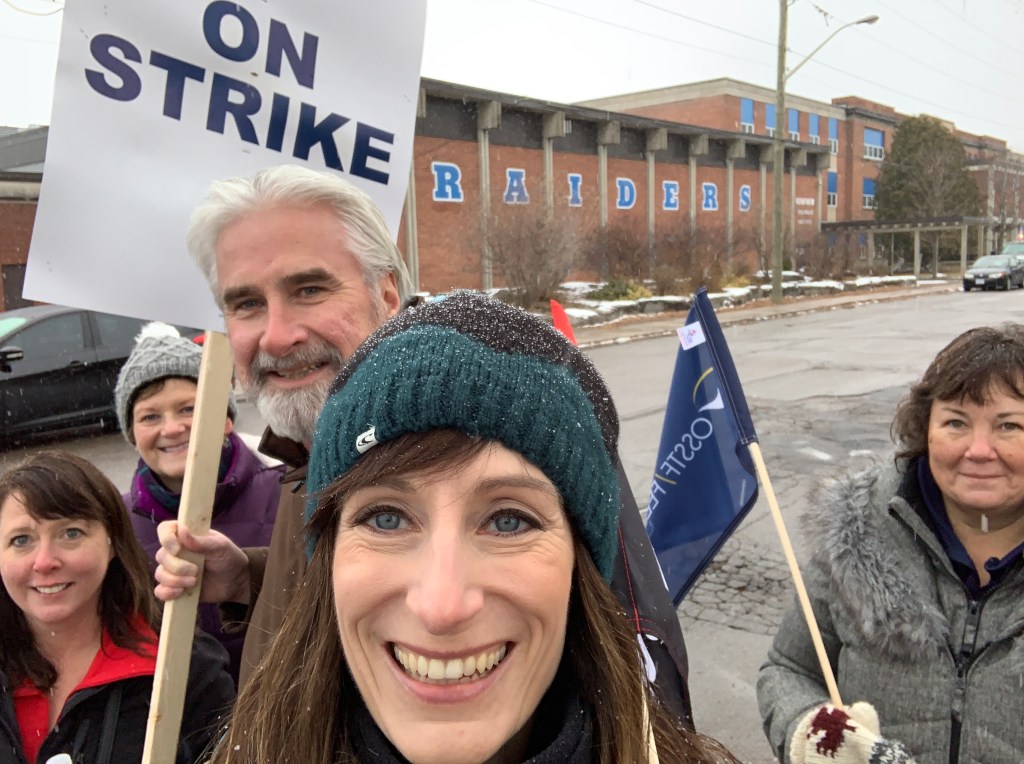
How soon this might happen I don’t know, but my timeline seems to indicate the the government may well act sooner than later,. But in honesty, I don’t have proper definitions for what “sooner” or “later” even looks like.
To me, the writing is on the wall, and you can see it in the maneuvering and you can read it and hear it in the statements from both sides. They’re already in that stage where statements are made for public consumption positioning themselves as the good guys and the other guys as the reason for the impasse.
At the moment, they’re arguing over what gets discussed at what bargaining table. What issues will be centralized? Which issues can be negotiated on a local level? In short, they’re arguing about what they’re going to be arguing about and where they’re going to be arguing about it.
Sort of sounds familiar.
Here are some examples coming out of various camps:
“At this early stage of bargaining, the first step is to determine what issues will be negotiated at central or local tables. Those decisions are still underway, with some unions choosing to bring this matter to the Ontario Labour Relations Board.”
“We respect their decision to do so and at all times are ready to continue discussions on the scope of central versus local issues before proceeding to the next stage of negotiations.”
Education Minister Paul Calandra
“We are working and dealing with a government that has eliminated so many of the supports that our students and our members and our workers rely on,”
David Matson: President of Elementary Teachers Federation of Ontario.
“We have to get over the procedural hurdles. But I will say to Minister Calandra and Premier Ford: If you want peace and stability, if you want a public education system where every child can succeed, then let us bargain. Let us bargain and get to the real issues affecting our schools.”
Martha Hradowy: President Ontario Secondary Schools Teachers Federation
This reminds me of the current back and forth between our own Executive-Director of Community Living Renfrew County South and the leadership of OPSEU Local 472. The current ping-pong discussion over which mediator, when and where to sit down to talk, and what can and can’t be talked about. The on and on game that’s played over and over to the point of extreme exhaustion.
But I guess this is just how the playbook was written up and everybody seems to believe they have no choice but to follow it.
All that said, the timing isn’t the greatest for the government if their intent was to keep those workers off work and on the picket lines indefinitely. Because there is no indefinitely. There’s a timeline, I’m sure of it, and let’s not forget that the people pulling the strings here believe in their own personal brilliance as strategists and tacticians.
So yeah, there’s a timeline.
Their move going into this was to attempt to freeze the union out in the hopes of weakening it or having union membership erode. Their plan was to throw everything they had them for as long as it might take in an attempt to make them break. And if they don’t break, then at least get the union to bend far enough that they’d be willing to make or even demand concessions from their own original bargaining position.
And if it doesn’t work?
Well, from their perspective, it’s no-harm no-foul. Spending hundreds of millions of dollars to battle a public sector union is always going to be worth it to these guys, even though it’s definitely not worth it to the taxpayers of this province, never mind all the people directly impacted by this strike. But they’ll do it anyways. If they didn’t, they wouldn’t be true to their mission as hard-ass Conservatives. It’s just in their blood.
They don’t know no better.
To the credit of the OPSEU 472 rank and file, the government, nor management, has broken them. They’ve tested the OPSEU members immensely and have allowed them to exist in anxiety for all this time, and even for some time before the strike. They did so with purposeful intent. The damage that they’ve caused has inflicted hardship and anxiety. And it was done with intent.
And they failed.
They succeeded with the anxiety and hardship aspect of their plan. But they didn’t break Local 472.
So soon, in my opinion, the journey towards resolution will begin, but only after we have to sift through all the communications gymnastics put out by both sides. And we have to endure all the disagreements over mediators, venues, and French’s versus Heinz ketchup on the hotdogs.

The government didn’t break the union but they felt they needed to try. But now the roadmap is showing a fight with teachers and educational workers on the horizon, and even these guys don’t have enough hubris to think they’ve got the resources and political capital to hate on everyone at the same time.
Their calculation has them fighting on the education front sometime in 2027, maybe early 2028. They do have enough hubris to think that they can do battle with teachers, decisively defeat them — they almost never do — and still wrap things up in enough time to prepare for a 2030 general election.
What they don’t want to be doing its fighting a series of non-stop labour wars and then go directly into an election campaign. I believe the Tories are going to lose that next provincial election for any number of existing reasons. Highly public and impactful strikes with public sector employees are not going to help them at the polls at all.
But they’re going to do it anyways. They just can’t help themselves.
For once, perhaps their stupidity can be put to good use. If they have plans to go to war with teachers in the coming months, they’re probably looking for an exit ramp from the lengthy strike involving OPSEU workers.
It’s a darned shame it was pushed to this point, but now that we’re here, perhaps this “writing on the wall” can offer some small encouragement to sticking workers.
There will be striking workers walking picket lines in 2027. But in the government’s planning, they won’t be developmental services workers and OPSEU members walking those lines. It will be teachers and educational workers instead.
Just how they drew it up

