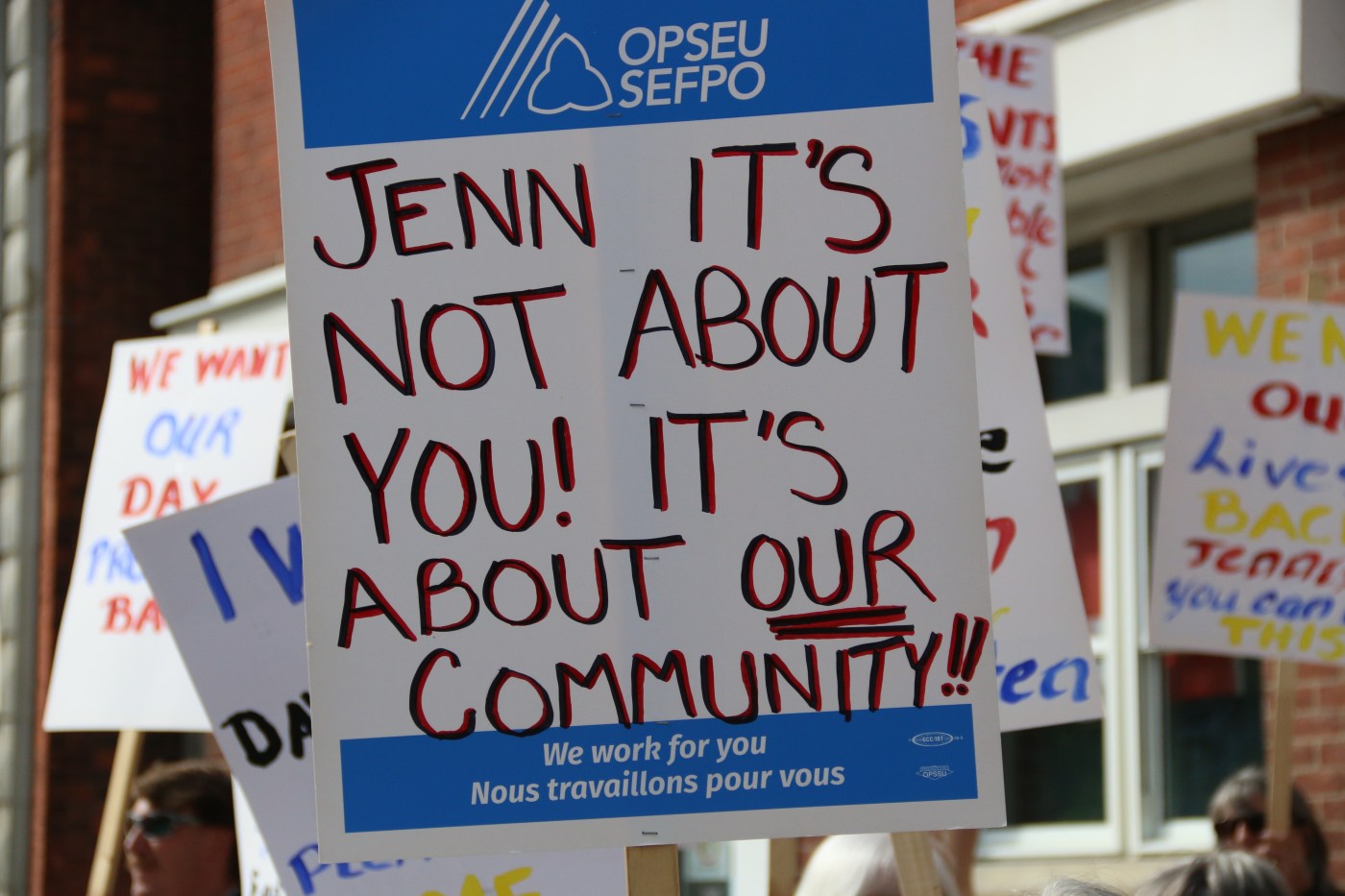
Any work stoppage is going to be tough for the people directly involved, as well as those indirectly involved through family or professional relationships. A strike lasting beyond thirteen weeks is only going to exacerbate the situation for participants.
I think that has to apply to the people on both sides of this or any other labour dispute.
It’s far easier to see things from the point of view of the workers because they’re obviously on strike, and that means visibility, signs and flags, songs and chants, here there, and seemingly everywhere. They’re tough to miss.
It’s also somewhat easier to see things from the point of view of impacted clients and their families. They’re not impacted financially in the same sense that strikers might be, although some may be footing additional expenses to keep their adult children supported during the strike period. They also have a burden of anxiety and fear, adding to what has become an already difficult struggle for them over the years, and one that’s not going to get any easier. You run into some of these people at events and they talk to you, and share with you. Not the same visibility as the picketers, but still, they have their stories to tell.
But nobody seems to take the time to wonder what this whole affair might be like for the people on the other side, specifically the managers, the directors, and members of the Board of Directors. I mean these are people too, and they’re outfitted with the same array of emotional responses to things happening around them. This side is harder to figure out because all of these people operate in the shadows by intent and seem to prefer keeping their own points of view in check and close to the vest.
I won’t take the time to look into the human impact of strikes on government MPPs or the province’s premier, nor will I take any time to look more closely at what it means to be a replacement worker or security guard. As far as I’m concerned, these people are all “outsiders” in the sense that, when all this is said and done, they won’t be around anymore, whereas the first three groups will.
And as to the government, it’s my view that, regardless of the side you’re on, all the local participants are in the positions they’re in precisely because their elected government engineered this whole thing, beginning with their horrendous underfunding in the sector of developmental services. Then they doubled down with the huge expense of replacement workers — the union refers to them as “scabs” — and those same security guards and private investigators. The government always wanted this strike to drag on, it’s part of their strategy. Their strategy may well be flawed, but it doesn’t stop them from having one, even a bad one.
I believe the local people involved, on both sides and in the middle, are all victims, each in their own way, of governmental duplicity and governmental manipulation.
And that includes the Executive-Director and her Board.
Full disclosure, I know none of the people on that side of things and have spoken with just as many. I could pass Jennifer Lavallee in the street and never know of it, and I’m sure she could say the same thing about me. I know nobody on the Board itself, although I’ve met a couple of them inn different contexts in the past. But I can’t for a second offer any personal assessments as to what kind of people they are because I simply don’t know.
But I know they’re people.
Which means they have all the same people things that the rest of us do. That means they have their own responses to pressure, anxiety, and uncertainty. It also means they, like anyone else, can get dug in around attitudes, pride, and yes, stubbornness. I’ll even throw a little bit of myopia in there for flavour.
This strike has been going on for more weeks than I can count, now in the double digits. And that has to make things difficult for anyone running the show, although the stresses experienced would be different from workers, clients, and client families. But as I said, I’ve not spoken with anyone over there on that side, so maybe they’re not feeling any of these effects at all. So I describe what I feel it might be like in a general sense.
And I’ll bet I’m not that far off.
Of course the Executive-Director is responsible for keeping the ship afloat during this work stoppage, and that would admittedly not be an easy task, one that runs smack up against the union, the people who are being replaced by replacement workers at a higher rate of pay. That causes significant tension between she and they, as it should and as can be expected. But we have to remember that this woman has to work with these striking workers when this is done, and they have to work with her. Long strikes can make things personal. Sometimes the bad feelings linger.
Almost always the bad feelings linger.
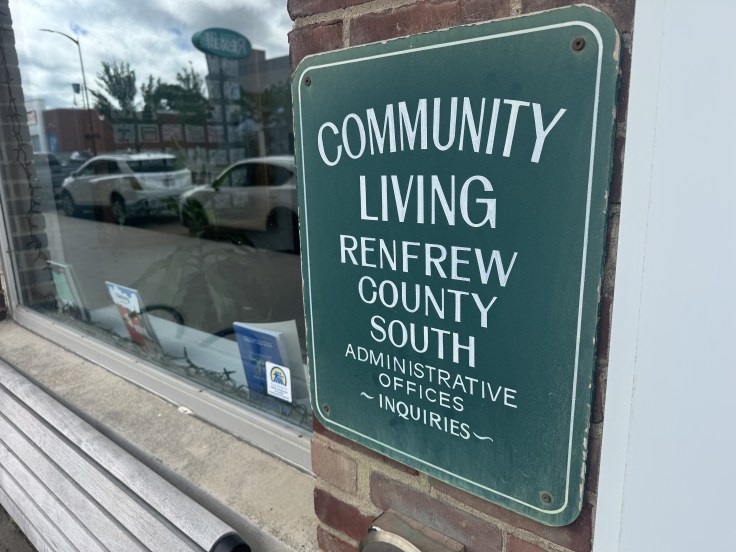
Setting yourself up for that almost certain outcome can’t be an easy thing to contemplate. Some people can do it, guys like Joe Stalin and the like, but by and large, most of us aren’t Joseph Stalin and we don’t have the luxury of making inconvenient people disappear or fall out of windows. Most of us have to deal with the aftermath or fallout everyday we go in to work with the person or people who we’ve perceived as being the enemy for many weeks, perhaps even longer.
This last thing is particularly important. A strike doesn’t simply end when a contract is signed. Management then has to rebuild a functioning workplace in which people who have spent months opposing one another have to work together again. And it’s not an easy task.
I’ve been on strike twice in may life, both times as an employee. So I have no first-hand experience of running a strike or participating in one from the managerial point of view. I do, however, have plenty of first-person experience with other human beings and humanity, so I feel I can still comment, as I said, in a general sense.
I may say things generally that may not fit the local situation at all. Maybe some people are just despicable people through-and-through and I’m giving them too much credit. Fair enough. But it’s a worthwhile effort to make anyways because, as I said, there are people involved.
On both sides.
There’s more to it than just keeping the place up and running, and it’s made even more complicated simply by the very nature of the service and the nature of the clientele that the service is intended for. So it’s more than just getting doors opened and switching on lights.
Your replacement workforce comes from God-Knows-Where and some of them struggle with English, which is an obvious problem. That’s not an anti-immigrant statement, it’s simply the truth of the matter. These same workers are vilified by the union workers, who refer to them as scabs and make life as difficult for them as much as they possibly can, all of it fair game. The replacement workers make more money despite quite likely being nowhere near as qualified as the regular workers they’re replacing. Managing all of this cannot be easy.
You have to deal with the union every single day in some capacity, but it’s almost always going to be adversarial in nature. It can’t be a great feeling to see your name plastered on a bunch of picket signs parading down the main drag. I don’t think I’d like it, but maybe my skin’s not tough enough for a job like this.
I would assume she’d also have to deal with her Board of Directors, but I don’t know exactly what I mean by that. Organizationally, the Board of Directors sits atop the Executive-Director with oversight powers. But it’s not unusual for the bureaucrat to be the one running the show while the “politicians” sit around and scratch their heads. Just look at any municipality and its government to see who really wears the pants in the family. Maybe I’m wrong here, though, and maybe it’s not her calling the shots. Maybe the Board itself came up with the tactics/strategy plan, although I do feel I’m giving them an extraordinary amount of credit. But if they do have any real power in any of this, then the Executive-Director, being the point person for the strike, will have to be in constant communication with her Board. And at the very least, one way or another, she’ll have to manage her relationship with them no matter what.
She would obviously have to be keeping her eye on the bottom line, because hers is an empire that lacks the financial resources necessary in the first place. Yet now there’s replacement workers working at higher rates of pay plus all their living and transportation expenses. Same for the security guards and private investigators. Who’s paying for all that? The government, who’s not “involved?” Or her, here, locally? If it’s the latter — and I don’t think it is — then that’s even more pressure to deal with.
Relationships with unionized workers are one thing, as is the criticism that comes from that source. But somebody in her position has to manage more public-facing communications, criticism, and political pressure. She, and they, have not been terribly forthcoming with what they hope to “achieve” as a result of all this, and that silence creates an informational vacuum. That can lead to significant outside criticism. So in addition to having your name on a protest sign, and union members picketing your house, you also get to see your name bandied about online, Again, I don’t think I’d like that myself.
Somehow you have to maintain relationships with your clients and client families. This can’t be easy when everyone seems to be really mad at you. There are also other relationships out there that need to be managed and maintained, people like donors or other community partners. Who knows, she quite likely has to interact with somebody higher up the food chain, the political food chain, and they may be the actual people running the show despite not being involved. That can be as delicate to deal with as it can be frustrating I would think.
I think, though, the most important concern of hers would be what life looks like after a new contract and employees return to work. As I said, strikes can be personal, and longer ones especially so. In her position, and in her role both before and during the strike, she may have engendered enough hostility that it might take some time to water down if it doesn’t remain in place permanently.
Again, this is really important. A strike isn’t “over” just because you signed a contract. It may never truly be “over” if all those hard feelings are allowed to fester in place without any remediation.
I don’t care who you are, it’s difficult to climb down from entrenched positions that have been cultivated and maintained for several months. Things get in a person’s head, and it’s tough to get rid of them once they’re in there. Surely that applies to all the local participants in this labour dispute.
As I said, I don’t know the Executive-Director. All I’ve heard is second-hand stuff, and to be honest, not much of it has been flattering. I never got invited to the Union-Bashers’ Barbecue and Three-Legged Sack Race so I’ve never had the opportunity to interact with her or them.
And as well, if you’re someone hell-bent on using this crisis as cover to make a determined effort to water down seniority rights or working conditions, then you’re simply going to have to accept negative criticism from questionable sources like me. If you’re playing peek-a-boo around dismantling that day program, then again you’ll be looked at in a harsher light, as you should.
This commentary is in no way an acceptance of the Executive-Director’s position in this strike. It’s simply an exercise in taking a look at this thing from as many angles as I can.
People are people, no matter what they do and where you find them. There are good ones, bad ones, and in-between ones. But all people nevertheless.
This article doesn’t excuse anyone or anything, nor does it ascribe any support from myself in the direction of the Executive-Director. It’s her job and I suppose she’s doing it. And maybe I don’t like the way she conducts her business, albeit all of that learned through second-hand sources. The article simply points out that the other side has their challenges as well.
Doesn’t mean I’m cheering for them.

